|
|

|
|
"If policy on drugs is in future to be pragmatic not moralistic, driven by ethics not dogma, then the current prohibitionist stance will have to be swept away as both unworkable and immoral, to be replaced with an evidence-based unified system (specifically including tobacco and alcohol) aimed at minimisation of harms to society."
|
|
Hard Day for Medical Marijuana Initiatives It was a tough night for medical marijuana, with two state initiatives losing decisively and a third trailing slightly very late in the game.
In Arizona, Proposition 203, which would create a tightly regulated medical marijuana dispensary system, was trailing in a very close race, with 49.74% of the vote to 50.26% against, in unofficial results from the secretary of state. The AZ Secretary of State's office reports that 100% of precincts have turned in their ballot counts. However, as an email from the initiative's main sponsor, the Marijuana Policy Project, pointed out Wednesday, there are 200,000-300,000 mail-in ballots estimated to have arrived at polling stations or elections offices in the final hours of the campaign, as well as "provisional" ballots cast by people whose residency was in dispute at the polls on Election Day. If 52% of those ballots have Yes on 203 votes in them -- more than the statewide average, but not radically -- Prop 203 would pull ahead.
Oregon's Measure 74 would have expanded the state's existing medical marijuana program by allowing for a system of state-regulated, nonprofit dispensaries and grow operations. According to official figures, it lost 42% to 58%. South Dakota's Measure 13 would have created a tightly restrictive medical marijuana program, with no dispensaries and a list of specified ailments and conditions. According to unofficial figures from the secretary of state, it lost 37% to 63%. None of the medical marijuana campaigns have yet reacted publicly to Tuesday's results. Look for a Chronicle feature article exploring what went wrong in the near future. |
|
Appeal: 2010 is Important in Drug Policy -- And So Are You Dear friend of drug policy reform: I am writing today to ask you to step up for drug policy reform. 2010 is a critical year in drug policy, with great opportunities for changing minds, laws, and lives:
There is a long, hard road still ahead, but things are definitely moving our way. Like every nonprofit, our funding has been affected by the troubled state of the economy, and we need your help. Can we count on your support in this important year? Please make a generous donation to StoptheDrugWar.org (DRCNet) today! The support of our generous members has been part of a winning combination that saw us draw nearly two million annual visitors to our web site last year -- the most yet! -- and which saw opinion leaders in the blogosphere using our work on a regular basis. (See links about this below.) StoptheDrugWar.org, thanks to you, is the #1 source for news, information and activism promoting sensible drug law reform and an end to prohibition worldwide. The more we do at StoptheDrugWar.org, the faster the reform movement will grow and the sooner that minds, laws and lives will change. Your support counts now more than ever -- please join our 2010 "Changing Minds, Changing Laws, Changing Lives" campaign by donating to StoptheDrugWar.org today. I would like to send you some free gifts to show our appreciation. For a contribution of $30 or more, choose either the important new DVD, 10 Rules for Dealing with Police, or its classic predecessor, Busted: The Citizen's Guide to Surviving Police Encounters -- or choose either of our popular StoptheDrugWar.org t-shirts -- "alcohol prohibition/drug prohibition" or "consequences of prohibition." For a gift of $55 or more, you get to pick any two... for a gift of $80 or more, pick any three... for a gift of $100 or more you can get all four! (Want to substitute? No problem. Choose any item from our inventory of books, videos and StoptheDrugWar.org items.) By joining today, you will make an immediate impact by helping StoptheDrugWar.org:
We are truly seeing more good things happen than ever before -- and the road ahead while challenging is also promising. Please donate to StoptheDrugWar.org today - with your help, we can win this. Sincerely,
David Borden P.S. Prohibition does not work -- and more and more people know it. Now is the perfect time to galvanize support for the cause. Please send in your donation and get your thank-you gifts today! Thank you for your support. |


|
"He is the first prime minister, this is the first government, that has ever in the history of the Misuse of Drugs Act gone against the advice of its scientific panel.
Two more members of the British government's Advisory Council on the Misuse of Drugs (ACMD) have resigned in the last week, citing the Labor government's emphasis on politics over evidence-based policy making. That brings to seven the number of ACMD members who have resigned since former ACMD head Professor David Nutt was sacked last fall. Home office Minister Alan Johnson fired Nutt after Nutt repeatedly criticized the government's decision to ignore the ACMD's advice and reschedule marijuana as a more dangerous drug. Johnson also took umbrage at Nutt's assertion that taking ecstasy was less dangerous than horse riding. Nutt's firing provoked the immediate resignation of two other members of the committee, Dr. Les King and Marion Walker, followed a week later by three more: Mephedrone, a so far legal stimulant derived from cathinone, which users say has similar effects to cocaine or ecstasy, has been the object of a media frenzy in Great Britain in recent weeks, with press reports breathlessly linking it to a number of deaths. Those reports are so far unsubstantiated, but that didn't stop the government from announcing it would move to ban it this month. It was the mephedrone issue that finally drove ACMD member Dr Eric Carlin to add his name to the list of now former ACMD members. In his resignation letter to Home Minister Johnson, Carlin lambasted the government and the ACMD for bowing to political and media pressure on scheduling mephedrone. Real ACMD business got pushed aside because of "the haste with which we were being pushed to make a decision about classifying Mephedrone; this so that the chair could come to meet with you later in the day and you could do a round of press announcements," Carlin wrote. "We had little or no discussion about how our recommendation to classify this drug would be likely to impact on young people's behavior. Our decision was unduly based on media and political pressure. The report was tabled to the whole council for the first time on Monday; the chair came to brief you before the whole council had even discussed all of the report. In fact, I still haven't seen the final version," Carlin complained. Saying that "we need to review our whole approach to drugs," Carlin argued that legally sanctioned punishments should not be the "main part of the armory" in addressing drug problems. He added that he had decided not to resign over the sacking of Nutt last fall, "preferring instead to see how things panned out and to hope that the ACMD could develop a work program which would help prevent and reduce harm, particularly to young people. I have no confidence that this will now happen, largely though not totally due to the lack of logic of the context within which the council is constrained to operate by the Misuse of Drugs Act," he wrote. "I am not prepared to continue to be part of a body which, as its main activity, works to facilitate the potential criminalization of increasing numbers of young people." The dispute between dissident ACMD members and the Labor government has highlighted a deeper argument over the nature of the relationship between the government and the scientists who advise it. Colin Blakemore, professor of neuroscience at Oxford, told The Independent that the furor over mephedrone pointed to "a crisis in the government's use of evidence potentially as serious as that produced by mad cow disease 20 years ago." In the case of mad cow, British ministers offered false assurances on the safety of beef which went beyond the available evidence. When it emerged that some people had contracted mad cow disease from infected beef, trust in the government collapsed. "I think there's been terrible pressure to come to a resolution about mephedrone -- inappropriate pressure," Professor Nutt told the Independent. "The meeting this week was rushed through so that the chairman could leave to do a press conference when the Home Secretary wanted to do one. It's a travesty of a proper discussion, of the proper way in which you should deal with an important issue like mephedrone." The Home Office said that Carlin's resignation was "regrettable," but that "it does not impact our plans to ban mephedrone as soon as parliamentary time allows." |
 Dr. Simon Campbell, Dr. Ian Ragan and Dr. John Marsden. A seventh member, Dr. Polly Taylor, the veterinary specialist on the panel, resigned two weeks ago, ahead of the council's crucial meeting on mephedrone last week, in protest of new guidelines that said scientific advisors could be fired if they "undermined" the government.
|
California Will Vote on Marijuana Legalization This Year!
Californians will be voting on whether to legalize marijuana in November. The California Secretary of State's office Wednesday certified the Regulate, Control and Tax Cannabis Act of 2010 initiative as having handed in enough valid voters' signatures to qualify for the November ballot.
The initiative is sponsored by Oaksterdam medical marijuana entrepreneur Richard Lee and would legalize the possession of up to an ounce of marijuana by adults and allow for personal grows of up to 25 square feet. It also provides for the taxed and regulated sale of marijuana by local option, meaning counties and municipalities could opt out of legalized marijuana sales.
Some 433,000 valid signatures were required to make the ballot; the initiative campaign had gathered some 690,000. On Tuesday, state officials had certified 415,000 signatures as valid, but that didn't include signatures from Los Angeles County. Initiative supporters there Wednesday handed in more than 140,000 signatures. With an overall signature validity rate of around 80%, that as much as ensured that the measure would make the ballot. Late Wednesday afternoon, the California Secretary of State's office made it official. Its web page listing Qualified Ballot Measures now includes the marijuana legalization under initiative approved for the November ballot. The 104,000 valid signatures from Los Angeles County put it well over the top. "This is a watershed moment in the decades-long struggle to end marijuana prohibition in this country," said Stephen Gutwillig, California director of the Drug Policy Alliance. "Banning marijuana outright has been a disaster, fueling a massive, increasingly brutal underground economy, wasting billions in scarce law enforcement resources, and making criminals of countless law-abiding citizens. Elected officials haven't stopped these punitive, profligate policies. Now voters can bring the reality check of sensible marijuana regulation to California." "If passed, this initiative would offer a welcome change to California's miserable status quo marijuana policy," said Aaron Smith, California policy director for the Marijuana Policy Project, which recently endorsed the initiative. "Our current marijuana laws are failing California. Year after year, prohibition forces police to spend time chasing down nonviolent marijuana offenders while tens of thousands of violent crimes go unsolved -- all while marijuana use and availability remain unchanged." Proponents of the measure will emphasize the fiscal impact of taxing marijuana -- the state Board of Equalization has estimated that legalization could generate $1.3 billion in tax revenues a year -- as well as the impact that regulation could have on reducing teen access to the weed. They can also point out that by now, California has lived with a form of regulated marijuana distribution -- the medical marijuana dispensary system -- for years and the sky hasn't fallen. Opponents, which will largely consist of law enforcement lobbying groups, community anti-drug organizations, and elements of the African-American religious community, will argue that marijuana is a dangerous drug, and that crime and drugged driving will increase. But if opponents want to play the cop card, initiative organizers have some cards of their own. In a press release Wednesday evening, they had several former law enforcement figures lined up in support of taxation and regulation. "As a retired Orange County Judge, I've been on the front lines of the drug war for three decades, and I know from experience that the current approach is simply not working," said retired Superior Court Judge and former prosecutor James P. Gray. "Controlling marijuana with regulations similar to those currently in place for alcohol will put street drug dealers and organized crime out of business." "The Control and Tax Initiative is a welcome change for law enforcement in California," said Kyle Kazan, a retired Torrance Police officer. "It will allow police to get back to work fighting violent crime." Jeffrey Studdard, a former Los Angeles Deputy Sheriff, emphasized the significant controls created by the Control and Tax Initiative to safely and responsibly regulate cannabis. "The initiative will toughen penalties for providing marijuana to minors, ban possession at schools, and prohibit public consumption," Studdard said. But the three leading contenders for the California governorship, which is also up for grabs this year, were quick to stake out positions opposing the initiative. "I've already indicated that that's not a provision I am likely to support," state Attorney General and Democratic gubernatorial candidate Jerry Brown told a gathering of law enforcement officials in Sacramento Wednesday. "I've been on the side of law enforcement for a long time and you can be sure that we will be together on this November ballot." Republican candidate Meg Whitman is "absolutely against legalizing marijuana for any reason," said spokeswoman Sarah Pompei. "She believes we have enough challenges in our society without heading down the path of drug legalization," she said. "Like electing Jerry Brown, the idea of legalizing drugs is one more bad idea from a bygone era," said Jarrod Agen, communications director for GOP candidate Steve Poizner. "Steve Poizner feels we need an across-the-board tax cut to reignite our state's economy, not an attempt to smoke our way out of the budget deficit," he said. The campaign should be a nail-biter. Legalization polled 56% in an April Field poll, and initiative organizers say their own private research is showing similar results. But the conventional wisdom among initiative watchers is that polling needs to be above 60% at the beginning of the campaign, before attacks on specific aspects of any given initiative begin to erode support. But despite the misgivings of some movement allies, who cringe at the thought of defeat in California, this year's legalization vote is now a reality. "California led the way on medical marijuana with Prop. 215 in 1996," said Ethan Nadelmann, executive director of the Drug Policy Alliance. "Now it's time again for California to lead the way in ending the follies of marijuana prohibition in favor of a responsible policy of tax and regulation." |

|
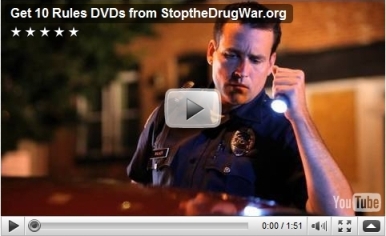
It's here. The bigger, better video, from the people who brought you Busted. 10 Rules for Dealing with Police is the most sophisticated and entertaining film of its kind. Narrated by legendary trial lawyer Billy Murphy, Jr., 10 Rules provides proven survival strategies for dealing with racial profiling and police abuse. You will be more confident and better prepared to handle every kind of police situation after watching 10 Rules for Dealing with Police. You can get 10 Rules for free with a donation to StoptheDrugWar.org (DRCNet). Visit http://stopthedrugwar.org/10rules to learn more about 10 Rules. StoptheDrugWar.org is the #1 source for the latest news, information and activism promoting sensible drug law reform and an end to prohibition worldwide. Thank you for your support!
|
|

|
DEA Raids LA Dispensary, LA City Attorney Moves Against 21 More
Thursday was a day of concentrated attack on the thriving Los Angeles-area medical marijuana scene, with the DEA hitting a Culver City dispensary and the LA City Attorney's Office serving eviction notices to 18 dispensaries within the city and filing nuisance abatement lawsuits against three more. One dispensary, the Organica Collective in Culver City, was the object of attention from both the feds and the city, while two Holistic Caregiver dispensaries were the objects of a joint multi-agency investigation including the DEA. The enforcement actions were undertaken independently, said DEA spokesperson Sarah Pullen. "It's a separate thing, but we were aware of each other's operations today," she said, declining to comment further except to say that search warrants were being served. Early reports had numerous police and DEA vehicles outside the collective and three people in handcuffs outside the building. Local TV station CBS 13 reported Thursday afternoon that Organica owner Jeffrey Joseph had been arrested, apparently on state marijuana distribution charges. According to a press release from the LA City Attorney's Office, Organica was also one of three dispensaries named in lawsuits filed by the city for violations of narcotics abatement and public nuisance ordinances. The other two were two Holistic Caregivers locations, which the city said were also the object of a joint investigation with the DEA. All three dispensaries were also accused of violating the Sherman Food, Drug, and Cosmetics Law, which requires the proper labeling of medicines. The LA City Attorney's Office won the first case applying that law to medical marijuana last month. The alleged behavior of the dispensaries may not have been prudent, but it's not clear it was unlawful. According to prosecutors, "Organica passed out flyers for the dispensary near Culver City High School as classes were being dismissed. Officers have found students to be in possession of marijuana apparently purchased from Organica. Persons stopped in the vicinity of Organica also admitted supplying the shop with marijuana laced edibles and picking up large quantities of marijuana from Organica for delivery to other dispensaries." All the prosecutors said about Holistic Caregivers is that "law enforcement officers conducted several undercover buys" there and that they recovered "large quantities" of marijuana at the home of dispensary owner Virgil Grant, who had been convicted in June on federal marijuana charges for his seven-dispensary operation. In addition to the abatement lawsuits against Organica and Holistic Caregivers, the City Attorney's Office sent eviction letters to owners of 18 different dispensaries and owners of the properties engaged in the sale of marijuana by dispensary employees. These actions are not part of LA's new medical marijuana dispensary ordinance, which has not yet taken effect. |
|
THIS WEEK IN HISTORY
February 14, 1929: St. Valentine's Day Massacre symbolizes the mob violence of the Prohibition era. February 12, 1961: In the first televised challenge to marijuana prohibition, Beat poet Allen Ginsberg uses an appearance on the John Crosby show to argue for the harmlessness of marijuana. By the end of the program, Crosby and guests author Norman Mailer and anthropologist Ashley Montagu all joined Ginsberg in agreeing the current laws were too extreme. February 16, 1982: During a speech in Miami, Florida, George H. W. Bush promises to use sophisticated military aircraft to track the airplanes used by drug smugglers. By June, airborne surveillance time is running a mere 40 hours per month, not the 360 hours promised by Bush, prompting Rep. Glenn English to call hearings on the topic. By October, the General Accounting Office issues an opinion in which it finds "it is doubtful whether the [South Florida] task force can have any substantial long-term impact on drug availability." February 14, 1995: The US House of Representatives approves several drug-related bills, including H.R. 728, a bill that replaces the police ($8.8 billion), prevention ($4 billion), and drug courts ($1 billion) provisions of the 1994 Crime Act with a $10 billion block grant program. February 14, 1996: Fairfax Police Chief Jim Anderson becomes one of the latest officials to speak out in favor of California's medical marijuana initiative when he says, "I believe there is adequate unbiased and scientific evidence that marijuana does have medicinal benefit." February 17, 1997: Legislation to repeal an 18 year-old state law permitting physicians to prescribe marijuana for patients suffering from cancer or glaucoma is voted down by a Virginia Senate committee in a 9-6 vote. February 18, 1999: Dr. Frank Fisher, a pain doctor from Northern California, is arrested and charged with five counts of murder. After about six years of legal wrangling and having more charges levied against him, he is determined to be completely innocent. February 18, 2000: President Clinton signs the "Hillary J. Farias and Samantha Reid Date-Rape Drug Prohibition Act of 2000," categorizing GHB as a Schedule I drug. February 12, 2002: The same day that President George W. Bush issues his National Drug Control Strategy, DEA agents raid the Harm Reduction Center, a medical marijuana club in San Francisco. February 15, 2002: The ImpacTeen Illicit Drug Team releases a report entitled "Illicit Drug Policies: Selected Laws from the 50 States." The report says that state statutory drug laws vary significantly across the United States, contradicting a commonly-held assumption that state drug policies follow federal drug policy. For instance, depending on the state, a first time offender may be subject to anywhere from one year to lifetime imprisonment and $5,000 to $1 million in fines for the sale of one ecstasy pill. The report also shows that, as of January 1, 2000, 24 states and the District of Columbia enacted legislation allowing the use of marijuana for medical purposes, despite the federal government's objections. February 14, 2004: The Daytona Beach News Journal reports that Volusia County sheriff's investigators seized bricks of marijuana during several drug busts that were, in fact, bricks they had already seized before. As it turned out, half a million dollars' worth of drugs was stolen from their evidence compound by a former evidence manager. How many times it may have happened prior wasn't known. |
|
Obama Nominates Drug Warrior Michele Leonhart to Head DEA
The Obama administration announced this week that it is nominating acting DEA Administrator Michele Leonhart to head the agency. Drug reformers responded with a collective groan and are preparing to challenge -- or at least question -- her nomination when it goes before the Senate Judiciary Committee for confirmation.
From a law enforcement perspective, Leonhart's career trajectory has been inspiring and exemplary. Growing up black in St. Paul, she developed an interest in law enforcement when someone stole her bicycle as a young girl. After graduating from college with a degree in criminal justice, she worked as a police officer in Baltimore before joining the DEA in 1980. She put in stints as a field agent in Minneapolis and St. Louis before being promoting to DEA's supervisory ranks in San Diego in 1988. She became the agency's first female Special Agent in Charge (SAC) there and later became SAC for the DEA's Los Angeles field division, the third largest in the country.
 She was confirmed as DEA deputy administrator in 2003 and named acting administrator upon the resignation of agency head Karen Tandy in 2007, a position she has held ever since. She was confirmed as DEA deputy administrator in 2003 and named acting administrator upon the resignation of agency head Karen Tandy in 2007, a position she has held ever since.
But Leonhart's career has also coincided with scandal and controversy. (A tip of the hat here to Pete Guither at Drug War Rant, who profiled her peccadillos in an August 2003 piece). Her time in St. Louis coincided with a perjuring informant scandal, her time in Los Angeles coincided with the beginning of the federal war against California's medical marijuana law, and as acting administrator, she blocked researchers from being able to grow their own marijuana for medical research, effectively blocking the research. As head of the DEA last year, Leonhart (or her staff) spent more than $123,000 of taxpayer money to charter a private plane for a trip to Colombia, rather than using one of the 106 airplanes the DEA already owned. While Leonhart's role in the persecution of California medical marijuana patients and providers is drawing the most heat, it is her association with one-time DEA supersnitch Andrew Chambers that is raising the most eyebrows. Chambers earned an astounding $2.2 million for his work as a DEA informant between 1984 and 2000. The problem was that he was caught perjuring himself repeatedly. The US 9th Circuit Court of Appeals called him a liar in 1993, and the 8th Circuit Court of Appeals echoed that verdict two years later. But instead of terminating its relationship with Chambers, the DEA protected him, failing to notify prosecutors and defense attorneys about his record. At one point, DEA and the Justice Department for 17 months stalled a public defender seeking to examine the results of DEA's background check on Chambers. Even after the agency knew its snitch was rotten, it refused to stop using Chambers, and it took the intervention of then Attorney General Janet Reno to force the agency to quit using him. Michele Leonhart defended Chambers. When asked if, given his credibility problems, the agency should quit using him, she said, "That would be a sad day for DEA, and a sad day for anybody in the law enforcement world... He's one in a million. In my career, I'll probably never come across another Andrew." Another Leonhart statement on Chambers is even more shocking, as much for what it says about Leonhart as for what Leonhart says about Chambers. "The only criticism (of Chambers) I've ever heard is what defense attorneys will characterize as perjury or a lie on the stand," she said, adding that once prosecutors check him out, they will agree with his DEA admirers that he is "an outstanding testifier." While Chambers snitched for the DEA in St. Louis while Leonhart was there and snitched for the DEA in Los Angeles while Leonhart was there, the exact nature of any relationship between them is murky. Reformers suggest that perhaps the Judiciary Committee might be able to clear it up. Leonhart was also there at the beginning of the federal assault on California's medical marijuana law. She stood beside US Attorney Michael Yamaguchi when he announced in a January 1998 press conference that the government would take action against medical marijuana clubs. And as SAC in Los Angeles up until 2004, she was the ranking DEA agent responsible for the numerous Bush administration raids against patients and providers. Her apparent distaste for marijuana extended to researchers. In January 2009, she overruled a DEA administrative law judge and denied UMass Professor Lyle Craker the ability to grow marijuana for medical research. And it wasn't just marijuana. She was in full drug warrior mode when she attacked ecstasy use at raves in 2001, telling the New York Times that "some of the dances in the desert are no longer just dances, they're like violent crack houses set to music." Drug reformers responded to Leonhart's nomination with one word: disappointing. "It's disappointing that we didn't see anyone other than a career narcotics officer and DEA employee get the nomination," said Allen St. Pierre of the National Organization for the Reform of Marijuana Laws (NORML). "But considering that his choice is a groundbreaker at DEA, perhaps there is a certain degree of political correctness for Obama. Leonhart is acceptable to conservatives because she comes from the DEA ranks, and at the same time, as a black woman who has risen from street officer to head of the DEA, she is certainly heralded by many in the Congressional Black Caucus." "What a disappointment that was," said Dale Gieringer, head of California NORML. "We've been waiting for change ever since Obama got elected, we're still sitting here with the same Bush-appointed US Attorneys, we were hoping at least he would appoint a new DEA administrator, but no. That really shows political cowardice at the top level, I think." "We're obviously very disappointed about this," said Aaron Houston, a spokesman for the Marijuana Policy Project. "She presided over the worst abuses of the Bush administration raids against patients and providers, she presided over some of the worst periods of activity in Los Angeles as Special Agent in Charge, she rejected the Craker application, she doesn't have a clue about the fact that the Mexicans are begging us to change our drug laws." "The Leonhart nomination is very disappointing, but not surprising," said Bill Piper, national affairs director for the Drug Policy Allliance. "We need to use her confirmation hearing to get her on record as promising to abide by the Obama administration guidelines on medical marijuana enforcement. She may just be someone who goes along to get along, but it would be good to get her on record on whether the DEA is going to continue to waste law enforcement resources going after low-level offenders." Law Enforcement Against Prohibition (LEAP) was more than disappointed by the nomination. "This nomination is disconcerting, to say the least," said LEAP media relations director Tom Angell. "It's hard to see how giving the DEA directorship to someone who went out of her way to block medical marijuana research aligns with President Obama's pledge to set policies based on science and facts." One question for reformers is how much Leonhart was following her own lead during her career and how much she was just following orders. "Now that she will be a permanent agency head, maybe she can establish a clearer doctrine under this administration," said St. Pierre. "When she made her Craker ruling, she was operating under Bush doctrine. The hope is that now perhaps she will get in line with Obama and Holder's articulation of criminal justice and drug war priorities." Reining in the raids on medical marijuana providers is one of those, St. Pierre noted. "Since last May's executive order on preemption and the October Justice Department memo on medical marijuana, it doesn't look like the DEA has really interfered very much with these dispensaries, especially in places like Montana and Colorado, where there were none and now there are hundreds," he said. "It looks like Leonhart has abated a bit compared to the marching orders she was under when she was first named acting administrator." "It's possible she will change her tune on getting orders from above," said Gieringer. "I don't know to what extent she was taking orders from above on indefensible things like deciding to disallow the research at UMass." Another question facing reformers is how to respond to the nomination. "We are contemplating how we are going to approach this," Houston said. "A lot of our members want us to ask senators to hold her nomination." "People should try to stop it, but we shouldn't get our hopes up," said Piper. "Democrats are going to rally around the president, and stopping one of Obama's nominees may be too much for Democrats to do. But we can still campaign against her, and one of the great things about that is that you can use the campaign to box them in, to get them to promise to do -- or not do -- a range of things. For instance, when we had the campaign to stop Asa Hutchinson from being nominated DEA head, we got him to go on record in favor of eliminating the crack/powder cocaine sentencing disparity and diverting more people to treatment. Even if we fail to stop the nomination, it can still lead to good things. It's certainly worth launching an all-out effort. " "Reformers should take the approach that a thorough hearing is called for," said Eric Sterling, director of the Criminal Justice Policy Foundation. "I don't know that they should argue she should be blocked, but that her role in these matters needs to be examined. That's a politically smarter way for us to approach her nomination." Sterling expressed real concern about Leonhart's role in the Chambers scandal. "I hope that the Judiciary Committee looks aggressively at her career, and what role she may have played in promoting the career of this informant who seems to be a career perjurer," he said. "If her practice was to knowingly tolerate perjury and encourage the use of an informant who is a perjurer, she is not qualified to be head of DEA by any stretch. The danger of perjury and the overzealousness of being willing to tolerate it is one of the greatest dangers any law enforcement agency faces. Given the enormously long sentences that exist in federal cases, the risks of injustice are monumental," he noted. "To the extent that she has a reputation on the street that she promoted or used a perjuring informant, that is a terrible signal within the agency -- if that is really the case," Sterling continued. "I think it is extremely important that the Judiciary Committee inquire into this before they vote on her nomination. I can only hope that the Obama administration has vetted her more scrupulously than some of their earlier nominees whose tax problems were either undiscovered or ignored. This is a much more sensitive position, and both good judgment regarding truth telling and punishing those who violate that trust by tolerating perjury are essential features of this job." Another area for senatorial scrutiny is medical marijuana, said Sterling. "With respect to medical marijuana, I don't know that I would fault her given the position of the agency and the Bush administration," he said. "It would be an extraordinary DEA manager who is going to fight for medical marijuana within the agency and block raids recommended by Special Agents in Charge or US Attorneys or the Justice Department. Yes, there were some really egregious cases during her time in Los Angeles, but I'm not sure those got handled at the level she was at. This is another area senators would be justified in inquiring about. If the committee just rubber stamps this nomination, that's a mistake." Sterling even had some questions ready for the senators. "One question to ask is what scientific evidence she would need to reschedule marijuana," Sterling suggested. "Another is what state actions would her agency honor and not carry out raids. And she could be asked why the DEA needs to be involved with medical marijuana in California, the largest state in the nation and one with a functioning medical marijuana law. Has the DEA so completely eliminated the state's heroin and methamphetamine problems that the DEA can now turn its attention to medical marijuana purveyors?" Chances are that Michele Leonhart is going to be the next head of DEA. But she is going to be under intense scrutiny between now and then, and reformers intend to make the most of it. |
'the times that are a changin'
|
|
To forbid or even seriously to restrict the use of so gracious an herb as hemp would cause widespread suffering and annoyance and to large bands of worshipped ascetics, deep-seated anger. It would rob the people of a solace in discomfort, of a cure in sickness, of a guardian whose gracious protection saves them from the attacks of evil influences, and whose mightly power makes the devotee of the Victorious, overcoming the demons of hunger and thirst, of panic, fear, of the glamour of Maya or matter, and of madness, able in rest to brood on the Eternal, till the Eternal,possessing him body and soul, frees him from the haunting of self and receives him into the Ocean of Being." Indian Hemp Drugs Commission
|
|
The 2009 International Drug Policy Reform Conference
Jazzed by the sense that the tide is finally turning their way, more than a thousand people interested in changing drug policies flooded into Albuquerque, New Mexico, last weekend for the 2009 International Drug Policy Reform Conference, hosted by the Drug Policy Alliance. Police officers in suits mingled with aging hippies, politicians met with harm reductionists, research scientists chatted with attorneys, former prisoners huddled with state legislators, and marijuana legalizers mingled with drug treatment professionals -- all united by the belief that drug prohibition is a failed policy.
As DPA's Ethan Nadelmann said before and repeated at the conference's opening session: "We are the people who love drugs, we are the people who hate drugs, we are the people that don't care about drugs," but who do care about the Constitution and social justice. "The wind is at our backs," Nadelmann chortled, echoing and amplifying the sense of progress and optimism that pervaded the conference like never before.
For three days, conference-goers attended a veritable plethora of panels and breakout sessions, with topics ranging from the drug war in Mexico and South It was almost too much. At any given moment, several fascinating panels were going on, ensuring that at least some of them would be missed even by the most interested. The Thursday afternoon time bloc, for example, had six panels: "Medical Marijuana Production and Distribution Systems," "After Vienna: Prospects for UN and International Reform," "Innovative Approaches to Sentencing Reform," "Examining Gender in Drug Policy Reform," "Artistic Interventions for Gang Involved Youth," and "The Message is the Medium: Communications and Outreach Without Borders." The choices weren't any easier at the Friday morning breakout session, with panels including "Marijuana Messaging that Works," "Fundraising in a Tough Economy," "Congress, President Obama, and the Drug Czar," "Zoned Out" (about "drug-free zones"), "Psychedelic Research: Neuroscience and Ethnobotanical Roots," "Opioid Overdose Prevention Workshop," and "Border Perspectives: Alternatives to the 40-Year-Old War on Drugs." People came from all over the United States -- predominantly from the East Coast -- as well as South Africa, Australia, Canada, Europe (Denmark, England, France, Hungary, the Netherlands, Poland, Portugal, Scotland, and Switzerland), Latin America (Argentina, Brazil, Colombia, and Mexico), and Asia (Cambodia and Thailand). Medical marijuana was one of the hot topics, and New Mexico, which has just authorized four dispensaries, was held up as a model by some panelists. "If we had a system as clear as New Mexico's, we'd be in great shape," said Alex Kreit, chair of a San Diego task force charged with developing regulations for dispensaries there. "Our process has been deliberate, which you can also read as 'slow,'" responded Steve Jenison, medical director of the state Department of Health's Infectious Disease Bureau. "But our process will be a very sustainable one. We build a lot of consensus before we do anything." Jenison added that the New Mexico, which relies on state-regulated dispensaries, was less likely to result in diversion than more open models, such as California's. "A not-for-profit being regulated by the state would be less likely to be a source of diversion to the illicit market," Jenison said. For ACLU Drug Policy Law Project attorney Allen Hopper, such tight regulation has an added benefit: it is less likely to excite the ire of the feds. "The greater the degree of state involvement, the more the federal government is going to leave the state alone," Hopper said. At Friday's plenary session, "Global Drug Prohibition: Costs, Consequences and Alternatives," Australia's Dr. Alex Wodak amused the audience by likening the drug war to "political Viagra" in that it "increases potency in elections." But he also made the more serious point that the US has exported its failed drug policy around the world, with deleterious consequences, especially for producer or transit states like Afghanistan, Bolivia, Colombia, Mexico, and Peru. At that same session, former Mexican foreign minister Jorge Castaneda warned that Latin American countries feel constrained from making drug policy reforms because of the glowering presence of the US. Drug reform is a "radioactive" political issue, he said, in explaining why it is either elder statesmen, such as former Brazilian President Cardoso or people like himself, "with no political future," who raise the issue. At a panel the following day, Castaneda made news by bluntly accusing the Mexican army of executing drug traffickers without trial. (See related story here). It wasn't all listening to panels. In the basement of the Albuquerque Convention Center, dozens of vendors showed off their wares, made their sales, and distributed their materials as attendees wandered through between sessions. And for many attendees, it was as much a reunion as a conference, with many informal small group huddles taking place at the center and in local bars and restaurants and nearby hotels so activists could swap experiences and strategies and just say hello again. The conference also saw at least two premieres. On the first day of the conference, reporters and other interested parties repaired to a Convention Center conference room to see the US unveiling of the British Transform Drug Policy Foundation publication, After the War on Drugs: A Blueprint for Legalization, a how-to manual on how to get to drug reform's promised land. Transform executive director Danny Kushlick was joined by Jack Cole of Law Enforcement Against Prohibition, Sanho Tree of the Institute for Policy Studies, Deborah Small of Break the Chains, and DPA's Nadelmann as he laid out the case for moving beyond "what would it look like." "There's never been a clear vision of a post-prohibition world," said Kushlick. "With this, we've tried to reclaim drug policy from the drug warriors. We want to make drug policy boring," he said. "We want not only harm reduction, but drama reduction," he added, envisioning debates about restrictions on sales hours, zoning, and other dreary topics instead of bloody drug wars and mass incarceration. "As a movement, we have failed to articulate the alternative," said Tree. "And that leaves us vulnerable to the fear of the unknown. This report restores order to the anarchy. Prohibition means we have given up on regulating drugs; this report outlines some of the options for regulation." That wasn't the only unveiling Thursday. Later in the evening, Flex Your Rights held the first public showing of a near-final version of its new video, 10 Rules for Dealing with Police. The screening of the self-explanatory successor to Flex Your Right's 2003 "Busted" -- which enjoyed a larger budget and consequently higher production level -- played to a packed and enthusiastic house. This highly useful examination of how not to get yourself busted is bound to equal if not exceed the break-out success of "Busted." "10 Rules" was one of a range of productions screened during a two-night conference film festival. The conference ended Saturday evening with a plenary address by former New Mexico Gov. Gary Johnson, who came out as a legalizer back in 2001, and was welcomed with waves of applause before he ever opened his mouth. "It makes no sense to spend the kind of money we spend as a society locking up people for using drugs and using the criminal justice system to solve the problem," he said, throwing red meat to the crowd. We'll do it all again two years from now in Los Angeles. See you there! |
 America to research on psychedelics, from implementing harm reduction policies in rural areas to legalizing marijuana, from how to organize for drug reform to what sort of treatment works, and from medical marijuana to prescription heroin.
|
Every two years drug policy reformers from across the United States and around the world come together to listen, learn, network and strategize. If you’re working to bring about drug policies based on science, compassion, health and human rights, you can’t afford to miss this extraordinary gathering! |
|
This week in History November 23, 1919: Mescaline is first isolated and identified by Dr. Arthur Heffter. November 22, 1963: Aldous Huxley uses LSD to enhance his awareness as he dies. November 22, 1975: Colombian police seize 600 kilos from a small plane at the Cali airport -- the largest cocaine seizure to date. In response, drug traffickers begin a vendetta known as the "Medellin Massacre." Forty people die in Medellin in one weekend. This event signals the new power of Colombia's cocaine industry, headquartered in Medellin. November 24, 1976: Federal Judge James Washington rules that Robert Randall's use of marijuana constitutes a "medical necessity." November 21, 1987: Jorge Ochoa is arrested in Colombia. Ochoa is held in prison on the bull-smuggling charge for which he was extradited from Spain. Twenty-four hours later a gang of thugs arrive at the house of Juan Gómez Martínez, the editor of Medellin's daily newspaper El Colombiano. They present Martinez with a communique signed by "The Extraditables," which threatens execution of Colombian political leaders if Ochoa is extradited. On December 30, Ochoa is released under dubious legal circumstances. In January 1988, the murder of Colombian Attorney General Carlos Mauro Hoyos is claimed by the Extraditables. November 26, 2002: The Winston-Salem Journal (NC) reports that more than 30 drug defendants in Davidson County have had charges dismissed or convictions overturned since the officers investigating their cases were charged with distributing drugs and planting evidence. November 20, 2009: Suffering from a rare bone disorder called multiple congenital cartilaginous exostoses, Irvin Rosenfeld marks his twenty-seventh anniversary of receiving a monthly tin of about 300 pre-rolled medical marijuana cigarettes from the United States government, as one of five living patients grandfathered into the now defunct Compassionate Investigative New Drug Program. At some point in the day he consumed his 115,000th marijuana cigarette, and set the world record for the consumption of cannabis cigarettes. All 115,000 cigarettes have been prescribed by US federally approved medical doctors from cannabis plants grown at the University of Mississippi in a test location and prepared for consumption in the research triangle area of North Carolina. |
|
On the quiet, the US is legalising marijuana
You know things are shifting in America when Fortune magazine, the bible for business journalism, runs a cover story titled “Is pot already legal?”. You also know it when Barack Obama’s Department of Justice publishes a long-expected memo signalling that the federal government will no longer raid medical marijuana dispensaries if they are legal under state law. That happened formally this month. It was not, moreover, a symbolic gesture. Marijuana for medical reasons — to tackle chemotherapy-induced nausea or Aids-related wasting or glaucoma, among other conditions — is now legal in 13 states, including the biggest, California. Next year, 13 more states are planning referendums or new laws following suit. Last week a California legislative committee held the first hearings not simply on whether medical marijuana should remain legal, but on whether all marijuana should be decriminalised, full stop. The incentive? The vast amounts of money the bankrupt state could raise by taxing cannabis. Now look at the polling on the question. In 1970, 84% of Americans supported keeping marijuana illegal. Today, that number has collapsed to 54%. The proportion believing that marijuana should be legal has gone from 18% at the end of the 1960s to 44% today. On current trends, a majority of Americans will favour legalisation by the end of Obama’s first term. In the western states, 53% already favour legalising and taxing the stuff. But the reality is already ahead of the polls. Take a trip, so to speak, to Los Angeles today, where one would be forgiven for thinking that marijuana was already legal. There are more than 800 marijuana dispensaries in the city — and an estimated 7,000 in the state of California as a whole (many times more than in Holland). Getting a doctor’s recommendation for marijuana is easier than getting health insurance — just look at the ads in the papers, where a consultation costs about $200. The dispensaries range from the dime store to elaborate palaces of capitalist taste. Seminars are held for entrepreneurs who want to start a business selling medical cannabis. On display are sophisticated strains that can provide exquisitely tailored effects: some best for countering nausea, some for building appetite, others for going to sleep, others for staying alert or for watching movies or for general relaxation. The concentration of THC, the active compound, is much higher than in the past. But since no one has ever overdosed on marijuana, it’s difficult to say why that matters. Yes, if someone has a history of mental illness, it’s not that smart to experiment with the cannabinoid receptors in the brain. But it isn’t smart for such people to take any drugs — or too much alcohol — for that matter. For most people, stronger pot merely translates into a need for less of it to get the same effect. Too much and you’ll likely nod off — and wake up later with no hangover. If pubs served pot rather than beer, crime rates would plummet. Americans, for whom the use of marijuana is almost a rite of passage in most colleges, know all this. And at some point they stopped pretending otherwise. The past three presidents smoked marijuana in their earlier days, even if only one has openly written about it. (Obama, when asked the Clinton question — if he had inhaled — responded: “I thought that was the point.”) In an online press conference with his younger supporters, the first question was about whether legalising and taxing The key to the shift has been the emphasis on marijuana’s medical properties. Human beings have used marijuana as medicine for millennia. It was once sold in the States by Eli Lilly, the pharmaceutical manufacturer. Allowing this compassionate use for a few soon revealed, accidentally, how harmless it is. It is not chemically addictive, although some mild withdrawal can happen if you are a regular pot-smoker and go cold turkey. Its side-effects are minimal compared with those of most authorised drugs for similar conditions. It is far less addictive than tobacco or alcohol. It leads to no measurable degree of antisocial behaviour, as is the case with, say, crystal meth or cocaine or heroin. Many of its users are successful, productive members of society who simply prefer it to alcohol as a relaxant in the evening or as a way to get through cancer treatment. Denying Aids patients a tool to stay alive tips the balance. I have one friend who would never have been able to tolerate the medications that saved his life without it. That’s pretty persuasive stuff and lots of people have similar first-hand experiences. A gateway drug? Yes, many users of hard drugs smoked pot in the first place. But almost all started out with alcohol as well — and that is not illegal. Of course, nothing is inevitable. The police still police it and hundreds of thousands of Americans — disproportionately black and poor — are in jail for it. Los Angeles’s failure to regulate adequately its hundreds of dispensaries may lead to connections with organised crime that could come back to delegitimise the whole thing. I give it a couple of years to become a non-issue or to go into reverse. And my bet is that in a decade’s time, the banning of cannabis will seem as strange as the banning of alcohol. In the end, unnecessary prohibition undermines itself. And this time around, there are millions of cancer and HIV patients who are on the side of legalising and some truly desperate branches of government looking to see what they can tax next. In fact, I’ll go further: sooner rather than later, marijuana may be more acceptable than tobacco. The need for taboos is eternal. But the object of the taboo is always shifting. The age of tobacco may be ending; and the millennium of marijuana may be about to begin. |
 Support for legalisation is strongest among the young — the Obama generation — but has climbed among self-described Republicans as well.
 pot would be a good thing to help raise revenues. Obama laughed it off. With an annual deficit of more than a trillion dollars, he may not be able to laugh it off much longer.
|
Obama's New Medical Marijuana Statement: What Just Happened?
Today's news that DOJ is officially calling on federal prosecutors to respect state medical marijuana laws is already a top story in every major news outlet. Although the announcement merely formalizes existing administration priorities, it has done so with considerable fanfare and the medical marijuana community is naturally quite thrilled about it. This event -- and the substantial attention it has drawn -- provides yet another important measure of the rapidly evolving political landscape surrounding marijuana policy in America. It's important to understand how this happened, which is why I think this comment from Glenn Greenwald is a little bit off the mark: The Obama administration deserves major credit not only for ceasing this practice, but for memorializing it formally in writing. Just as is true for Jim Webb's brave crusade to radically revise the nation's criminal justice and drug laws, there is little political gain -- and some political risk -- in adopting a policy that can be depicted as "soft on drugs" or even "pro-marijuana." It's just not at all clear to me at this point what political risk exists with regards to protecting medical marijuana. Public support has ranged from 70-80% for a long time. We have a 9-1 record passing state-level initiatives to legalize medical marijuana, losing only in South Dakota. Obama's campaign promises on this issue earned only praise, while contrary statements from Romney, McCain and Giuliani ignited a firestorm of public outrage. Who even opposes medical marijuana anymore other than paranoid politicians, power-hungry police and creepy old drug war demagogues? Even Michelle Malkin and Bill O'Reilly are cool with it. The real story behind what happened today, I believe, is that the new administration sees public support for medical marijuana as the safest course from a purely political standpoint. They didn't have to issue this statement at all, let alone on a Monday morning, and I can only assume that they're perfectly content to make major headlines with it. As such, this event is significant not only for its implications with regards to medical marijuana, but also because it fundamentally reframes the political calculus that has long driven drug policy decision-making in Washington, D.C. There are many good things to be said about all of this, but praising Obama's political courage may serve only to unintentionally re-inflate the dubious notion that there's anything to fear by standing with us in the first place. |

|
Will Foster Back in Prison in Oklahoma
Will Foster became a poster boy for drug law reform more than a decade ago, when he was sentenced by an Oklahoma court to a nightmarish 93 years in prison for growing marijuana plants to treat his rheumatoid arthritis. National publicity -- indirectly gained for Foster by StoptheDrugWar.org, publisher of this newsletter -- helped get his sentence reduced to 20 years, and in 2001, he was paroled to California. Now he is back in prison in Oklahoma, charged with violating the terms of his parole, and is likely to remain there until either 2011 or 2015 -- depending on whose interpretation of the state's arcane sentencing laws is followed. Foster did well in California, sponsored in his parole by "Guru of Ganja" Ed Rosenthal. After three years on parole there, California parole officials deemed him rehabilitated and ended his parole. That didn't sit well with Oklahoma parole officials, who argued that under the interstate compact governing parole to other states, it was the state which had sentenced the parolee that should determine when he had discharged his sentence."Based on his discharge date, we requested that Foster be put back under supervision," said Milt Gilliam, administrator of Parole and Interstate Services for the Oklahoma Department of Corrections. "California indicated they were finished, but we indicated to him that no, we dete\rmine the length of the sentence, as required by our state law." Oklahoma issued a parole violation warrant for Foster, and, after an encounter with police in California -- he was cited for driving with an Oklahoma license -- he was jailed pending extradition back to Oklahoma. But Foster filed a writ of habeas corpus seeking his freedom in California and won. "That warrant was thrown out," Gilliam recalled. "We didn't agree with the judge's decision, and our best option was still to get him under supervision, but we were not successful." Oklahoma parole officials then notified Foster that they had changed his discharge date from 2011 to 2015 and demanded that he sign paperwork to that effect. He refused, and Oklahoma issued another parole violation warrant. "We sent an explanation to Mr. Foster about the difference in discharge dates," said Gilliam, explaining that the later date was based on the fact that he had earned credits at a different rate than originally stated. But a moment later, Gilliam argued that 2015 had always been his discharge date. "My contention is that the 2011 date and the 2015 date were given to him from the beginning," he said. "That is complete crap," retorted Foster's partner and primary supporter, Susie Mueller. "All of the original documents we have only mention 2011. This 2015 stuff only came up after they lost that habeas case. They said they made a mistake and they were taking away his good time credit, then they added the additional time. But every document we have says his discharge date is 2011. They went back in and added two fake charges, gave him 18 years, and set his discharge date for 2015, but that isn't in the original documents." Foster's Oklahoma Department of Corrections "Before the Department of Corrections can treat a conviction as valid, they have to have a certified copy of the judgment of sentence," said Foster's Oklahoma attorney, Mike Arnett. Arnett declined to comment on the specifics of Foster's case until he could talk to Foster and get his approval. Oklahoma got another crack at Foster last year, when he and Mueller were arrested by California police after an informant with a grudge against the pair told police Foster was engaged in illegal marijuana cultivation. But Foster was a registered medical marijuana patient, and his grow was within state and local guidelines. After letting Foster sit in the Sonoma County Jail for more than a year, local prosecutors dropped all charges against him and Mueller. But Foster remained behind bars under the new Oklahoma parole violation warrant. A new writ of habeas corpus was unsuccessful, and late last month, Oklahoma officials arrived at the jail, shackled Foster in a van, and drove him back to Oklahoma. After sitting in the Tulsa County Jail for a week, Foster faced an preliminary hearing to revoke his parole on Tuesday and is now housed in the Oklahoma state prison system. He will get an administrative hearing sometime in the next one to three months. If administrators revoke his parole, his case then goes to the governor's office. Under Oklahoma law, the governor ultimately decides whether or not to revoke parole. Foster's supporters are working up a campaign to ask the governor and the parole board to either pardon Foster or commute his sentence. For more information on the campaign, go here. Lynda Forrester, the parole officer handling Foster's case, declined to speak to the Chronicle. Instead, she referred reporters to the department's public information office, whose Kathy King did attempt to explain what was going on. "The basis of Foster's parole revocation is that he violated city, state, or federal law, the use or possession of illicit substances, failure to report, and failure to follow the parole officer's directives," she said, reading from documents. "Police in California confiscated 184 marijuana plants, MDMA, and methamphetamine." Although Foster and Mueller were never charged with possession of MDMA or meth and although the marijuana cultivation charges were dropped because Foster was operating within California's medical marijuana law, parole officials can still use that against him, King said. "That will be presented in revocation hearings," she said. "The MDMA and meth stuff is a flat-out lie," said Mueller, suggesting strongly that any drugs found in the home -- if any really were -- were "throw-down" drugs placed there by the raiding officers. "We have never seen any MDMA or meth," she said. "We volunteered to take immediate drug tests, but they just laughed at us. There were arrest reports written by three different officers, and each report had the supposed drugs recovered from a different location. They do this to try to discredit the medical marijuana movement, to try to portray us as drug dealers." When confronted by the discrepancy in release dates, King was unable to explain it. "The official record shows 2015," she said. "I can't answer questions about the stuff on the web site. I don't know where that information comes from." Unlike Tuesday's preliminary parole revocation hearing, Foster and his attorney will have the opportunity to challenge the evidence and cross examine witnesses at his next hearing. They intend to make the most of it. In the meantime, Foster remains behind bars, yet another victim of a justice system seemingly operating on petty vengeance and mindless reflex. |
 offender page suggests that something funny is going on. It shows the four charges Foster was convicted of in 1997 with the latest discharge date of 2011. But a recent addition to the page lists two new counts of cultivation of a controlled substance with a discharge date of 2015. Oddly, though, unlike the four original counts, which show a conviction date of February 27, 1997, the two new counts show no conviction date.

|
Marc Emery on Farewell Tour As US Prison Term Looms
Canada's Prince of Pot, Marc Emery, has less than a month of freedom remaining before he heads to the US border to be handcuffed and escorted to federal court in Seattle, where he will accept a plea bargain and probable five-year prison sentence for selling marijuana seeds over the Internet. But while he is resigned to years of imprisonment for his actions and beliefs, he is by no means giving up the fight and vows to reemerge stronger and more motivated than ever.
Emery rose to prominence in the marijuana legalization movement more than a decade ago, after moving from Ontario to Vancouver, where he set up shop as a marijuana entrepreneur, operating cannabis cafes, establishing Cannabis Culture magazine, and operating the Marc Emery Seed Company. Always a thorn in the side of repressive authorities, Emery tussled repeatedly with Canadian bureaucrats, spoke out frequently and loudly (and at length) about the injustice of pot prohibition, founded the British Columbia Marijuana Party (BCMP), ran for office repeatedly, and, using the profits from his enterprises, donated generously to the reform movements in both Canada and the US.
His outspoken activism brought him to the attention of US authorities, and in July 2005, he and two employees, Michelle Rainey and Greg Williams, were arrested in Vancouver at the behest of the DEA on a US warrant charging them with marijuana trafficking for their seed sales. DEA administrator Karen Tandy crowed loudly at the time about shutting down a leading funding source for legalization eforts, but quickly backtracked when accused of undertaking a politically motivated prosecution. After four years of legal tussles, Rainey and Williams accepted plea bargains that allowed them to serve probationary sentences in Canada. Now, Emery, too, has accepted a plea deal. The agreement comes after Canada's Conservative government rejected a plea deal last year that would have allowed Emery to plead to a Canadian offense and serve his time in a Canadian prison. It was also clear that the Canadian government would not block his extradition to the US. Faced with a possible life sentence if convicted on all counts, Emery agreed to plead guilty to conspiracy to traffic marijuana, and will appear for sentencing in federal court in Seattle on Monday, September 21. But if he is to vanish into the American drug war gulag, it is going to be with a bang, not a whimper. This summer, Emery and his young wife, Jodie, have been on a farewell tour, crisscrossing Canada to bid a temporary adieu to his legions of supporters. Emery is consistently drawing crowds in the hundreds and generating media coverage wherever he goes as he renews his longstanding call for marijuana legalization and urges supporters to agitate around getting him transferred to a Canadian prison to do his time. And Emery is calling on his supporters to organize demonstrations on his behalf on Saturday, September 19, two days before his sentencing. Local demos are already set up in several dozen towns and cities, and more are welcome. "There will be worldwide rallies for Marc," said Cannabis Culture editor Jeremiah Vandermeer. "There are already 50 cities on the list, and more signing up every day. We basically just want to show support for Marc and his cause and demand his freedom. We're also asking people to send respectful letters to the judge." (For more information on holding a rally or writing a letter, click here.) "Marc is probably the most noted marijuana activist within the Americas," said Allen St. Pierre, executive director of the National Organization for the Reform of Marijuana Laws (NORML). "Much of that is due to his tremendous ego and publicity stunts, but that does not diminish the work he has done. He's always tried to use the political system to advance change, and he has certainly used his entrepreneurial talents as well, in publishing, seed sales, the hemp business, and his downtown Vancouver shop." St. Pierre pointed out that Emery's activism was not limited to marijuana law reform. "If you are a Canadian, you have to respect the man because for all intents and purposes, Canadians have the equivalent of First Amendment rights only because of the cases he brought as a bookseller in the early 1990s," he said. "His contribution to free speech and knowledge really marks his life, and his cannabis activism is sort of a metaphor for that. He provided unsanctioned information about how to grow marijuana, its therapeutic value, the religious component, all that. Before his challenges to Canadian censorship laws, the government would have said you don't have the right to know that." Before his incarnation as Prince of Pot, Emery was a libertarian bookseller in Ontario, and it was there that he brought repeated successful court challenges to Canadian censorship laws, including a battle to win the right to sell High Times magazine in the country. Emery's activism also included pumping money into the drug reform movement, both in Canada and the US. While he was raking in the dollars with his seed company, much of the profits were being plowed right back into the fight. "I've witnessed him giving money to virtually every drug reform group in the US, which puts him in the top 1% in the Americas," said St. Pierre. "He is in the elite in that respect, and unlike George Soros and Peter Lewis, who picked people to choose where their money would go, Marc's philosophy seemed to be let all the flowers bloom. It wasn't huge money, like Soros and Lewis, but it was a lot of money, and that's pretty remarkable." Among the beneficiaries of Emery's munificence was the Seattle Hempfest, which could count on him to come up with a couple of thousand dollars for last minute expenses, the Drug Truth Network, and the US Marijuana Party, among others. Loretta Nall was head of the US Marijuana Party. "Marc alone funded my activities from September 2002 until his arrest in 2005," she said. "The total amount was something on the order of $150,000. Even after he was arrested he continued to try and send money when he could despite his own major need for cash to pay his lawyers." Nall became an activist after her home was raided by police in helicopters. When she wrote a letter to the editor of the local newspaper to protest the raid, she was arrested shortly later. "Marc stepped in and hired an attorney for me, gave me a job a Pot TV News anchor and roving activist in the US. He funded my trip to Goose Creek South Carolina, Colombia, South America, the first DPA conference I ever attended and everything in between," Nall recalled. "While working for him he also paid for my daughter to have ear surgery which cost over $6,000 and he provided me with whatever I requested. Marc taught me practically everything I know about drug policy reform. He was my rock when I wanted to run away from Alabama and not fight because I was scared. He was and is my mentor. I owe him a great deal," she said. "Marc Emery has been as important to the movement as Martin Luther King Jr. was to the civil rights movement here in Alabama in the 1960's," Nall continued. "No one individual has done more to promote outright rebellion -- peaceful of course -- of the unjust marijuana laws than Marc. No one has put their ass on the line for this cause more than Marc." "We gave away $4.5 million for the movement," said Emery Wednesday from a hotel in Saskatoon, Saskatchewan, where he and Jodie continued his farewell tour. "We paid for the defense of early compassion clubs, like Philippe Lucas's, we've been paying their lawyer for years to litigate for them, we were the chief funder of the 1998 Washington, DC, medical marijuana initiative, we helped Dean Becker's Cultural Baggage/Drug Truth Network stay afloat, and now he's on hundreds of stations." "The farewell tour is going great," Emery said. "It feels good. I love talking to and meeting people all across the country and inspiring them to do a lot of activism. And Jodie and I are having a wonderful time in our last month together. I'm blessed to be with such an intelligent, lucid, and lovely wife." Emery, of course, is agitating to the bitter end. "I tell my Canadian audiences that I fully expect them to have legalized it by the time I get back. With all that's going on in Latin America, we're starting to see a huge group of countries not in sync with prohibitionist drug policies, and I will be disappointed if Canada hasn't joined that group." He is also urging supporters to act on his behalf. "I'm urging Americans to lobby the Bureau of Prisons and Canadians to lobby the Ministry of Public Safety to get me transferred back to Canada," he said. "I'm also urging people to vote out the Conservative government here. The US and Canada have a treaty allowing nationals to serve their time in their home country, but the Conservatives are not taking back weed prisoners. We need people to vote this government out. In the meantime, we'll be hitting them with phone calls and emails. We have the people to swamp them." But Emery is also preparing for his time behind bars. "I'll be writing a book based on my life, and I'll be holding myself to finishing a chapter every two weeks," he said. "I also plan on learning French and Spanish, French because I intend to become a Member of Parliament and want to be able to speak with all my constituents, and Spanish because it is the most widely spoken language in the hemisphere." "There were several dozen seed sellers the US could have gone after, but they focused almost exclusively on Marc and now they are making him a martyr," said NORML's St. Pierre. "Unfortunately for the US government, they chose to martyr someone who is keen on martydom, and all those years he will have to spend in prison is just going to further personify him, certainly in Canada but also in the US, as someone who is being treated incredibly unfairly." For a sense of how unfairly, one need only recall the last time Emery was convicted of seed-selling in Canada. In that 1998 case, he was fined $2,000. BC appeals courts more recently have suggested a proper sentence for seed-selling was a couple of months in jail and a year or two on probation. Between that 1998 conviction and his 2005 arrest on US charges, Emery paid in more than $600,000 in Canadian income taxes. Canadian authorities did not bother him again, nor did they have any qualms about accepting his tax monies. Now, Emery is preparing to become America's best known marijuana prisoner. "When they're out to get you, they're out to get you. It doesn't matter that they can't point to a single victim of my 'crimes,'" he said. "After 20 years of work, I can be the one person everyone will be aware of who is in prison for marijuana." And he remains adamant about ending prohibition. "What is the public benefit in prohibition? There is none. We get more drugs, more drug use, more gangs, the treasuries are empty, the jails are full, but they don't care about that. The only thing important to a prohibitionist is suffering. They think we must suffer because we have a moral failing. They have a puritanical hatred for what we represent." The forces of prohibition may have won a temporary victory in their battle to shut up the Prince of Pot. But it may well be a pyrrhic one. |
|
300,000 at Seattle Hempfest
Somewhere around 300,000 people converged on the Seattle waterfront Saturday and Sunday to attend the 19th annual Seattle Hempfest, the world's largest marijuana "protestival," as organizers like to call it. While organizers and drug reform advocates were out in force to encourage attendees to get involved in changing the marijuana laws, for most of the crowd, Hempfest was one big pot party. And that has some movement critics unhappy.
Last year's attendance was estimated at 310,000. While figures are not yet in for last weekend's event, given the huge crowds, it is likely this year's figure will be even higher.
With hundreds of vendors selling glass pipes, bongs, tie-dyes, and assorted other pot-related paraphernalia, as well as dozens of food vendors, with seven stages alternating musical acts with activist speakers, and with crowds so thick that people literally could not move at some points That's in part because Seattleites voted in 2003 to make adult marijuana offenses the lowest law enforcement priority. But it is also in part because, unlike some other police forces, the Seattle police actually acknowledge and heed the will of the voters. In all of last year, Seattle police arrested only 133 people for marijuana possession -- and those were all people who had already been detained on other charges. It is that tolerant attitude toward marijuana that makes the massive law-breaking at Hempfest possible. In almost any other city in the US, such brazen defiance of the drug laws would almost certainly result in mass arrests. Even this weekend's Boston Freedom Rally, the second largest pro-marijuana event in the country, will see numerous arrests -- if police behavior in the past is any indicator.
Drug reform organizations including NORML, Students for Sensible Drug Policy and StoptheDrugWar.org (publisher of this newsletter) were present with booths or tables, as were numerous medical marijuana support groups. But those booths and tables had to compete with bong-sellers and pipe-makers, t-shirt vendors and hippie couture outlets, and the hundreds of other vendors cashing in on the crowds.
To really get the drug reform message out, Hempfest organizers and reform activists took to the various stages between acts to exhort audiences to make Hempfest a party with a purpose. Among the nationally known activists speechifying at Hempfest were "Radical Russ" Belville of NORML, Sandee Burbank of Mothers Against Misuse and Abuse, Mike and Valerie Corral of the Wo/Men's Alliance for Medical Marijuana (WAMM), Debbie Goldsberry of the Berkeley Patients Group, Washington state legislator and head of the Voluntary Committee of Lawyers Roger Goodman, Marijuana Policy Project head Rob Kampia, medical marijuana specialist Dr. Frank Lucido, former medical marijuana prisoner Todd McCormick, cannabis scientist Dr. Robert Melamede, and NORML founder Keith Stroup and current executive director Allen St. Pierre. For a complete list of speakers, go here. Activists also educated those interested in learning more about marijuana law reform and related topics at the Hemposium tent, which featured panels on "Human Rights for Cannabis Farmers, Dispensers and Consumers," "Global Hempenomics," "Cannabliss: An Entheogen for the Ages," "Cannabis and the Culture Wars: The Coming Truce," and "Cannabis Coverage: Reefer Sanity for the 21st Century." For a complete list of Hemposium panels, click here. While Hempfest came off without any serious problems, it has sparked a couple of related controversies. This week, Criminal Justice Policy Foundation head Eric Sterling wrote a blog post, Hempfest is Huge, But is It Good Politics?, in which he answered his own question with a resounding "no." Hempfest and similar rallies are "a political fraud," he wrote. Even worse, they are "advertisements for irresponsible drug use."
Similarly, former Hempfest organizer Dominic Holden stirred the pot the week before Hempfest with an article in the Seattle Stranger, A Few Words About Hempfest, in which he complained it was a "patchouli-scented ghetto" and overly countercultural. Like Sterling, Holden saw the hippiesque trappings of Hempfest as counterproductive. "Countercultural celebrations and drug legalization advocacy are mutually undermining ambitions," he wrote.
Hempfest organizers were not amused, and on Sunday, Holden was removed from the back of the Main Stage by unhappy erstwhile comrades. They explained why in an interview with Steve Bloom's Celebstoner, and Holden continued the spat with his own interview. Perhaps the organizers of Hempfest and similar events will listen to Sterling and Holden, but probably not. Hempfest is a celebration of the pot-smoking counterculture, and it's not likely to go away or change its ways because a guy in a suit and a disaffected former friend are unhappy with how it operates. Straight-laced drug reformers will most likely just have to put up with Hempfest and its pot-happy ilk. They can treat it like the crazy aunt in the attic, but they can't get rid of it. |
 by mid-afternoon on both days, Hempfest seems more like a dense urban community than a festival. And like any urban community, Hempfest had a police presence, but as far as can be determined, police couldn't find anyone to arrest despite the ever-present scent of marijuana smoke in the air.
|
US Targets 50 Taliban-Linked Drug Traffickers to Capture or Kill
A congressional study released Tuesday reveals that US military forces occupying Afghanistan have placed 50 drug traffickers on a "capture or kill" list. The list of those targeted for arrest or assassination had previously been reserved for leaders of the insurgency aimed at driving Western forces from Afghanistan and restoring Taliban rule. The addition of drug traffickers to the hit list means the US military will now be capturing or killing criminal -- not political or military -- foes without benefit of warrant or trial. The policy was announced earlier this year, when the US persuaded reluctant NATO allies to come on board as it began shifting its Afghan drug policy from eradication of peasant poppy fields to trying to interdict opium and heroin in transit out from the country. But it is receiving renewed attention as the fight heats up this summer, and the release of the report from the Senate Foreign Relations Committee has brought the policy under the spotlight. The report, Afghanistan's Narco War: Breaking the Link between Drug Traffickers and Insurgents, includes the following highlights:
While it didn't make the highlights, the following passage bluntly spells out the lengths to which the military is prepared to go to complete its new anti-drug mission: "In a dramatic illustration of the new policy, major drug traffickers who help finance the insurgency are likely to find themselves in the crosshairs of the military. Some 50 of them are now officially on the target list to be killed or captured." Or, as one US military officer told the committee staff: "We have a list of 367 'kill or capture' targets, including 50 nexus targets who link drugs and insurgency."
US military commanders argue that the killing of civilian drug trafficking suspects is legal under their rules of engagement and the international law. While the exact rules of engagement are classified, the generals said "the ROE and the internationally recognized Law of War have been interpreted to allow them to put drug traffickers with proven links to the insurgency on a kill list, called the joint integrated prioritized target list."
Not everyone agrees that killing civilian drug traffickers in a foreign country is legal. The UN General Assembly has called for a moratorium on the use of the death penalty. In a 2007 report, the International Harm Reduction Association identified the resort to the death penalty for drug offenses as a violation of the UN Charter and Universal Declaration on Human Rights. "What was striking about the news coverage of this this week was that the culture of US impunity is so entrenched that nobody questioned or even mentioned the fact that extrajudicial murder is illegal under international law, and presumably under US law as well," said Steve Rolles of the British drug reform group Transform. "The UK government could never get away with an assassination list like this, and even when countries like Israel do it, there is widespread condemnation. Imagine the uproar if the Afghans had produced a list of US assassination targets on the basis that US forces in Afghanistan were responsible for thousands of civilian casualties." Rolles noted that while international law condemns the death penalty for drug offenses, the US policy of "capture or kill" doesn't even necessarily contemplate trying offenders before executing them. "This hit list is something different," he argued. "They are specifically calling for executions without any recourse to trial, prosecution, or legal norms. Whilst a 'war' can arguably create exceptions in terms of targeting 'enemy combatants,' the war on terror and war on drugs are amorphous concepts apparently being used to create a blanket exemption under which almost any actions are justified, whether conventionally viewed as legal or not -- as recent controversies over torture have all too clearly demonstrated." But observers on this side of the water were more sanguine. "This is arguably no different from US forces trying to capture or kill Taliban leaders," said Vanda Felbab-Brown, an expert on drugs, security, and insurgencies at the Brookings Institution. "As long as you are in a war context and part of your policy is to immobilize the insurgency, this is no different," she said. "This supposedly focuses on major traffickers closely aligned to the Taliban and Al Qaeda," said Ted Galen Carpenter, a foreign policy analyst for the Cato Institute. "That at least is preferable to going around destroying the opium crops of Afghan farmers, but it is still a questionable strategy," he said. But even if they can live with hit-listing drug traffickers, both analysts said the success of the policy would depend on how it is implemented. "The major weakness of this new initiative is that it is subject to manipulation -- it creates a huge incentive for rival traffickers or people who simply have a quarrel with someone to finger that person and get US and NATO forces to take him out," said Carpenter, noting that Western forces had been similarly played in the recent past in Afghanistan. "You'll no doubt be amazed by the number of traffickers who are going to be identified as Taliban-linked. Other traffickers will have a vested interest in eliminating the competition." "This is better than eradication," agreed Felbab-Brown, "but how effective it will be depends to a large extent on how it's implemented. There are potential pitfalls. One is that you send a signal that the best way to be a drug trafficker is to be part of the government. There needs to be a parallel effort to go after traffickers aligned with the government," she said. "A second pitfall is with deciding the purpose of interdiction," Felbab-Brown continued. "This is being billed as a way to bankrupt the Taliban, but I am skeptical about that, and there is the danger that expectations will not be met. Perhaps this should be focused on limiting the traffickers' power to corrupt and coerce the state." Another danger, said Felbab-Brown, is if the policy is implemented too broadly. "If the policy targets low-level traders even if they are aligned with the Taliban or targets extensive networks of trafficking organizations and ends up arresting thousands of people, its disruptive effects may be indistinguishable from eradication at the local level. That would be economically hurting populations the international community is trying to court." Felbab-Brown pointed to the Colombian and Mexican examples to highlight another potential pitfall for the policy of targeting Taliban-linked traffickers. "Such operations could end up allowing the Taliban to take more control over trafficking, as in Colombia after the Medellin and Cali cartels were destroyed, where the FARC and the paramilitaries ended up becoming major players," she warned. "Or like Mexico, where the traffickers have responded by fighting back against the state. This could add another dimension to the conflict and increase the levels of violence." The level of violence is already at its highest level since the US invasion and occupation nearly eight years ago. Last month was the bloodiest month of the war for Western troops, with 76 US and NATO soldiers killed. As of Wednesday, another 28 have been killed this month. |
 troops a lead role in trying to stop the flow of illicit drug profits that are bankrolling the Taliban and fueling the corruption that undermines the Afghan government. Simultaneously, the United States has set up an intelligence center to analyze the flow of drug money to the Taliban and corrupt Afghan officials, and a task force combining military, intelligence and law enforcement resources from several countries to pursue drug networks linked to the Taliban in southern Afghanistan awaits formal approval.
|
This Week In History
August 15, 1988: In his acceptance speech to the Republican National Convention, George Herbert Walker Bush states, "I want a drug-free America. Tonight, I challenge the young people of our country to shut down the drug dealers around the world... My Administration will be telling the dealers, 'Whatever we have to do, we'll do, but your day is over. You're history.'" August 18, 1989: Luis Carlos Galan, a Colombian presidential candidate who spoke in favor of extradition, is assassinated at a campaign rally near Bogota. That evening, President Virgilio Barco Vargas issues an emergency decree reestablishing the policy of extradition. In response, the "Extraditables" declare all-out war against the Colombian government and begin a bombing/murder campaign that lasts until January 1991. August 20, 1990: The US House of Representatives Committee on Government Operations releases a report on the results of Operation Snowcap, the Reagan-Bush administration program aimed at stopping the flow of drugs into the United States at their source. Snowcap's goal had been to eliminate coca crops, cocaine processing laboratories, clandestine landing strips, and other trafficking operations in the coca producing countries of South America. The report found that less than one percent of the region's cocaine had been destroyed by this campaign and that authorities in Bolivia, Peru, and Colombia were deeply involved in narcotics trafficking. August 20, 1994: The Guardian reports that Raymond Kendall, secretary general of Interpol, said, "The prosecution of thousands of otherwise law-abiding citizens every year is both hypocritical and an affront to individual, civil, and human rights... Drug use should no longer be a criminal offense." August 16, 1996: While visiting San Francisco, US drug czar Barry McCaffrey claims to media, "There is not a shred of scientific evidence that shows that smoked marijuana is useful or needed. This is not science. This is not medicine. This is a cruel hoax and sounds more like something out of a Cheech and Chong show." Advocates later point out that there is in fact scientific evidence supporting medical marijuana. August 18, 1996: In San Francisco, a city church distributes marijuana to patients who possess a doctor's recommendation in wake of the temporary injunction closing the San Francisco Cannabis Buyers' Club. "I believe the moral stance [in this instance] is to break the law to make this marijuana available," said Rev. Jim Mitulski of the Metropolitan Community Church of San Francisco. "Our church's spiritual vitality has always come from a willingness to act where people have been reluctant to act. This is not a bystander church." August 17, 1999: CNN reports that federal authorities say they are sweeping up the last few indicted members of a major drug trafficking network that shipped tons of mostly Colombian cocaine and marijuana throughout the United States. Nearly 100 suspects have been indicted in "Operation Southwest Express" and 77 have been arrested in raids in 14 cities. August 14, 2002: Twelve hundred medical marijuana patients, many suffering from life-threatening illnesses, lose their supply of medicine when Ontario police raid the Toronto Compassion Centre. |
|
The Marijuana Policy Project (MPP) kicked off a TV ad campaign aimed at gaining support for a California marijuana legalization bill in the legislature on Wednesday, but ran into problems with several TV stations around the state, which either rejected the ad outright or just ignored MPP efforts to place it. Still, the spots are up and running on other Golden State stations. Playing on California's budget crisis -- the state is $26 billion in the hole and currently issuing IOUs to vendors and laying off state workers -- the 30-second spots feature middle-aged suburban Sacramento housewife Nadene Herndon, who tells the camera:
As Herndon finishes speaking, the words "Tax and regulate marijuana" appear on the screen, as well as a link to Controlmarijuana.org. Clicking on that link actually takes you to MPP's "MPP of California" web page. "I'm a medical marijuana user," Herndon told the Chronicle. "I was at Oaksterdam University with my husband looking at some classes, and the chancellor [Richard Lee] came out and said I would be perfect for an ad they were thinking about. I talked to my husband, and he said maybe I should do it. It is a cause near and dear to my heart, so I did," she said. The response from acquaintances has been very positive, she said. "I've gotten lots of positive messages, and a few who are worried for my safety or that my house might be vandalized," said Herndon. "I have gotten a couple of odd phone calls, though, so I've changed my number." The spots are aimed at creating public support for AB 390, a bill introduced in February by Assemblyman Tom Ammiano (D-San Francisco). That bill would legalize the adult possession of marijuana and set up a system of taxed and regulated cultivation and sales. The bill and the ad campaign come as support for marijuana legalization is on the rise in California. A recent Field poll showed support at 56%. Gov. Arnold Schwarzenegger has gone on the record saying that legalization needs to be discussed. And, thanks to the state's medical marijuana laws, millions of Californians can see with their own eyes what a regime of legal marijuana sales might look like. It would appear that marijuana legalization is a legitimate political topic in California, but that's not what a number of the state's major market TV stations think. At least six stations have rejected or ignored the ads. Oakland NBC affiliate KTVU and San Francisco ABC affiliate KGO declined to air the ad, as did San Jose NBC affiliate KNTV. Three Los Angeles stations, KABC, Fox affiliate KTTV, and KTLA also refused to air the ad. KGO told MPP that they "weren't comfortable" with the spot, while KNTV said only that "standards rejected the spot." KABC claimed the ad "promotes marijuana use." But while some local stations have balked, the ad is running on stations in Oakland, Sacramento, and San Francisco, as well as on MSNBC, CNBC, and CNN, via California cable operators. "We are astonished that major California TV stations chose to censor a discussion that Governor Schwarzenegger has said our state should have on an issue supported by 56% of voters, according to the Field poll," said Aaron Smith, MPP California policy director. "The two million Californians who use marijuana in a given month deserve to have their voices heard -- and their tax dollars should help solve the fiscal emergency that threatens our schools, police and parks." "That those stations would refuse to run the ad is appalling," said MPP communications director Bruce Mirken. "This wasn't something we expected; this wasn't a stunt to get press coverage. This was intentionally a very innocuous ad." Mirken took special umbrage at KABC's suggestion that the ad "promotes marijuana use." "It's a really tortured reading of that ad to claim that," he said. "The ad is simply recognizing the reality that there are lots of marijuana consumers out there unable to pay taxes on their purchases because we have consigned marijuana to a criminal underground," he said. Alison Holcomb, drug policy director for the ACLU of Washington, told the Huffington Post that while the refusals don't "implicate the First Amendment from a legal standpoint," she believes the practice "undermines a core principle underlying the First Amendment: that the strength of a democracy flows from the exchange of ideas." As Holcomb noted, the various stations' refusal to accept the ad is not a First amendment violation in the strict sense -- no governmental entity is suppressing MPP's right to seek air time to run its ad, and the stations are within their legal rights to refuse it. But the effect is to suppress MPP's ability to compete in the marketplace of ideas, and MPP smells a double standard. "When the governor of the state has said we ought to have this debate, it would seem to mean letting all sides air their views," said Mirken. "Pretty much all of these stations that rejected our ad have aired ONDCP anti-marijuana ads, which are often blatantly dishonest, so they are effectively taking sides in the argument. That feels fundamentally unfair." The battle continues. As of Thursday, MPP was effectively shut out of the Los Angeles market, except for the cable news networks. But Mirken said he hoped to have the ad on the air there by the weekend. |
|
America's War in Afghanistan Becomes America's Drug War in Afghanistan
As summer arrives in Afghanistan, it's not just the temperature that is heating up. Nearly 20,000 additional US troops are joining American and NATO forces on the ground, bringing foreign troop totals to nearly 90,000, and an insurgency grown wealthy off the opium and heroin trade is engaging them with dozens of attacks a day across the country. But this year, something different is going on: For the first time, the West is taking direct aim at the drug trafficking networks that deliver hundreds of millions of dollars a year to the insurgents.
Last week, hundreds of British and Afghan troops backed by US and Canadian helicopters and US jets engaged in a series of raids in southern Helmand province, the country's largest opium producing and heroin refining region, seizing 5,500 kilograms of opium paste, 220 kilos of morphine, more than 100 kilos of heroin, and 148 kilos of hashish. They also uncovered and destroyed heroin labs and weapons caches, fending off Taliban machine gun and rocket-propelled grenade attacks as they did so.

"This has been an important operation against the illegal narcotics industry and represents a significant setback for the insurgency in Helmand Province," said Lt. Col. Stephen Cartwright, commanding officer of some of the British troops. "The link between the insurgents and the narcotics industry is proven as militants use the money derived from the drug trade as a principle source of funding to arm themselves with weapons and conduct their campaign of intimidation and violence. By destroying this opium and the drug making facilities we are directly target their fighting capability. The operation has been well received by the Afghan people." It wasn't the first Western attack on the Afghan drug trade this year, and it certainly won't be the last. Operating since last fall on new marching orders, Western troops and their Afghan allies are for the first time engaging in serious drug war as part of their seemingly endless counterinsurgency. And they are drawing a sharp response from the Taliban, which must be seen not so much as a monolithic Islamic fundamentalist movement, but as an ever-shifting amalgam of jihadis, home-grown and foreign, competing warlords, including the titular head of the movement, Mullah Omar, disenchanted tribesmen, and purely criminal drug trafficking organizations collectively called "the Taliban." So far this year, 142 NATO and US troops have been killed in the fighting, putting 2009 on a pace to be the bloodiest year yet for the West in the now nearly eight-year-old invasion, occupation, and counterinsurgency aimed at uprooting the Taliban and its Al Qaeda allies. Also dead are hundreds, if not more, Taliban fighters, and an unknown number of Afghan civilians, victims of Western air strikes, twitchy trigger fingers, and unending Taliban attacks on security forces and public places. There will be "tough fighting" this summer and beyond in Afghanistan, top US commander Gen. David Petraeus said Wednesday in remarks to reporters in Tampa. As US and NATO troops go on the offensive "to take back from the Taliban areas that they have been able to control, there will be tough fighting," he said. "Certainly that tough fighting will not be concluded just this year. Certainly there will be tough periods beyond this year," he added, noting that the Taliban insurgency is at its bloodiest levels since 2001. That rising insurgency, financed in large part by drug trade profits, has sparked a rethinking of Western anti-drug strategy, as well as the deployment of nearly 20,000 additional troops, with some 7,000 of them headed for Helmand, which, if it were a country, would be the world's largest opium producer. Admiral Michael Mullen, chairman of the US Joint Chiefs of Staff, laid out the new thinking in testimony to the Senate last month. The West is losing the battle against opium production, he said, so instead of merely going after Taliban militants it is time to "go after" the powerful drug lords who control the trafficking and smuggling networks in Afghanistan. "With respect to the narcotics -- the threat that is there -- it is very clearly funding the insurgency. We know that, and strategically, my view is that it has to be eliminated," Mullen said. "We have had almost no success in the last seven or eight years doing that, including this year's efforts, because we are unable to put viable livelihood in behind any kind of eradication." While the new approach -- de-emphasized eradication of farmers' fields and targeting the drug trade, especially when linked to the insurgency -- is better than the approach of the Bush years, it is still rife with problems, obstacles, and uncertainties, said a trio of experts consulted by the Chronicle. "We are seeing a clear shift away from eradication being the dominant focus and a clear emphasis on rural development as a way to proceed, and that is a major positive development," said Vanda Felbab-Brown, a scholar of drugs and insurgency at the Brookings Institution. "Interdiction was always nominally part of the package, but there is now a new mandate. Since October, NATO countries can participate in the interdiction of Taliban-linked traffickers. Certainly, the US and the UK are planning to vastly engage in this mission." "The whole policy has changed," agreed Raheem Yaseer, assistant director of the Afghanistan Studies Center at the University of Nebraska-Omaha. "There was lots of criticism about the troops not going after the drug leaders and the trafficking. They were concentrating on the terrorists, but now they realize the opium traffic has actually been used to finance their activities, so now they are trying to eliminate the traffickers and promoters of the trade," he explained. "There is more emphasis on reconstruction," said Yaseer. "There will be some compensation for people who are giving up the poppy, and shifting from poppy to saffron, things like that. Still, security is key, and there are some problems with security," he added in a masterful use of understatement. "The administration appears at least to understand that eradication should target cartels rather than poor local farmers," said Malou Innocent, a foreign policy analyst with the libertarian leaning Cato Institute. "I hope they continue down that path; it's the best of many horrible options. The best policy would be legalization," she said, adding wistfully that she would prefer a more sensible drug policy. "I have a feeling this is going to be a very bloody summer," said Malou. "There will be more violence because of the Afghan elections this August, as well as the Taliban's annual spring and summer offensive, which this year is going to be a sort of counteroffensive to the Western surge." What the new emphasis on going after traffickers will accomplish remains to be seen, said Felbab-Brown. "Interdiction could provide a good reason for the Taliban to insert itself more deeply into the drug trade, or it could encourage traffickers to join the Karzai government," she said. The effect of the new campaign on security in the countryside also remains to be seen, Felbab-Brown said. "Our reconstruction capacity is so weak after decades of neglect and a systematic effort to destroy those projects," she noted. "At bottom, though, the effectiveness of rural development programs depends on security. Without security, there is no effective program." Western military forces also have some image-building to do, said Yaseer. "Because of wrong policies of the past and high civilian casualties, the original favorable perception of the foreign troops has changed from favorable to antagonistic. It will take some time to get back the good image." Yaseer also had doubts about the utility of the massive foreign, mainly US, troop increase now underway. "Unless the sources of the problem, which lie in Pakistan, are attacked, adding more troops will not be very useful," he said. "They will just make the region more volatile and create more resentment, and they will provide the insurgents with a larger target than before," he said. "The new administration's desire to change the policy makes one a bit optimistic, but again, time will tell whether the West is serious about them," Yaseer continued. Progress will depend on the nature of the operations and whether the new policies are actually implemented, whether this is real." For Malou, the clock is ticking, and Western soldiers have no good reason to be remaining in Afghanistan for much longer. "We haven't found bin Laden in eight years, and most of the high-level Al Qaeda we've captured have been the result of police detective work, not military force. The foreign military presence in Afghanistan is perceived as a foreign occupation by many people in the region on both sides of the border, and that's poisoning the well even further," she said. The US needs to be planning an exit strategy, said Malou. "When you look strategically and economically, the US just doesn't have a vital interest impelling us to stay in the region indefinitely," she said. "We need a timeframe for withdrawal within the next several years. We need to narrow our objectives to training security forces. I don't see any reason why we need to stay in this region any longer." |
|
Nice People Take Drugs, Says British Advocacy Group
In a bid to jump-start a campaign to move Britain toward more sensible drug policies, the drug reform advocacy group Release is posting advertisements saying "Nice People Take Drugs" on the sides of passenger buses. It is time to shift the debate, the group says. The group notes that more people in Britain have smoked pot than voted for the governing Labor Party in the last election and that more than one-third of adults in England and Wales have used an illegal substance. It also notes that more than one million British citizens used Class A (the most serious class) drugs last year.Although Britain "Politicians are afraid to take on a subject that governments have totally failed to bring under control," Release noted. "Breaking the taboo on drugs is the first step to reducing the harm that they can cause. We must shift the perception that drug users are 'bad' and that all drug use is 'evil'. Over one third of the adult population of England and Wales have used illegal drugs. By far the greatest risk to the majority of these people is criminalization and stigmatization. A focus on banning substances and arresting those who experiment with them has been at the expense of the absence of a robust and comprehensive public health campaign. Release believes there are more effective ways to manage drug use, ways that would make drugs much less dangerous and critically, less available to children." It is time for a new approach, the group said. "Nice People Take Drugs" will advance that effort by beginning to counter the decades of propaganda that caricature and demonize drug users. "It will challenge politicians who use their ineffective 'tough on drugs' stance for political expedience. It will start a debate about the kind of drug policy that this country wants to see. The UK does not want drug laws that benefit massive drug cartels and are convenient for politicians, but ones that deal sensibly and maturely with drugs and make our society a safer place for our children." If nice people take drugs, what does that make the people who want to throw those nice people in jail? |
 down-scheduled marijuana from Class B to Class C in 2004, the Labor government of Prime Minister Gordon Brown returned it to Class B last year. Britain remains mired in a marijuana panic, with tabloid newspapers trumpeting skunk scare stories and the British constabulary busting pot growers on a more than daily basis. In addition to pot, Britons also enjoy their heroin, cocaine, and ecstasy, reporting high use levels of all three drugs. The country's heroin users are thought to account for a high proportion of property crimes. But the British government has remained immune to a rising chorus of calls for a more effective drug policy.
|
Eddy Lepp Sentenced to 10 Years in Federal Prison
California medical marijuana grower, spiritualist, and activist Eddy Lepp was sentenced Monday to a mandatory minimum 10-year prison sentence on federal marijuana cultivation charges in a case where he grew more than 20,000 pot plants in plain view of a state highway in Northern California's Lake County. US District Court Judge Marilyn Patel also sentenced him to five years probation. He must report to federal authorities by July 6.
Lepp contended that the plants were a medical marijuana grow for members of the Multi Denominational Ministry of Cannabis and Rastafari and legal under California law. But during his trial, he was not allowed to introduce medical marijuana or religious defenses. He was found guilty of conspiracy to possess marijuana with the intent to distribute more than 1,000 pot plants and of cultivating more than 1,000 plants, which carries a maximum life sentence.
According to California NORML (CANORML) and the Santa Rosa Press-Democrat, there were gasps and sobs from Lepp supporters in the courtroom as Patel passed sentence. The sentence was "extreme," Patel conceded, but said her hands were tied by federal law. In a nod toward the current turmoil over the status of federal prosecutions of medical marijuana providers, Judge Patel said Lepp could apply for a rehearing if the laws changed. Lepp and his attorneys plan to appeal the verdict and the sentence. Lepp attorney Michael Hall told Patel the sentence was "incredible." "Incredible is what the law requires," Patel responded, adding that legalizing marijuana appeared to be Lepp's driving passion. "Maybe you want to be a martyr for the cause," she said. Sentencing Lepp, a 56-year-old veteran in ill health, to prison is a travesty and a waste, said supporters. "This case sadly illustrates the senselessness of federal marijuana laws," said CANORML's Dale Geiringer. "The last thing this country needs is more medical marijuana prisoners. Hopefully, we can change the law and get Eddy out of jail before he completes his sentence." "Locking up Eddy Lepp serves no purpose and is a huge waste of life and scarce prison space," said Aaron Smith, California policy director of the Marijuana Policy Project. "The community would be a lot better served if we taxed and regulated California's $14 billion marijuana industry rather than continuing to incarcerate nonviolent people like Eddy, who are clearly of no danger to society." |
|
South Australia Police Subject Club, Concert-Goers to Drug Dog Checks
Under an amendment to South Australia's Controlled Substances Act of 1984 approved last year, police are allowed to use drug-sniffing dogs as part of their general drug detection duties. They are doing so with a vengeance.
Unlike the United States, where drug dog searches are typically conducted on vehicles or homes,
 the South Australian law allows police to sic the dogs on individuals. Since October, when four drug dogs and their handlers have been working bars, nightclubs, concerts, and festivals, they have managed to arrest more than 300 people on drug charges. the South Australian law allows police to sic the dogs on individuals. Since October, when four drug dogs and their handlers have been working bars, nightclubs, concerts, and festivals, they have managed to arrest more than 300 people on drug charges.
Police Minister Michael Wright told reporters Monday 327 people had been caught with drugs, including Ecstasy, LSD, amphetamines, cocaine, and cannabis. Of those, only 17 were arrested for serious drug offenses; the others were given fines, strongly suggesting that what the drug dogs were finding was mainly pot. Wright naturally praised the drug dog teams, saying they were working hard and producing results. He also said the drug dogs acted as a deterrent for people thinking about going out and taking drugs with them. "This government is committed to protecting the people of South Australia and helping to ensure Wright did not provide any statistics on the number of drug dog "alerts" that proved unfounded. But a 2007 study that examined a similar program in New South Wales from February 2002 to February 2003 found that drugs were found in only 27% of the cases where drug dogs alerted. In another 40% of the cases, suspects admitted having smoked cannabis in the recent past or having been near cannabis smokers. |

|
This Week in History
May 27, 1963: President Nathan M. Pusey of Harvard University announces that an assistant professor of clinical psychology and education has been fired. The man dismissed was Dr. Richard Alpert, later known as "Ram Dass." May 26, 1971: In tapes revealed long after his presidency ended, President Richard M. Nixon says, "You know it's a funny thing, every one of the bastards that are out for legalizing marijuana is Jewish. What the Christ is the matter with the Jews, Bob, what is the matter with them? I suppose it's because most of them are psychiatrists, you know, there's so many, all the greatest psychiatrists are Jewish." May 25, 1973: The NBC Evening News reports that 28 marines and 18 sailors handling the president's yacht were transferred and reassigned from Camp David due to marijuana offenses. May 24, 1988: The domestic hashish seizure record is set (still in effect today) -- 75,066 pounds in San Francisco, California. May 24, 1993: At 3:45pm, Juan Jesús Cardinal Posados Ocampo, the archbishop of Guadalajara, is assassinated at Hidalgo International Airport in Guadalajara by San Diego gang members hired by the Arellano-Felix Organization. As the archbishop's car arrives in the parking lot across the street from the terminal, a young man opens the door and opens fire, while half a dozen other gunmen spray the scene killing the driver and five bystanders, including an old woman, her nephew and a startled businessman with a cell phone in his hand. May 28, 1994: President Clinton's appointed director of the Drug Enforcement Administration, Thomas Constantine, says in a Washington Times interview: "Many times people talk about the nonviolent drug offender. That is a rare species. There is not some sterile drug type not involved in violence -- there is no drug user who is contributing some good to the community -- they are contributing nothing but evil." May 22, 1997: Milwaukee, Wisconsin, Mayor John Norquist signs a measure into law decriminalizing first time possession of small amounts of marijuana after the proposal squeaks by the city council. May 23, 2000: Eighty-five US troops arrive in Guatemala to participate in the two-week-long "Operation Maya Jaguar," intended to provide training for Guatemalan police, to carry out seizures of illegal drug shipments, and to facilitate joint counternarcotics operations. May 22, 2003: Maryland becomes the ninth state to relax restrictions on medicinal marijuana use for seriously ill patients when Governor Robert L. Ehrlich, Jr. signs a bill reducing the maximum penalty to a $100 fine. The law goes into effect on October 1. Ehrlich, the first Republican governor to sign a bill relaxing penalties for medicinal use of marijuana, signs the measure despite pressure from the Bush administration to veto it. |
|
Drug Czar Avoids Answering Question on Fed Response to California Initiative
Office of National Drug Control Policy (ONDCP -- the drug czar's office) head Gil Kerlikowske declined to directly answer a question about how the federal government would respond if California voters passed the Tax, Regulate and Control Cannabis Act, the marijuana legalization initiative sponsored by Oaksterdam entrepreneur Richard Lee. Kerlikowske's no comment came in a Thursday webcast on ABC News' Top Line program.
Kerlikowske said he wouldn't speculate on how the Obama administration would respond to a legalization victory in November. "Since it hasn't passed -- right now it would be improper to speculate on what the federal government's role is," he said.
The Obama administration has made it clear it would respect the rights of medical marijuana patients and providers in states where it is legal, but it is not at all clear that it would respond in the same way to legalization for personal use. When prodded, Kerlikowske said the federal government could respond in a variety of ways, including filing lawsuits to litigate differences between state and federal drug laws. "You can envision a lot of different things," he said. Let's hope that come November, the question is no longer hypothetical and the administration will be forced to grapple with the question of how to deal with Californians having voted to free the weed. Then things could get really interesting.
|

|
Coalition Death Toll Mounts as Fight for Opium Center Helmand Province Ratchets Up
US and NATO casualties in Afghanistan jumped sharply this week as some 4,000 US Marines and 650 Afghan army troops poured into Helmand province, Afghanistan's largest producer, which supplies more than half of the world's opium by itself. According to the war monitoring site icasualties.org least 23 US and NATO soldiers were killed in fighting this week, although not all the casualties came from Helmand. NATO and US military commanders have warned that this year's offensives against a Taliban insurgency flush with opium and heroin funds would be bloody, and they've been right. So far this year, 179 coalition troops have been killed, a pace that will easily eclipse last year's record 254 coalition deaths. In fact, each year since 2003 has seen a new record number of US and NATO troops killed. Some 1,224 coalition troops have been killed in Afghanistan since the US invaded in late 2001. The US leads the casualty count with 728 killed, followed by Great Britain with 176, and Canada with 124. Several other NATO countries, including France, German, and Spain, have had dozens of troops killed. As the center of opium production in Afghanistan and a stronghold of the Taliban, Helmand is a key battleground in the Afghan war. Unlike previous years, when the Western presence in Helmand was light and fleeting, this time the Marines are there to stay in a bid to woo the local population, provide security, and allow for the establishment of effective government |
|
Salvia Mania Sweeps State Legislatures as Bans Spread Across County
After more than five years of examination, the Drug Enforcement Administration (DEA) has yet to find that salvia divinorum is dangerous or addictive enough to merit placement as a scheduled drug under the Controlled Substances Act, but that isn't stopping legislators across the land from moving to criminalize it or restrict its sales despite the lack of any real evidence that it does anything more than take its users on a psychedelic journey of a no more than a few minutes duration.
Since the plant was first banned in Delaware in 2004, a handful of states each year have made efforts to prohibit the increasingly popular psychedelic. This year, the trickle is turning into a tide despite a rising chorus of opposition from scientists, researchers, public health experts, and people who believe they should be able to control their own consciousness.
The Nebraska legislature voted 44-0 last Friday to add salvia and its active ingredient, Salvinorin A, to Schedule I of its controlled substance list, the same as LSD and psychedelic mushrooms. The state of Nebraska is going to save its youth from themselves by sending them to prison for up to five years for having some leaf or extract, and up to 20 years for selling it. The man behind the campaign to ban the plant, Attorney General Jon Bruning, pronounced himself satisfied. "I'm pleased with the legislature's vote today to ban salvia," Bruning said. "I think it is important that salvia not be allowed to be used by members of the public." Nebraska's northern neighbor, South Dakota, is on the verge of doing the same. A bill pronouncing the salvia "threat" an emergency easily passed the House two weeks ago and a Senate committee this week. Under the emergency legislation, a ban would go into effect immediately upon the governor's signature of the bill. And the Kentucky House Tuesday voted 99-0 to make it illegal to possess, buy, sell, or cultivate salvia. The sponsor of that bill, Rep. Will Coursey (R-Benton) told his colleagues the plant was a safety risk. Meanwhile, similar bills have been filed or proposed in Iowa, Maryland, Michigan, Minnesota, New Jersey, North Carolina, Ohio, Pennsylvania, South Carolina, and Texas. Thirteen states -- Delaware, Florida, Illinois, Kansas, Mississippi, Missouri, Nebraska, North Dakota, Oklahoma, and Virginia -- have classified salvia as Schedule I under state drug laws. Three more -- Louisiana, Maine, and Tennessee -- restrict the sale of the plant. Maine and California ban it only for minors. |

|
MAPS News - February 2009: Congress Asks Attorney General to Fix Bush’s DEA Wrongs
Here’s a sample of what is happening this month at MAPS:
|
|
'DEA Rejects Yet Another Rescheduling Petition The DEA has rejected yet another petition seeking to remove marijuana from Schedule I of the Controlled Substances Act (CSA), this one from Iowa-based marijuana reformer Carl Olsen. It is only the latest petition rejection by the agency in a glacially-paced struggle to reschedule marijuana that has been going on since 1972.
But Olsen and other advocates of the rescheduling tactic say that is to be expected, and the rejection is only the opening phase of this particular battle, not the end of the line. And while Olsen heads to federal court to challenge the DEA ruling, another petition to reschedule marijuana is still in process, as it has been for the past six years.
Richard Nixon was just beginning his second term in office when the National Organization for the Reform of Marijuana Laws (NORML) filed the first rescheduling petition. It took 22 years and numerous court challenges before the DEA finally rejected that petition. In the meantime, the DEA rescheduled marijuana's primary psychoactive ingredient, THC, as a Schedule II drug in 1985 and loosened controls over THC even further by rescheduling it to Schedule III in 1999. That allows doctors to prescribe Marinol, but not marijuana. Another rescheduling petition, filed by Olsen in 1992, was rejected years later, as was a 1995 petition submitted by former NORML head, researcher, and professor of public policy Jon Gettman. In 2002, Gettman, in association with a long list of supporters, submitted yet another Cannabis Rescheduling Petition, which remains pending. Under the CSA, he argues, substances must meet several criteria to be placed in Schedule I, the most restrictive schedule. The substance must have a high potential for abuse, it must have "no currently accepted medical use" in the US, and there must be a lack of accepted safety for use of the substance. Both the Olsen petition that was rejected last month (although the decision was not published until this week) and the pending Gettman petition argue that marijuana no longer qualifies to be placed in Schedule I because it does have "currently accepted medical use" in the US, citing in particular the ever-growing number of states that have legalized its medicinal use. But the two petitions differ in the way they seek to remedy the situation, and it is this difference that accounts for the vastly different pace at which they have been handled by the DEA. While the Gettman petition is still awaiting a ruling six years after it was filed, Olsen's petition was only filed this year. The Gettman petition seeks to reschedule marijuana through the administrative process, the Olsen petition argues that the issue is a matter of statutory law. Under the CSA, if marijuana is found to have "currently accepted medical use," it cannot be Schedule I. "I filed in May, filed a federal lawsuit in September, and got a ruling December," said Olsen. "The DEA has never moved that fast on a petition in its history, and by denying the petition, it is avoiding the possibility of having to deal with it again because now it will instead go back to the court of appeals." Olsen's petition was not a request, but a demand that DEA recognize the reality that marijuana cannot be a Schedule I drug, he said. "I didn't ask for anything; I demanded that they comply with the law. It's not a Schedule I drug, and they are breaking the law by keeping it there," he said. "The statute says it can't be a Schedule I drug if it has accepted medical use, and 13 states say it has accepted medical use. Doesn't that mean anything?" Not according to the DEA it doesn't. "Your petition and notice rest on your contention that federal drug law gives states the authority to determine, for purposes of the CSA, whether a drug has a "currently accepted medical use in treatment in the United States," and that marijuana has such a currently accepted medical use because 12 states have passed laws relating to the use of marijuana for medical purposes," wrote DEA Deputy Administrator Michele Leonhart in denying the petition. Leonhart cited the Raich medical marijuana case in arguing that marijuana has no "accepted medical use" because the federal government doesn't recognize it, and even quoted from the decision: "The Supremacy Clause unambiguously provides that if there is any conflict between federal and state law, federal law shall prevail," and "Congress expressly found that [marijuana] has no acceptable medical uses." Leonhart also quickly disposed of additional arguments presented by Olsen, summarizing her position by finding that "the existence of state legislation is not relevant to a scheduling determination." Thus, "there is no statutory basis for DEA to grant your petition to initiate proceedings to reschedule marijuana. Nor is there any basis to initiate any action based on your August 5th notice. The Petitioner's request is denied." Now, it will be up to the federal courts to decide who is right. "The court has to rule on my complaint to enjoin the DEA from enforcing Schedule I," said Olsen. "If they rule in my favor, the DEA cannot claim it is a Schedule I drug; it will have to remove it from Schedule I." In either case, the losing side will appeal. Look for a resolution of the Olsen case some time in the not-so-near future. That's just how Olsen planned it, said Gettmann. "I wasn't surprised at the DEA decision, and I don't think Carl was either," he said. "The whole point of his petition was to get this into federal court, and to do that, he had to be rejected administratively. This is really the beginning of Carl's legal challenge rather than the end." Gettman credited Olsen with breaking new ground with the petition and even for inspiring Gettman himself to get involved with rescheduling. "Carl's arguments greatly clarify and build on state-level recognition of medical use, and set the stage for greater attention to this matter," he said. "And I have to say that Carl's activity and pioneering efforts are one of the things that inspired me to file the 1995 petition in the first place." Meanwhile, Gettman's petition is still pending, although it has already moved through several stages of a lengthy bureaucratic process involving the DEA, the Department of Health and Human Services and the Food & Drug Administration (FDA). "The last time we got a status report from FDA, they were nearing the end of their review," Gettman reported. He is no hurry right now, he said. "We have deliberately decided not to pressure the government to complete the review. We would prefer to deal with the next administration instead of the current one," he explained. "Regardless of how the election turned out, we would have new personnel overseeing the process, and we think a fresh perspective would be beneficial." Even if the FDA were to come down with a favorable review, there are many steps between that and actually rescheduling marijuana, and even then, the fight over marijuana will still be underway, said Gettman. "Rescheduling will not make medical marijuana available right away and it is not the end of deciding marijuana's regulatory status, it's the beginning," he said. "But it would change the regulatory environment and make it easier for states to accelerate the pace of reform, as well as make it easier for human studies to get under way and for companies to develop marijuana as a medical substance. Schedule I status discourages companies from doing that." NORML founder Keith Stroup, who was in on the original 1972 rescheduling effort applauds Gettman's and Olsen's efforts, but said he has lost faith in ever gaining redress through that process. "I just don't believe anymore that the rulemaking process is ever going to work in our favor," he said. "We've been trying since 1973, and I think we're going to have to win this the old-fashioned way, through the legislative process or voter initiatives. I just don't think the people in those agencies have the principled courage to do the right thing," Stroup added. "Still, I'm pleased that Carl and Jon continue to pursue these avenues," he said. "It's to our advantage to put pressure on the system wherever we can." Whether it's a long-shot or not, the effort to change the marijuana laws through seeking rescheduling is not going away. And who knows? It might actually pay off big one of these years. |

MAPS News: Healing Hearts and Minds in 2009 - January
|
|
Bush Commutes Cocaine Sentences for Two, Grants 12 Pardons
The US Justice Department announced Tuesday that President Bush Monday had commuted the sentences of two people imprisoned for cocaine trafficking, including rapper and former Fugees producer John Forte, and pardoned 12 others, including three more people who had been convicted of drug-related offenses. Pardons are typically granted to persons convicted of a crime who have served their sentences -- the Justice Department recommends waiting five years after that to apply for a pardon -- while commutations typically cut the sentences of those still imprisoned, usually to time served, or in this case December 22.Presidents typically issue pardons at year's end and especially at term's end, but President Bush has been comparatively stingy. So far, he has granted a total of 171 pardons and eight commutations. That's less than half as many as either President Clinton or President Reagan during their two terms. Perhaps it's a case of like father, like son: President George Herbert Walker Bush pardoned only 74 people during his four years in office. Those pardoned for drug-related offenses were:
Those whose sentences were commuted:
Forte is the only one with a public profile. He co-wrote and produced two songs on the Fugees 1996 Grammy Award winner "The Score," and released two rap albums himself, including one with a track featuring a duet with Carly Simon. Forte got busted flying into Newark International Airport with 31 pounds of liquid cocaine in 2000. Julie Stewart, president and founder of Families Against Mandatory Minimums, told the she applauded Bush's decision to commute the sentences. She told the AP sentences for many "low-level, first-time, nonviolent drug offenders" don't fit the crime. According to the latest statistics from the federal Bureau of Prisons, there are currently more than 98,000 people doing time for drug offenses in the federal system. |
|
Tough luck, American farmers
American hemp consumers still can't grow their own, but as of this week, they now have one more choice of where to import it from. The state government of New South Wales, Australia's most populous state, Wednesday approved large-scale hemp farming and is set to begin considering license applications under the new plan.
Hemp, the lanky, minimal-THC cousin to recreational marijuana, produces oils used in foods and balms, as well as fibers that are used in in clothing, cosmetics, livestock and animal feeds, and building materials, among other things. The US DEA considers hemp to be marijuana and bars its cultivation to the US, although due to a federal appeals court ruling, it has been blocked in its efforts to ban hemp imports or the sale of hemp products here.

Hemp is also environmentally friendly. It requires little water and grows quickly. In the US Midwest, feral hemp plants grow in abundance more than 60 years after fields were planted during World War II's "Hemp For Victory" campaign and then destroyed after the war. "Industrial hemp has the potential to provide farmers with a much-needed additional fast-growing summer crop option that can be used in rotation with winter grain crops," said the Minister for Primary Industries, Ian Macdonald, in remarks reported by the Sydney Morning Herald. "It's a potentially lucrative industry due to its environmentally friendly nature." Under the Hemp Industry Act regulations, farmers must be licensed, fields must be audited and regularly inspected, and police must test the crop to ensure that it has insignificant THC levels. Some 200 people have contacted the Department of Primary Industries to inquire about growing hemp, the Morning Herald reported. Australia will now join Canada, China, and a number of European countries as hemp producers. The US will continue to import the hemp it consumes. Tough luck, American farmers. |
|
The Next Drug Czar? So, who is it going to be?
If there is one man who symbolizes and epitomizes the federal war on drugs, it is the head of the White House Office of National Drug Control Policy (ONDCP), colloquially known as the drug czar's office. For the last eight years, that man has been John Walters, a protege of conservative moralist Bill Bennett, the first ONDCP drug czar. With his anti-marijuana media campaigns, his innumerable press releases, and his interference in various state-level initiatives, Walters has been drug reform's bete noire. Now, Walters and his boss, President Bush, are preparing to exit stage right, and the Obama administration will have to choose his successor. Given the foreign wars and failing economy facing the incoming administration, filling the drug czar position doesn't appear to be a high priority for the new resident at the White House. Only one name has been publicly mentioned, Los Angeles police chief William Bratton, and he has said he's not interested. A US News & World Report list of potential White House appointments doesn't even list any names for consideration as drug czar.But for people interested in undoing some of the harms of the Bush era drug war, ONDCP is very important. As ONDCP explains on its home page:
So, who is it going to be? Drug reformers and others consulted this week by the Chronicle had few actual suggestions -- some worried that anyone suggested or supported by the reform movement would be doomed -- but plenty of ideas about what type of person should replace Walters. And some even speculated about the possibility of just doing away with the drug czar's office altogether. "The reform community needs to be looking at someone who has a comprehensive public health orientation or who has an evidence-based focus," said Eric Sterling, former counsel to the House Judiciary Committee and currently president of the Criminal Justice Policy Foundation. "This would be someone who says goal number one is treatment of people with hard-core addiction problems and number two is to make sure our prevention programs are effective and well-grounded." Sterling mentioned a couple of possibilities. "I don't think it's realistic to think we can get a reform sympathizer in there. It's not going to be Ethan Nadelmann. It needs to be someone who has administrative experience in some capacity. One possibility would be Chris Fichtner, the former head of mental health for the state of Illinois," Sterling suggested. Fichtner is an associate professor of psychiatry at the University of Chicago who has worked with drug reformers in Illinois. He testified in favor of medical marijuana bills in Illinois and Wisconsin. "Another possibility, someone I know the reform community had a lot of respect for before he went into government is Westley Clark, head of the federal Center for Substance Abuse Services," Sterling continued. "If we had our druthers," said National Organization for the Reform of Marijuana Laws (NORML) executive director Allen St. Pierre, "it would be somebody like Ethan Nadelmann, with a comprehensive understanding of drugs, but that's a wet dream." Instead, he said, one name being kicked around was Mark Kleiman, a professor of Public Policy at the UCLA School of Public Affairs who has written extensively on drug policy and whose innovative ideas sometimes raise as many hackles in the reform community as they do among drug warriors. St. Pierre mentioned one other possible candidate. "Another name we're hearing is Bud Schuster, a former head of NIDA in the 1980s," he said. "That would be someone coming at it at least from a NIDA point of view, and we need someone like that, not someone just coming at it from a criminal justice perspective." "I'd almost be happy with any drug czar who doesn't constantly say stupid things," said David Borden, executive director of StoptheDrugWar.org (publisher of this newsletter). "We would like to see someone who will approach it from a public health standpoint, who will work to contain the criminal justice system in ways that protect the public health objectives of drug policy." Borden pointed to a trio of what he called "moderate academics" as possibilities. "People like Kleiman or Peter Reuter and Robert MacCoun [coauthors of 'Drug War Heresies'] are not drug war hawks and they are thinking people. We need some logical thought at the White House drug office." "We're as anxious to see what names pop up as anybody," said Dan Bernath, a spokesman for the Marijuana Policy Project. "We think John Walters set the bar pretty low. If there has to be a drug czar, we want to see someone who bases policy on facts and science, not ideology." "Former Baltimore Mayor Kurt Schmoke once said we need a surgeon general, not a military general, and I think that's a good starting point," said Drug Policy Alliance national affairs director Bill Piper. "At a minimum, we want someone coming from "If we're going to have a drug czar, we need one who insists on accuracy, honesty, transparency, and who is is willing to consider alternatives to the drug war including harm reduction approaches as well as modifications of the drug war such as increased funding for treatment and prevention," said Matthew Robinson, professor of criminal justice at Appalachian State University and co-author of "Lies, Damned Lies, and Drug War Statistics: A Critical Analysis of Claims Made by the Office of National Drug Control Policy." But, said Robinson, we don't really need a drug czar. "We don't need an ONDCP or a drug war, so therefore we don't need a drug czar," he argued. "Yet, we do need an accurate, honest, transparent agency to evaluate drug abuse control policy (just like with other government policies). It can be ONDCP or some other agency, but if it is ONDCP, it must be removed from the White House since there it is merely a political office whose aim is to further drug war ideology." Former ONDCP Public Affairs Director (during the Clinton years) Robert Weiner was as critical of Walters and the Bush administration as anybody, but for different reasons. Weiner complained of the systematic weakening of the office in the Bush years. "This administration has been a disaster in shrinking the power of the drug czar," Weiner said. "They dropped the drug czar's budget certification authority from $19 billion to $13 billion, they took away oversight power over some programs, they've cut the media program, they tried to move out the High Intensity Drug Trafficking Area (HIDTA) program and the Justice Department community grants program. I've shed many tears as I watched the power of the drug czar deflate by his own lack of initiative." It didn't have to be that way, Weiner said. "When Bush was selecting a drug czar, there were eight or 10 treatment honchos they were looking at, but he chose a partisan hack. It was as if there were no drug czar. His job was to press the drug issue as a national security and domestic health issue, and he didn't do enough of it." Weiner is less concerned with the field from which the next drug czar emerges than his ability to advance the office's charge. "The most important thing is that he be a forceful, aggressive, forceful advocate," he said. "No matter what side of the fence you're on, everyone is in favor of drug treatment, and drug court is very good. We need someone who will push the concept of treatment not imprisonment for nonviolent offenders," he said. But while Weiner would like to see a strengthened drug czar, many drug reformers would be glad to see no drug czar at all. "Patients Out of Time "Ideally, ONDCP should be sunsetted," said St. Pierre. "I think many reformers could agree with that, but it doesn't appear to be on the table. If we're going to be burdened with a drug czar's office, we need a break from the two principal models -- the political hacks, like Walters and Bennett, and the law enforcement/military types, like McCaffrey and Lee Brown. If we're going to have a drug czar, make him an MD or someone in the public health realm." "The nation and the government don't need a drug czar," said Sterling. "One of the important warnings of the 1973 Shafer Commission was about the institutionalization of the anti-drug effort, the creation of self-sustaining bureaucracies. The ONDCP is the prime example of that problem. Because of its prominence, it has the greatest capacity for mischief and gets the most attention for its falsehoods and PR-driven policies," he said. The federal drug apparatus could be reorganized, he argued. "It may be the case that a reorganization of federal drug agencies is called for, probably with coordination under the Department of Health and Human Services," he posited. "There doesn't need to be a DEA with its SWAT mentality, and the effective management of a drug control program doesn't require White House supervision, either." The agency comes up for reauthorization in 2010. That could prove an opportunity to try to kill it or, more likely, to try to restructure it. While going for the kill would be sweet, that appears unlikely to happen at this point. It is "not realistic" to think an effort to sunset ONDCP in 2010 will bear immediate fruit, said Sterling. "The effective drug control movement has not developed a campaign and a political imperative, a drug control organizational paradigm that is a clear alternative to the existing one," he pointed out. "Therefore, there is no campaign in the Congress or in the news media." Nor is there any evidence that the Obama administration is eyeing ONDCP for the axe. "The only way there would be any drive in the administration to do away with ONDCP would be if there is an analysis from the new cabinet secretaries deciding collectively that ONDCP is a big enough problem that they would want to abolish it," said Sterling. Another obstacle is that incoming vice-president Joe Biden crafted the legislation that created ONDCP 20 years ago. "Any proposal to do away with the drug czar would get into that history with Biden. It would have to reject Biden's approach, or he would have to change his mind. If Biden were to say ONDCP was now unneeded, that would be one thing, but I haven't seen any sign of that." With the prospect of killing ONDCP apparently off the table for now, some reformers are concentrating on making the best ONDCP possible. That may be the best to hope for in the near- and medium-term. "If we could change this office so its responsibility is reducing the harms of both substance abuse and drug prohibition, then it would be very useful," said Piper. "There are very clearly problems with both drug abuse and the war on drugs. Even if the drug war ended tomorrow, there would still be a drug problem and a need for national leadership around harm reduction and treatment, including alcohol and tobacco. Reauthorization in 2010 is a real chance to change what ONDCP is all about. If that's possible it's worth keeping the agency." Now the waiting game begins. Given the Obama administration's priorities and the full plate of problems it faces, we could be waiting awhile for a new drug czar. |

 "He's African-American, been at the federal level for a long time, has experience managing a federal agency, and a lot of experience in the field."
 public health or medicine, as opposed to law enforcement or the conservative punditry. Drug reformers and harm reductionists and treatment providers have been in the wilderness for 20 years; now it's time for someone who understands addiction and supports evidence-based programs."
|
Plan Colombia Didn't Work, GAO Report Says
Washington's ambitious $6 billion investment in wiping out Colombia's coca crops and cocaine production has been a failure, the GAO said in a report released Wednesday. The aid program, known as Plan Colombia, had a goal of reducing Colombian coca and cocaine production by half between 2000 and 2006, but instead of shrinking, coca production was up 15% and cocaine production was up 4%, the review found. Or, as the GAO diplomatically put it: "Plan Colombia's goal of reducing the cultivation, processing, and distribution of illegal narcotics by 50 percent in 6 years was not fully achieved." By all accounts, Colombia has been and remains the world's number one coca and cocaine producer. It is estimated that 90% of the cocaine reaching the US is from Colombia. Despite years of aerial eradication with herbicides, as well as manual eradication, Washington and Bogotá have been unable to put a serious dent in the Colombian coca and cocaine trade. The inability to suppress coca and cocaine production "can be explained by measures taken by coca farmers to counter US and Colombian eradication efforts," the report said.
The report was commissioned by Sen. Joe Biden (D-DE), chairman of the Senate Foreign Relations Committee. It could provide powerful ammunition for congressional foes of Plan Colombia, who are seeking to reduce US assistance to the government of President Alvaro Uribe, many of them citing human rights violations by the Colombian military and the right-wing paramilitaries, who have an ambiguous relationship with the Colombian government.
The report calls for aid cuts and advises US and Colombian officials to "develop a joint plan for turning over operational and funding responsibilities for US-supported programs to Colombia." It also called for USAID, which has administered more than $1.3 billion in alternative development funding, to come up with methods of measuring whether its efforts were having any impact. The GAO did give Washington and Bogotá credit for improving Colombia's security climate "through systematic military and police engagements with illegal armed groups and by degrading these groups' finances." But, as we reported last week, Amnesty International has found that the human rights situation in Colombia remains atrocious, with thousands of killings each year and between two and three million Colombians displaced and living as refugees. With Democrats in control of both Congress and the White House, Plan Colombia's days could be numbered, and a report like this one ought to kill the beast. But don't be surprised if it doesn't. |
|
Walters Billion Dollar Anti-Drug Media Campaign a Waste of Money
Despite spending more than $1 billion between 1999 and 2004, the Office of National Drug Control Policy (ONDCP -- the drug czar's office) National Youth Anti-Drug Media Campaign has failed to demonstrate any measurable positive effects -- and it some cases, it may even have made youths more likely to use drugs, a new study has found.
The campaign, memorable for its over-the-top TV ads linking marijuana smokers to terrorists and drivers who run down children in fast-food parking lots, was initiated in 1998 and originally derived from a Partnership for a Drug-Free America program.
 Its goal is to reduce teen drug use. Its goal is to reduce teen drug use.
The findings come from a congressionally-mandated study conducted by researchers at the University of Pennsylvania's Annenberg School of Communication. The researchers conducted four rounds of interviews conducted between 1999 and 2004, each involving about 5,000 to 8,000 youths between the ages of 9 and 18 years. The study will be published in the December edition of the American Journal of Public Health. "The evidence does not support a claim that the campaign produced anti-marijuana effects," concluded the authors, led by Professor Robert Hornik. "There is little evidence for a contemporaneous association between exposure to anti-drug advertising and any of the outcomes... Non-users who reported more exposure to anti-drug messages were no more likely to express anti-drug beliefs than were youths who were less exposed," they wrote. "Despite extensive funding, governmental agency support, the employment of professional advertising and public relations firms, and consultation with subject-matter experts, the evidence from the evaluation suggests that the National Youth Anti-Drug Media Campaign had no favorable effects on youths' behavior and that it may even have had an unintended and undesirable effect on drug cognitions and use," the report said. The authors found that the anti-drug ads may have inadvertently suggested to youth that other kids were doing drugs. That could have had pushed more kids to try drugs, they suggested. "Youths who saw the campaign ads took from them the message that their peers were using marijuana," the report found. "In turn, those who came to believe that their peers were using marijuana were more likely to initiate use themselves." While the anti-drug message may have been muddled, the ads were seen. Overall, 94% of the youths interviewed reported seeing one or more ads a week, with an average frequency of two or three a week. Still, teen marijuana use is down, declining by 40% between 1997, before the campaign began, and 2007, according to the annual Monitoring the Future surveys of 8th-, 10th-, and 12th-graders. In an interview with ABC News last week, lead author Hornik said that the reported decline in marijuana use "could be due to lots of influences, not just the campaign." He said he had gone into the study expecting positive results, "but we couldn't find 'em." This would appear to be a program ripe for the chopping block when Congress returns next year. After all, we are in for a time when we can't afford to be paying for unproven programs. |

|
Honduran President Manuel Zelaya Joins Drug Legalization Chorus
During a conference in Tegucigalpa bringing together UN Office on Drugs and Crime (UNODC) officials and drug ministers from 32 Latin American and Caribbean nations, the conference host, called for legalizing drug use. In so doing, he joins a growing list of Latin American leaders singing the same tune.
Legalizing drug use, or more accurately, decriminalization, would de-fang international drug trafficking organizations and free Honduras of the financial burden of attempting to impose drug prohibition, Zelaya said. "The trade of arms, drugs and people... are scourges on the international economy, and we are unable to provide effective responses" because of the global drug prohibition regime, Zelaya said Monday at the opening of the 18th meeting of regional leaders against drug trafficking.

Drug users should be considered patients, not criminals, Zelaya said. Drug users could be treated by health care professionals instead of arrested or harassed by police. And the state could stop throwing money down a rat hole, too, he added. "Rather than continue to kill and capture traffickers, we could invest in resources for education and training," the Honduran leader said. Like the rest of Central America, Honduras is plagued by illegal drug syndicates typically using the country as a transshipment point for Colombian cocaine headed for the North American market. It is also seeing increasing drug use levels as some of the product inevitably falls off of the back of the truck. With his remarks Monday, Zelaya is joining what could become an emerging Latin American consensus. Just days ago, Mexican President Felipe Calderon, whose country is plagued with prohibition-related violence, called for the decriminalization of small amounts of drugs. The government of Argentine President Cristina Fernandez de Kirchner is actively pushing decriminalization there. In Brazil, the courts are leading the way to decriminalization. Meanwhile, Bolivia and Venezuela are openly feuding with the US, in part over drug policy issues. In August, officials of the left-leaning Mexican PRD, the largest opposition party, asked party legislators to consider calling for drug legalization as part of a 'grand national accord' to deal with violence and insecurity in the country. The talk of legalization by Latin American political leaders is often imprecise -- do they mean decrim or legal, regulated production and sales? -- and to the degree they are really talking only about decriminalization -- not legalization -- the enactment of such policies will fail to reduce some of the harms associated with drug prohibition, although they will reduce certain harms suffered by drug users. But Latin America appears to be on the verge of showing its northern neighbor a thing or two when it comes to humane and effective drug policies. |
|
Salvia Divinorum: Massachusetts Ban Passes House
A bill that would add salvia divinorum to the Bay State's list of controlled substances has passed out of the Massachusetts House of Representatives. HB 4434 passed the House on September 29 and now heads for the state Senate. Supporters of the ban, led by Rep. Viriato Manuel deMacedo (R-Plymouth), who cosponsored the bill, said salvia is a dangerous, mild-altering drug. They cited the infamous Youtube videos of young people under the influence of the plant, as well as recent national survey data suggesting that use is on the rise.Salvia has no known toxic level and produces a fast-acting, short-lived high. It has been used in traditional shamanism in Mexico, where it originated, for hundreds, if not thousands, of years. According to the Salvia Divinorum Research and Information Center, the herb has been used in divination, healing, meditation, and for exploration of consciousness. If the Massachusetts salvia ban passes into law, Massachusetts would become at least the ninth state to outlaw the herb. Another handful of states have restricted its sales without an outright ban. The Massachusetts bill also includes a provision adding blunt wrapping papers and glass rose pipes to the state's list of items deemed drug paraphernalia. |
|
Kosovo Has Lowest Illicit Drug Prices in Region
Budget-conscious European junkies looking for the biggest bang for their drug buck might want to visit Kosovo, if a report from Balkan Insight is accurate. According to the report, Kosovo has the lowest street prices for illicit drugs in the entire Balkan region. Kosovo is the former Serbian province largely populated by ethnic Albanians who broke away from Serbia in 1999. It is currently a UN-administered territory still occupied by several thousand US and NATO troops. According to the US State Department's 2008 report on international drug trafficking: "Kosovo is a transit point for Afghan heroin moving to Western Europe by way of Turkey. Narcotics traffickers capitalize on weak border control in Kosovo. The Kosovo Border Police is a young service, lacks basic equipment, and only has a mandate to patrol the "Green Border" (area where there are no official, manned borders or administrative boundary line gates) from two to three kilometers beyond the actual border and administrative boundary lines. NATO's Kosovo Force (KFOR) has roving teams that patrol the green border up to the actual border and administrative boundary lines, but traffickers easily take advantage of numerous passable roads leading into Kosovo that lack border or administrative boundary line gates. Moreover, narcotics interdiction is not part of KFOR's mandate; they seize narcotics they happen to encounter while performing their duties, but they do not actively investigate narcotics trafficking. Kosovo Border Police and Customs agents are susceptible to corruption. Kosovo officials are attempting to tackle the problem, but United Nations Mission in Kosovo (UNMIK) officials believe some officers allow narcotics shipments." Albania and Kosovo are also the home of well-organized Albanian drug trafficking organizations that helped fund the Kosovo independence movement. Ironically, the NATO blockade of Serbia during the Kosovo crisis accelerated the growth of the Eastern European organized crime groups that are now smuggling Afghan heroin into Europe. By blockading Serbia, the center of the East European economy, NATO sanctions created the conditions for a rapid expansion of clandestine activities. Now, a gram of heroin in Kosovo goes for as little as 10 Euros, compared to 15 to 25 Euros in Bosnia & Herzegovina, 25 to 40 Euros in Macedonia, and at least 25 Euros in Albania and Serbia. You can get a gram of cocaine in Kosovo for 50 Euros, while that same gram would cost 60 Euros in Macedonia and Bosnia and 70 Euros in Albania and Serbia. Prices for marijuana, around 5 to 10 Euros a gram, however, are similar throughout the region. Balkans prices are significantly lower than in Western Europe, where the UN Office on Drugs and Crime put the average price per gram of heroin in 2006 at 67 Euros, or in the US, where the UN had a gram of heroin going for $170. That 50-Euro gram of cocaine you bought in Kosovo would cost you 85 Euros on average in the rest of Europe. |

|
"which will induce an intoxicated condition ...when the seller,
Sometimes no publicity is good publicity, but it's too late for that for Lincoln, Nebraska shop-owner Christian Firoz. Firoz runs Exotica, a Lincoln boutique, and back in March, as the Nebraska legislature was pondering legislation that would ban salvia (it died without a vote), Firoz was quoted in a March Lincoln Journal-Star article about an up-tick in interest in the fast-acting, short-lived hallucinogen after the ban effort received local news coverage. That resulted That prompted Firoz' attorney, Susan Kirchmann, to seek dismissal of the charges, arguing that the law is so vague ordinary people can't understand what is prohibited and must guess at its meaning. But the state countered that Firoz was not selling cleaning chemicals with no idea they were to be used to get high. Instead, he was knowingly selling salvia his purchasers would use to become intoxicated, they argued. Last week, Lancaster County Judge Gale Pokorny sided with the prosecution. In a September 10 order, Pokorny ruled that Firoz must stand trial because he knew what he was selling. "This judge is of the opinion that Mr. Christian Firoz knew precisely that the Salvia Divinorum he was selling was a 'substance' his purchasers were buying intended for human ingestion for the sole purpose of achieving mind altering intoxication," Pokorny wrote. "While there may be others who potentially might be caught up in some confusing terminology contained in these two statutes, Mr. Christian Firoz does not appear to be one of them." Firoz will go on trial for unlawfully selling a legal substance next month. He faces up to three months in jail and a $500 fine. Meanwhile, the first prosecution of anyone on salvia charges anywhere in the United States is set for next week in Bismarck, North Dakota, where at last word, Kenneth Rau was set to go to trial Monday on felony salvia possession charges. |
 in a visit from undercover officers from the Lincoln police, who purchased salvia at the shop, then returned with arrest and search warrants. Firoz was charged not with selling salvia, but with violating a state law against selling substances "which will induce an intoxicated condition ...when the seller, offerer or deliverer knows or has reason to know that such compound is intended for use to induce such condition."
|
Walters Continues US Attack on Venezuela Anti-Drug Efforts
The US government continued its attack on Venezuelan anti-drug efforts this week, with Office of National Drug Control Policy head John Walters saying that President Hugo Chavez's stance toward the cocaine trade represents a "global threat," especially for Europe. In recent weeks, ahead of looming US government certification of other countries' compliance with US drug policy objectives, US officials have accused Venezuela of being responsible for about one-quarter of the cocaine smuggled out of Latin America. Venezuela has repeatedly denied that it is shirking on anti-drug efforts. It says that it has cooperative anti-trafficking agreements with other countries, but it refuses to allow the US DEA to operate in its territory and accuses the US of heavy-handedness. Drug czar Walters wasn't showing a light touch Tuesday in Stockholm, where he addressed an international anti-drug conference. "The problem is not that Chavez needs or doesn't need US help, the problem is that Hugo Chavez is not acting," Walters told the Associated Press during a break in the conference. "He is not only threatening the safety and security of the people of Venezuela," Walters said. "It is a growing global threat; he is putting Europe at risk." But Venezuela can point to large seizures over the past few years, including some 20 tons of cocaine seized so far this year, according to figures made available by the Venezuelan embassy. Curiously, Walters did not mention US ally Colombia as a "global threat" because of cocaine production. Venezuela produces no cocaine, but Colombia is the world's largest producer. Similarly, while it is entirely possible that Venezuela, which shares a long and wild border with Colombia, may indeed see a quarter of the Colombian cocaine supply transit its territory, Walters had nothing to say about the other countries in the region responsible for the other three-quarters of Colombia's cocaine traffic. |

|
Afghan Opium Production Declines Slightly From Record Levels
With the West's occupation of Afghanistan now nearing the seven-year mark and plagued by an increasingly powerful and deadly insurgency revitalized by massive profits from the opium trade, Western officials gained some small solace this week when the United Nations announced that opium production there had declined slightly from last year's record level. But the small decline comes as the Taliban and related insurgents are strengthening their grip on precisely those areas where opium cultivation is highest, and the light at the end of the tunnel is, at best, only a distant glimmer. According to the UN Office on Drugs and Crime (UNODC) Afghanistan Opium Survey 2008, released Tuesday, total Afghan opium production this year will be 7,500 metric tons, down 6% from last year's all-time record of 8,200 tons. Also, according to the survey, the amount of land devoted to opium production declined 19%. The UN said the total crop had decreased by a smaller number than the amount of land because farmers in key opium-producing provinces were producing bumper crops. The UN attributed the decline in production to drought conditions and the efforts of a small number of Afghan governors and tribal and religious leaders to persuade farmers to give up the illicit crop. It also crowed that the number of opium-free provinces in the country had risen from 13 to 18, although it failed to mention that farmers in those provinces had, in many cases, merely switched from growing poppies to growing cannabis. This year, almost all opium cultivation -- about 98% -- is now concentrated in seven provinces in south-west Afghanistan that house permanent Taliban settlements and are home to related trafficking groups that pay taxes to various Taliban factions on their opium transactions. The Taliban is making between $200 and $400 million a year off taxing poppy farmers and traders, Costa said earlier this year. In the report, Costa referred to Helmand province, one of the most Taliban-dominated in the country. "The most glaring example is Helmand province, where 103,000 hectares of opium were cultivated this year -- two thirds of all opium in Afghanistan," Costa wrote. "If Helmand were a country, it would once again be the world's biggest producer of illicit drugs." The UN said that manual eradication played almost no role in the decline, affecting only about 3% of the crop. What manual eradication did accomplish was the deaths of some 77 anti-drug workers and police at the hands of insurgents and angry farmers. On Wednesday, Costa told Afghan President Hamid Karzai that he should abandon manual eradication as useless and even counter-productive. While Afghan poppy production is down slightly, it still surpasses global demand for its illicit end products. And after several years of crops greater than global demand, it is likely that Afghan traders are sitting on huge stockpiles of opium, so even if production were to be slashed substantially, it would cause no significant disruption in the global markets for opium and heroin. Still, with the war news from Afghanistan seemingly growing worse by the day, UN and Western officials were eager to jump on any good news they could find. "The opium flood waters in Afghanistan have started to recede," Antonio Maria Costa, the executive director of the Vienna-based UNODC, wrote in the report. "This year, the historic high-water mark of 193,000 hectares of opium cultivated in 2007 has dropped by 19 percent to 157,000 hectares." The Bush administration welcomed the report, saying it provided vindication for its much-criticized anti-drug policies in the country. But a State Department spokesman told the Washington Post, "the drug threat in Afghanistan remains unacceptably high. We are particularly concerned by the deterioration in security conditions in the south, where the insurgency dominates." The US Agency for International Development (USAID), in charge of efforts to provide alternative development for farmers as part of the broader US counter-drug and counter-insurgency strategy, also looked for the silver lining in the storm clouds over Afghanistan. Its efforts are "paying off for Afghanistan in the war against poppy production," it said in a press release Tuesday. The British foreign office also joined the chorus, with FCO Minister Lord Malloch-Brown releasing a statement welcoming the report's findings. "This shows that the Afghan government's Drug Control Strategy is starting to pay dividends," he said. Still, Malloch-Brown warned there is a long way to go. "However, there is no room for complacency," he said. "Afghanistan is still the world's biggest supplier of heroin. High cultivation levels are concentrated in the unstable south, where we are working with the government of Afghanistan, local governors, and international partners to build security and governance." Other, non-governmental observers were much less sanguine about what the slight decline in opium production signified. "I don't think there has been any real progress made at all," said Raheem Yaseer, assistant director of the University of Nebraska-Omaha Center for Afghanistan Studies. "But there has been so much money and pressure invested that they feel they have to justify their efforts. It's true that cultivation has ended in some provinces, but other areas are compensating for that." A large part of the problem is that too many important players are involved and profiting from the trade, said Yaseer. "There are lots of strong, powerful people involved -- influential people in the Afghan government, governors, parliamentarians, provincial police commanders -- and unless they are suppressed, nothing will change. There is lots of concern expressed, but the business is hot and everyone is making money," he said. Yaseer also pointed to the increasing ability of insurgents to wreak havoc. "Security is horrible, it's getting worse and worse precisely in those growing areas, and where the security gets worse, there are more opportunities for the drug business," he said. "Everyone takes advantage of the lack of security and the chaos." The UNODC reports provides only "false hope," said the Senlis Council, the Paris-based drugs and security nonprofit that has long proposed buying up illicit poppy crops and diverting them into the licit medicinal market as a means of getting a handle on illicit production and the support for political violence it provides. "Opium is the cancer destroying the south of Afghanistan," said Emmanuel Reinert, the group's executive director in a Wednesday statement. "Current counter-narcotics policies are failing to address the loss of the southern provinces to the dual scourges of poppy production and terrorism." The decrease in poppy cultivation will have a minimal effect on the drugs trade, given the exponential growth in opium production since 2002. "This decrease is no more than a ripple in the ocean," Reinert added. "Without an urgent change of direction in the country's counter-narcotics policies, the international community will be unable to prevent the consolidation of opium production in the south of the country, and the consolidation of the Taliban which is financed by the illegal drugs trade." Instead of pushing farmers into the waiting arms of the Taliban and related insurgent groups by pursuing crop eradication, the West and the Afghan government should revisit the Senlis proposal, which was rejected out of hand when introduced in 2005, said Senlis policy analyst Gabrielle Archer. "It is clear that a long-term, sustainable solution is required to solve Afghanistan's opium crisis -- and prevent the insurgency's funding by illegal cultivation," she said. "Poppy for Medicine would allow farmers to diversify their crops, and give Afghanistan an opportunity to be part of a legal pharmaceutical industry. We need the Afghan people on our side if we are to be successful there, and this initiative could go a long way to winning back much-needed hearts and minds, which would be highly beneficial for our troops fighting there." The hearts and minds of the Afghan population are turning increasingly against the West and the country's occupation by foreign troops, warned Yaseer, ticking off a seemingly endless series of incidents where Afghan civilians have been killed by coalition forces, the most recent being the reported deaths of 90 civilians -- 60 of them children -- in a NATO bombing raid last week. That raid prompted Afghan President Hamid Karzai to call this week for a reevaluation of the foreign military presence in his country. "Everyday there are new uproars in parliament and local councils," said Yaseer. "They say there is no difference between the Soviets and the coalition forces. They bombard whole villages in the middle of the night because they hear four or five Taliban are there. These killings keep happening all the time, and people are fed up with it. This is all developing very rapidly now. 'Why did you bring this war to Afghanistan?' the people ask. The gap between the people and the government is growing larger every day," Yaseer said. With coalition military casualties on the rise, the Taliban grown fat off opium profits and ever more aggressive, and growing hostility to the West in the Afghan population, a minor down-turn in opium production doesn't look so impressive. |
|
Move in Poland to loosen Marijuana Laws According to Polish Radio, a campaign to loosen the marijuana laws is underway in Poland. A petition to the Ministry of Justice requesting the legalization of marijuana for personal use has already been signed by hundreds of people, including drug rehab specialists and members of Monar, a nonprofit group that works with addicts, the HIV/AIDS positive, and the homeless. |
|
Prosecutors Want Five Years for North Dakota Man Who Bought $32 Worth of Salvia Divinorum on eBay Kenneth Rau, the Bismarck, North Dakota, man who suffers the dubious distinction of being the first person in the United States prosecuted under laws criminalizing the possession of salvia divinorum, has been offered a plea deal under which he would serve five years in state prison, he told the Chronicle this week. But driven by little more than the now infamous YouTube videos of young people under the influence acting strangely and the story of one Delaware youth whose parents blamed his suicide on salvia, state legislators have not waited for the DEA's measured considerations to act. Since Delaware became the first state to ban salvia, at least eight others, including North Dakota, followed suit. Moves are currently afoot in a number of other states to join the club, with Florida and Virginia being the latest states to pass laws criminalizing the plant. Rau has said he did not know the drug was now illegal when he bid on an eight-ounce bunch of salvia leaves and was pleasantly surprised when his $32 bid came in highest. The local TV station's web site has inadvertently supported Rau's contention. When the Chronicle first wrote about Rau's case in April, that site's online version of the news report about Rau's arrest was still pulling up salvia ads by Google. (From the east coast at least it is still doing so as of this writing.) Rau emailed the link to Drug War Chronicle, proving that the salvia ads are showing up on computers in North Dakota. Salvia divinorum, a member of the Mexican mint family, has been used by Mazatec shamans for hundreds of years. Smoking or chewing the leaves, or more commonly, concentrated extracts, can produce intense, albeit short-lived hallucinogenic experiences. While the plant has become notorious through YouTube videos of young people smoking it and behaving strangely, it is also of interest to "psychonauts," or people attempting to explore consciousness through herbal means. Daniel Siebert is a salvia researcher and host of the salvia information web site Sage Wisdom. In Siebert's view, while salvia should be subject to some sort of regulation, sending someone like Rau to prison for years for possessing it is almost obscene. I think salvia should be regulated in the same way we regulate alcohol," he said. "Its effects are quite different, but there are some parallels in terms of the possible dangers from its use. Like alcohol, people can exhibit dangerous behavior if they take excessively high doses. That's why we prohibit driving while intoxicated or allowing minors to drink. But it's obvious that many, many people can enjoy alcohol without getting into trouble with it, and they should not be subjected to harsh penalties. Neither should adults who want to use salvia." Not that the drug will ever be a popular recreational drug, he said. "Salvia can be very strange and interesting, but it's not something most people consider fun, it's not a recreational kind of experience," he said. "Most people find it bewildering; it's not something most people are motivated to repeat. It won't ever become a popular drug. The main reason people seem interested in it is because the media keeps putting out these sensational stories comparing it to LSD or marijuana. That creates a misleading impression, and people who try salvia expecting something like that are usually disappointed." "Siebert was sympathetic to Rau's predicament. "I'm shocked and appalled that they can put people in prison for using salvia for personal use," he said. "The drug had just been made illegal there, and he says he didn't know it was illegal. I think that's believable -- most people wouldn't know about an obscure law being passed." Kenneth Rau now faces a lonely struggle. North Dakota is not noted for its abundance of attorneys skilled in defending cases involving arcane plants, and national organizations have yet to respond to his entreaties for help, Rau said. Still, Rau is trying to get a defense together. "I'm hoping to take depositions from people like Dr. Andrew Weil or Daniel Siebert or other experts," he said. "I'm looking for attorneys in their vicinities who might be willing to take a deposition." |
|
A Family Traumatized, two Dogs Dead, Another Day in the Drug War This newsletter has reported or opined on the issue of paramilitarization in policing many times. This week that outrage struck in my own figurative backyard. At 7:00pm Wednesday, in the tiny DC suburb of Berwyn Heights, a SWAT team from the Prince Georges County, Maryland, police department, stormed a home, killed two dogs, then handcuffed one of the homeowners and his mother-in-law on the floor for hours as the dogs' blood drained around them. That homeowner happened to be the mayor of the town, a fact which has drawn a lot of attention to the incident. Unfortunately, as reckless as this police squad's actions were, and as tragic the outcome, it is by no means unique. One study has estimated the number of SWAT raids nationwide at about 40,000 per year, and the killing of both dogs and people has occurred many times. One mother and child who lost their dog to a SWAT team spoke out in an interview with one of our supporters two years ago. The rationale for the home invasion was that a package of marijuana -- 32 pounds of it -- had been delivered to the home. What was mentioned in the reporting, though, but not reflected on, is that the package had actually been brought to the home by the police! The sequence of events is both revealing and nauseating. A drug dog in Arizona smelled marijuana inside a package at the post office, addressed to the mayor's wife. Police brought the package to Maryland, and disguised as postal workers delivered it the house. The box sat outside all day. When Mayor Calvo came home, he brought the box inside, placed it near the door, and went upstairs. The SWAT team then stormed the house, killed the dogs, and locked the people up. There are plausible ways in which the family can have had nothing to do with the package, despite it having been mailed to them, and Calvo and his wife seem unlikely lawbreakers. Police have yet to file any charges. Still, suppose that someone living in the home is guilty. Would that justify the actions of the police? Absolutely not. The idea that a man returning to his home and moving a package from his porch to his hallway, should trigger a SWAT raid, by a SWAT team that had literally been waiting in hiding to see him move the package, is criminally insane. They didn't wait for the package to go inside because of any tactical purpose. They waited because they wanted to use the action of bringing the package inside as evidence. They had all literally all day to figure out some way of being able to arrest the residents of the home without murdering their dogs! They didn't even have to bring the package to the house -- they already had the address with which it had been marked. They could have simply called the individuals in for questioning, or conducted an ordinary search or arrest warrant, waited for Mayor Calvo or his wife to walk up and approach them on the street, almost anything other than what they did. And as evidence goes, moving the package inside the doorway is worthless anyway, or should be. Would you bring a package that arrived in your mail inside, maybe even open it to see what it contains? Doing so would prove nothing about your knowledge of the contents. So even that weak rationale falls to pieces. The town's police chief, Patrick Murphy, who was not involved in the raid or informed of it, had wise words to say in the aftermath: "You can't tell me the chief of police of a municipality wouldn't have been able to knock on the door of the mayor of that municipality, gain his confidence and enter the residence," he told the Washington Post. "It would not have been a necessity to shoot and kill this man's dogs." He really wishes the narcs had contacted him about it first, and the tragedy thereby prevented. But while the fact that this was the mayor's house makes the action even more deranged, it would be a mistake to regard that as the reason not to use a SWAT team. The truth is that entering a home in that fashion is unnecessary, and therefore wrongful, almost all of the time. SWAT teams are meant for emergency or other high-intensity situations -- hostage situations and the like -- not routine drug enforcement. But even if there had been 200 pounds of marijuana, or 2,000 pounds, there would still be no excuse. Invading a home in this manner endangers people and animals and property, for no good reason, if there is any other way of dealing with the situation. |
|
Grow Lights Now Illegal in South Australia The state government of South Australia has made the possession of lights, reflectors, and associated equipment that can be used for growing marijuana a criminal offense punishable by up to two years in prison. Also included in the list of proscribed horticultural items are carbon filters, evaporators, heating tools, stirrers, funnels, and flasks. Under the new statute, people caught in possession of such items will have to prove they have a legitimate reason for having them or face criminal penalties. The move is the latest effort by the state government to crack down on marijuana cultivation there. It also reflects the peculiar Australian obsession with "hydroponic" marijuana, which in the land Down Under is widely considered to be somehow different and more dangerous than marijuana grown by other means."These are the tools of the lucrative but deadly drug trade," said state Attorney General Michael Atkinson in remarks reported by Adelaide Now. "They're used in sophisticated set-ups and two-bit backyard operations alike. Atkinson scoffed at the notion anyone would be using such equipment for anything other than growing pot. "With the amount of hydroponic equipment being sold, you would think South Australia was the hydroponic tomato capital of Australia," he said. "Alas, we do not produce as many hydroponic tomatoes as hydroponic cannabis." Atkinson said banning such equipment was the best way to attack the drug trade, which he characterized as dominated by biker gangs. "It's no secret that those who have these items aren't planning to bake biscuits for the Girl Guides," he said. The move will "make a big dent" against pot growing, he promised. |
|
US Leads in Cannabis, Cocaine Use, Global Survey Finds
Despite decades of harshly punitive policies aimed at reducing illicit drug use, the US has the world's highest rates of drug use, according to a study using World Health Organization (WHO) data that compared global drug use rates. Harsh drug laws do not correlate "simply" with drug use rates, the study found -- a finding critics of drug prohibition were quick to jump on. The study, Toward a Global View of Alcohol, Tobacco, Cannabis, and Cocaine Use: Findings from the WHO World Mental Health Surveys, examined a cohort of some 54,000 people in 17 countries who had undergone WHO's Composite International Diagnostic Interview (CIDI) and looked at their use of four drugs: alcohol, cannabis, cocaine, and tobacco. Not all countries in the world were included, rates of participation varied from country to country, and researchers acknowledged uncertainty about the reliability of people reporting their own drug use. "Nevertheless, the findings present comprehensive data on the patterns of drug use from national samples representing all regions of the world," said the report's editors. The study found that 16.2% of Americans had tried cocaine at least once, more than three times the number in any other country surveyed. In four countries (Colombia, Mexico, Spain, and New Zealand), use rates were between 4% and 5%, while in five others (Belgium, Germany, France, Italy, and the Netherlands), use rates were between 1% and 2%. In the remaining countries in the survey (Israel, Ukraine, Lebanon, Nigeria, South Africa, Japan, China), use rates were under 1%. Americans led in cannabis consumption as well, with 42.4% of adults reporting having tried the drug at least once, although New Zealand, with 41.9%, was only a few tenths of a percentage point behind. The cannabis-friendly Netherlands was a distant third at 19.8%, followed by France (19.0%), Germany (17.5%), and Spain (15.0%). Use rates for Asian and African countries were significantly lower. A vast majority of survey participants from the United States, Europe, Japan and New Zealand had consumed alcohol, compared to smaller percentages from the Middle East, Africa and China. The data also revealed socioeconomic patterns in drug use. Single young adult men with high income had the greatest tendency to regularly use drugs, although researchers reported women were rapidly closing the existing gender gap in drug use. "Globally, drug use is not distributed evenly and is not simply related to drug policy, since countries with stringent user-level illegal drug policies did not have lower levels of use than countries with liberal ones," the researchers concluded, citing in particular the difference in cannabis use rates in the punitive US (42%) versus those in the land of Dutch cannabis coffee shops (20%). The point that drug policy seems to have little impact on drug use rates is not new -- researchers such as NYU's Harry Levine and now-retired Dutch academic Peter Cohen have been trumpeting similar findings for years -- but it is worth repeating, again in the researcher's own words: "The US, which has been driving much of the world's drug research and drug policy agenda, stands out with higher levels of use of alcohol, cocaine, and cannabis, despite punitive illegal drug policies... The Netherlands, with a less criminally punitive approach to cannabis use than the US, has experienced lower levels of use, particularly among younger adults. Clearly, by itself, a punitive policy towards possession and use accounts for limited variation in nation level rates of illegal drug use." Surprisingly, the Office of National Drug Control policy seemed to agree, with its spokesman, Tom Riley, telling Bloomberg News Service in response to the study that trying to find a link between drug policy and drug use doesn't make sense. "The US has high crime rates but we spend a lot on law enforcement and prison,'' Riley said. "Should we spend less? We're just a different kind of country. We have higher drug use rates, a higher crime rate, many things that go with a highly free and mobile society." That's not a line the drug czar's office commonly takes. Instead, it more typically rails against reforms "sending the wrong message," but Riley was singing a different tune when confronted with the research findings. The Marijuana Policy Project (MPP) agrees. In an op-ed submission by MPP communications director Bruce Mirken, the group called US drug policies "a crashing failure" and hailed the study. "This study is important because it's the first time a respected international group has surveyed drug use around the world, using the same questions and procedure everywhere," Mirken wrote. "While many countries have their own drug use surveys, the questions and methodology vary, and comparisons between countries are difficult. This new study eliminates that problem." And Mirken found himself in the unusual position of agreeing with Riley. "In fact, ONCDP's latest excuse for the failure of US drug policies -- that enforcement and penalties don't really have much effect on rates of use -- is probably just about right. But it also dynamites any justification for our current marijuana laws." It also begs the question of why, in the face of evidence that treating drug use harshly and inhumanely doesn't work, we continue to resort to it. |
|
More Executions, More Death Sentences, A Glimmer of Hope in Vietnam
The resort to the death penalty for drug offenses continues apace. And it is the usual suspects. Here's what's gone on so far this month, with a glimmer of potential good news from Vietnam. (All information below comes from the anti-death penalty group Hands Off Cain.) June 9: Iran hanged a man convicted of drug trafficking in the northeastern province of North Khorasan, the Jomhouri Eslami newspaper reported. The unidentified man was executed in the prison of Bojnourd city for buying and trafficking four kilos of crystal methamphetamine. June 10: The Nigerian Minister of Foreign Affairs, Chief Ojo Maduekwe, told reporters that no fewer than 60 Nigerian nationals face death sentences for drug offenses in Indonesia alone. The foreign minister had earlier pleaded with Indonesian authorities to commute a death sentence on one of his fellow citizens, but wondered how he could make the case for the others. "With over 60 Nigerians on the death row in Indonesia, how will the government be able to make a case for all of them?' he asked. June 19: In a rare bit of good news on the death penalty front, Vietnam announced it is considering abolishing the ultimate sanction for 12 crimes, including smuggling and "organization of illegal drug use." Vietnam has sentenced dozens of people to death for drug offenses so far this year. June 23: A Malaysian High Court sentenced a 59-year-old cook to death for trafficking 1.4 kilos of heroin in front of a hotel eight years ago. Tan Kok Tiong will go to the gallows, but his co-defendant got only 18 years. In Malaysia capital crimes include murder, rape, drug crimes, treason and possession of arms. Under the Dangerous Drugs Act 1952, a death sentence is mandatory for distributing drugs. June 24: The Kuwaiti Supreme Court upheld a death sentence against a member of the royal family for drug trafficking. The royal, identified only as Sheikh Talal, was arrested along with two Lebanese, an Iraqi, a "stateless Arab" (Palestinian), and a Bangladeshi in April 2007 when police found 22 pounds of cocaine and 260 pounds of hashish. Three codefendants got life sentences, while two others got seven years each. Only one other member of the royal family has been sentenced to death -- for murder -- but that sentence was later commuted. June 25: On the eve of the International Day Against Drug Abuse and Illicit Trafficking, courts in three Chinese cities executed three drug dealers and sentenced five more to death in a coordinated move designed to spotlight the country's tough approach to drug abuse. "As the number and scale of drug dealing cases have been increasing in recent years, the court has raised its strength to crack down," Zhang Zhijie, Deputy Chief Judge of the Second Intermediate People's Court of Shanghai Municipality, was quoted as saying by official Xinhua news agency. The Shanghai court handed down sentences in four drug trafficking cases on Monday, giving capital punishment in three of them. Two others were sentenced to death by the Intermediate People's Court at Shenzhen in Guangdong province which pronounced sentences in seven cases, it said. |
|
Coca Production Up Last Year, UN Reports In an annual report released Wednesday, Coca Cultivation in the Andean Region, the UN Office on Drugs and Crime (UNODC) found itself "surprised and shocked" to announce that the amount of land devoted to coca growing in Bolivia, Colombia, and Peru had risen to more than 181,000 hectares, or more than 700 square miles. That is a 16% increase over 2006 figures and the highest level of cultivation since 2001. Colombia, which remains the region's largest coca and cocaine producer despite a seven-year, $5 billion dollar US effort to wipe out the crop, had the most dramatic increase, jumping up 27%. Cultivation increased 5% in Bolivia, where a coca-friendly government is de facto allowing small increases, and 4% in Peru, where a non-coca-friendly government is in constant low-level conflict with coca growers. "The increase in coca cultivation in Colombia is a surprise and shock: a surprise because it comes at a time when the Colombian government is trying so hard to eradicate coca; a shock because of the magnitude of cultivation," said UNODC executive director Antonio Maria Costa. "But this bad news must be put in perspective," he added in desperate search of a silver lining. "Just like in Afghanistan, where most opium is grown in provinces with a heavy Taliban presence, in Colombia most coca is grown in areas controlled by insurgents", Costa said, noting that half of all cocaine production and a third of all cultivation occurs in just 10 of the country's 195 municipalities. But despite the increase in coca cultivation, cocaine production remained stable. Last year, global potential production of cocaine was 994 metric tons, according to the UNODC, while in 2006, it was 984 metric tons. The UNODC pointed to lower yields as a result of pressure from massive aerial eradication, which caused farmers to seek out peripheral lands and resort to smaller, more dispersed coca patches. "In the past few years, the Colombian government destroyed large-scale coca farming by means of massive aerial eradication, which unsettled armed groups and drug traffickers alike. In the future, with the FARC in disarray, it may become easier to control coca cultivation," Costa predicted rosily. Last year, Colombia's drug police, working with US funds and US contractors, sprayed herbicide on 160,000 hectares of coca and manually eradicated another 50,000 hectares. But as in the past, Colombia's coca growing peasants, faced with few alternatives, have adapted rapidly, negating the gains of the eradicators. While Congress has gone along with the $5 billion experiment to eradicate coca in Colombia in the last year of the Clinton administration and throughout the Bush presidency, the clamor is rising on Capitol Hill for a shift in emphasis in US aid. Currently, the aid goes 80% to security forces and 20% for development assistance. Solons can rightly ask just what they've been getting for all that money. |
|
Argentine Courts Throw Out Drug Possession Charges
In April, judges in Argentine federal courts in the province of Buenos Aires threw out drug possession charges against two young men arrested at a 2007 electronic music festival, saying they were unconstitutional. Last week, more Argentine courts weighed in, with a group of judges echoing that ruling as they considered the case of a young man arrested for marijuana possession. The judges dismissed the charges, saying that criminalizing drug possession without showing harm to others violated the Argentine constitution. "Criminalization will only apply in cases where the possession of narcotics for personal consumption represents a danger for the public health of others," the judges announced, according to a report from the Associated Press. For the past several years, the Argentine government has been working on a rewrite of the country's drug laws, but judges there are not waiting for the legislature to do its work. Their rulings are winning the support of constitutional scholars and are in line with the attitudes of the government of President Cristina Fernandez de Kirchner. Anibal Fernandez, the minister of justice, security, and health, has publicly denounced the country's drug laws as a "catastrophe." "This criterion fits in well with the laws of more civilized nations," Daniel Sabsay, an Argentine constitutional scholar, told Buenos Aires's Clarin newspaper. "I believe that with this, the sense of a broadening of freedom is respected." |
|
Cocaine use rises after three years of decline COCAINE use among young people in Britain is on the rise after three years of decline, a survey showed last week. More than one fifth of 16 to 24 year-olds admitted using the drug once a month in the latest figures for 2005/2006 compared 17/2 per cent in 2003/2004, according to the European Union’s drugs agency. Meanwhile, cannabis use in the UK has fallen from 46.9 per cent in 2003/2004 to 41.2 per cent. Beer sales fall flat in British pubs Beer sales in pubs are at their lowest level since for decades, brewers said last week. Seven million fewer pints are now being sold in Britain per day compared to the beer market’s 1979 peak- a drop of22 per cent according to the British Beer and Pub Association. In pubs beer sales have fallen 49 per cent since 1979 but supermarket and off-licence sales have increased over the same period, lessening the decline. One of the reasons is the move towards drinking at home. Another is the increasing popularity of wine. But Britons are drinking up to a third more than they realise. This is because wine and beer are getting stronger and glasses are larger. The Office of National Statistics recalculated alcohol levels so a glass of wine now equals two units and a half pint of beer could equal two units. The average man drinks almost 20 units a week, up from 16 under previous measurements. Women who thought they drank 6.5. units actually drink nine. |
|
Brazil Appeals Court Rules Drug Possession Not a Crime
At the end of March, a Brazilian appeals court in São Paulo declared that possession of drugs for personal use is not a criminal offense. Several lower courts had previously ruled in the same way, but the ruling from the São Paulo Justice Court's 6th Criminal Chamber marked the first time an appeals court there had found Brazil's drug law unconstitutional as it pertains to simple drug possession. The ruling came in the case of Ronaldo Lopes, who was arrested with 7.7 grams of cocaine in three separate bags on the night before Carnival began in 2007. Lopes acknowledged that the drugs were his and said they were for his personal use. Lopes was sentenced to 2 1/2 years in prison as a drug trafficker. But the appeals court judges threw out the trafficking charge since it was based on an anonymous complaint. It then threw out the possession charge, saying it was unconstitutional. In his opinion in the case, Judge José Henrique Rodrigues Torres said the law criminalizing drug possession for personal use was invalid because it violated the constitutional principles of harm (there is no harm to third parties), privacy (it is a personal choice), and equality (possessing alcohol is not a crime). "One cannot admit any state intervention, mainly repressive and of penal character, in the realm of personal choice, especially when it comes to legislating morality," he said. The ruling applies only to Lopes, but can be used as a precedent in other court proceedings. There is no word yet on whether the Brazilian government will appeal. The ruling comes nearly two years after Brazil changed its drug laws to depenalize -- but not decriminalize -- drug possession for personal use. Under that law, drug possession is still a criminal offense, but penalties are limited to fines, fees, education, and community service. In his opinion, Torres cited earlier decisions by now retired Judge Maria Lúcia Karam, who told the Chronicle this week the appeals court decision was "praiseworthy" and "significant." "The praiseworthy ruling by a Court of Appeals in São Paulo, proclaiming the unconstitutionality of the Brazilian law that criminalizes drug possession for personal use, is a remarkable moment in Brazil's judicial history," she said. "This is a decision of great significance. This is the first time a Brazilian appeals court has clearly stated that a law that criminalizes drug possession for personal use contradicts the Constitution and the international declarations of human rights. This is the first time that a Brazilian appeals court has clearly stated that drug possession for personal use is a behavior that matters only to the individual, to his or her privacy, and to his or her personal choices. This is the first time that a Brazilian appeals court has clearly stated that the state is not authorized to interfere within this sphere of privacy. This is the first time that a Brazilian appeals court has clearly stated that the individual shall be free to be and to do whatever he or she wants, while behaving in such a way that does not affect any rights of others," Karam said. The decision should reverberate through the Brazilian courts, said Karam. "This is a real precedent, and it should encourage other Brazilian courts and judges to also accomplish their main mission, that is to guarantee liberty and all other fundamental rights of individuals, to actually respect the Constitution and the international declarations of human rights," she said. "This is good news," agreed Luiz Paulo Guanabara, head of the Brazilian drug reform group Psicotropicus. "The 2006 drug law reform did away with prison sentences for people possessing illicit drugs for personal use, but under that law, drug users were still criminals who could be penalized by community service or fines and fees. This is an advance," he said. "Amazing," said Martín Arangurí Soto, a graduate student in political science in São Paulo and Drug War Chronicle's Spanish and Portuguese translator. "The Justice Court of São Paulo is a very conservative court. It was among the ones that banned the marijuana marches at the beginning of this month," he noted. "Does this mean the marijuana march is on next year? They won't be able to argue that it is an 'apology for drug use,' because possessing for personal use is not a crime anymore." Drug law reform is a work in process in Brazil, said Guanabara. "This is a timely decision because the new law is not carved in stone and must be amended to fit social reality. Now we have the chance to quit unjustly criminalizing people for consuming this or that substance or carrying illicit drugs for personal use." One of the remaining issues to be resolved is what quantity of drugs is considered personal use, said Guanabara. "There is no set quantity to distinguish users from dealers," he explained. "This ruling is notable because the defendant was caught carrying more than seven grams of cocaine. If he had lived in a slum and been detained with that same amount he would have been considered a drug dealer and subjected to the same penalties as someone caught with 10 kilos of cocaine, which is one of the more irrational aspects of our drug laws." Beyond the impact the ruling could have on the lives of drug users, it also shows how far Brazil has come, said Guanabara. "The drug policy discussion has reached the mainstream in Brazil," he said. "When Psicotropicus was created just a few years ago, the topic was taboo and people who spoke in favor of drug policy reform were regarded as lunatics or advocates against the 'indisputable' crime of possessing, using or selling the forbidden drugs." |
|
Colombian Vice-President Wants Debate on Cocaine Legalization Appearing in London at an event aimed at undermining cocaine consumption in Great Britain, Colombian Vice-President Francisco Santos Calderón appeared to suggest that discussions about cocaine policy should include the possibility of legalization. But there is no political will to do so, he complained. "In the case of Colombia and this country, the discussion of legalization is something that does not have the political will or the possibility of becoming a reality in the near future," Santos said in remarks reported by politics.co.uk. "So in Colombia, where a lot of illegal groups fund themselves through this kind of operation, we have no other option in terms of combating it. The debate is open but we wish it had a louder sense in terms of how we can reduce consumption and production." It's not the first time Santos has criticized current drug policies. In September of last year, Santos noted the failure of aerial eradication programs targeting coca (the plant from which cocaine is derived), and called for a change in emphasis in anti-drug efforts. According to the British Home Office, whose head, Home Secretary Vernon Coaker also attended the event, cocaine is the only drug in Britain to see an increase in use over 1998. It is a Class A drug under Britain's Misuse of Drugs Act, with possession punishable by up to seven years and sales punishable by up to life in prison. While the British government is now engaged in a public relations campaign to reduce cocaine use, it appears deaf to the Colombian vice-president's suggestion that legalization be put on the table. It's all about law enforcement, said Home Secretary Coaker. The new campaign is "just one part of enforcement measures we use," Coaker said. "The really important thing about drugs policy, whether it is in respect of cannabis or cocaine, is that we have a tough law enforcement approach in respect of that, of course you do, but alongside that people know we also have to have education programs and treatment programs so when we have got people in the system we try to help them and work with them," he added. |
|
Prohibition-Related Violence Surges in Mexico
More than 100 people, including at least 20 police officers, died in prohibition-related violence in Mexico in the past week as drug trafficking organizations -- the so-called cartels -- shot it out with police, soldiers, and each other in cities across the country. Among those killed were Federal Preventive Police (PFP) Commander Édgar Millán, assassinated on his doorstep in Mexico City, and Ciudad Juárez Municipal Police Chief Juan Antonio Román, gunned down in front of his home Saturday in a hail of bullets. At least three other high-ranking PFP commanders have been gunned down in Mexico City in the past few days, presumably by gunmen of the Sinaloa Cartel, headed by Joaquín "El Chapo" Guzmán. Another PFP commander, Arturo Cabrero, narrowly escaped the assassin's bullet Tuesday in Monterrey. He was attacked by gunmen as he left the state police academy, but managed to retreat back to the base, where he managed to hold off his attackers with his own gun until being rescued by a police SWAT team.Guzmán's own son, Édgar Guzmán, was himself gunned down in Culiacán, the capital of Sinaloa, on Saturday, presumably by gunmen of the rival Juárez Cartel, which has been battling Guzman's group for control over the drug traffic there. That was only the latest flare-up in two weeks of violence there that have seen bloody attacks on PFP and local police, massive multi-vehicle convoys of armed narcos marauding through the streets, and an infusion of 3,000 more soldiers into the state. Mexican President Felipe Calderón deployed the Mexican military a year and half ago in a bid to break the power of the cartels. But with some 30,000 soldiers now deployed in the fight, the violence not only continues, but seems to be escalating. Around 3,000 people have been killed since Calderón's offensive began, more than 1,100 of them so far this year, according to Mexican media reports. The US Congress is now debating approval of a $1.6 billion, three-year anti-drug aid package for Mexico, heavily tilted toward military assistance. While the violence would appear to strengthen the case for such an aid program, it is unclear whether an infusion of military training and technology will have a positive impact on Mexico's drug war. [Ed: In February 2003, a Mexican congressman from Sinaloa, Gregorio Urías Germán, after calling for drug legalization, attended our Latin America conference, "Out from the Shadows: Ending Drug Prohibition in the 21st Century" ("Saliendo de las sombras: Terminando con la prohibición de las drogas en el Siglo XXI" en español). Urías argued that "If we can't even discuss the alternatives, if we can't even admit the drug war is a failure, then we will never solve the problem." He said that existing forums, such as the UN and the Organization of American States, are not fruitful places for discussion, "because only the repressive policies of the United States are discussed at these forums." Sinaloa continues to suffer from the violence caused by drug prohibition, as discussed in this newsbrief five years later. In different but similar ways, inner-city neighborhoods throughout the US suffer from violence and disorder caused by prohibition as well.] |
|
Efforts in state legislatures to ban or otherwise restrict the sale and possession of salvia divinorum, a fast-acting, short-lived psychedelic member of the mint family, continue apace. So far, ten states -- Louisiana, Missouri, Tennessee, Oklahoma, Delaware, Maine, North Dakota, Illinois, Virginia, and Kansas -- have passed laws criminalizing or restricting the sale and possession of salvia. More than a dozen other state legislatures are considering criminalizing the drug. This marks the second year Alabama solons failed to act on a salvia measure. But Erwin and Bedford are undeterred and say they will be back again next year. They cited concerns for young people in seeking to criminalize the substance. That was enough for the Kansas legislature and Gov. Kathleen Sibelius (D), who late last month signed into law a bill criminalizing salvia possession and sale in the Jayhawk State. That law went into effect last week. The DEA, which is in charge of scheduling drugs at the federal level, has been reviewing salvia's status for several years, but has yet to determine that it qualifies as a dangerous drug needing scheduling under the federal Controlled Substances Act. But clearly, that isn't stopping legislators from going off half-cocked. A simple-minded and sensationalist press has been part of the problem, too, as Slate's Jack Shafer noted in Salvia Divinorum Hysteria, which is well worth the read. |
|
Dutch Ban on Magic Mushrooms Moves Ever Closer
The conservative Dutch cabinet last Friday formally proposed a ban on the sale of psychedelic mushrooms. The proposal now goes before the Dutch parliament, where it is expected to pass.
Currently, dried mushrooms are illegal in the Netherlands, but fresh ones can be bought legally in "Smart Shops," stores that sell cognition-enhancing products, but also magic mushrooms, salvia divinorum, and other legal but mind-altering substances.

A campaign to ban psychedelic mushrooms gathered steam after a particularly photogenic French girl died jumping off a bridge after eating them last year. A number of other incidents, most involving young visitors, have also been publicized. Amsterdam emergency services reported 128 mushroom-related incidents in 2006, more than double the 55 calls they got two years earlier. Most of them involved young British tourists. The Dutch health ministry cited such cases in a statement laying out the rationale for a ban. "The use of mushrooms can produce hallucinogenic effects which can lead to extreme or life-threatening behavior," it said, according to a Reuters report. Industry efforts to blunt the ban by self-policing were of no avail. In February, the Dutch Association of Smart Shops (VLOS) said the industry would self-regulate and protested that the increase in reported incidents was smaller than the increase in mushroom sales. The conservative Dutch government has been trying to find ways to reverse the country's 30-year experiment in pragmatism with the cannabis coffee shops. Now, it is on the verge of criminalizing psilocybe cubensis. A VLOS spokesman told Reuters the coffee shops better watch out. "If they succeed with this mushroom ban then I am sure they will try to ban things like cannabis as well. This is part of a wider trend," said Freddy Schaap. |
|
LSD Inventor Albert Hofmann Dead at Age 102 RIP........ Albert Hofmann, the pioneering Swiss chemist and advocate of psychedelics who discovered the hallucinogenic properties of LSD, died Tuesday. He was 102. In his autobiography, LSD, My Problem Child, Hofmann remembered his discovery this way: The experience led Hofmann to begin experimenting with other hallucinogens and he became an advocate of their use, in both the arenas of psychoanalysis and personal growth. He was critical of LSD's casual use by the counterculture during the '60s, accusing rank amateurs of hijacking the drug he still refers to as "medicine for the soul" without understanding either its positive or negative effects. Hofmann was also the first scientist to synthesize psilocybin, the active ingredient in psilocybin mushrooms, in 1958. |
 when he inadvertently absorbed a bit through his fingertips. Intrigued by the effect it had on his perception, Hofmann decided further exploration was warranted. Three days later, on April 19, he ingested 250 micrograms of LSD, embarking on the first full-fledged acid trip. That day became known among LSD fans as "bicycle day" because Hofmann began experiencing the drug's intense effects on his bicycle trip home from the lab.
|
It takes time to cut through the haze, but a clearer picture does emerge.
|
|
'discrimination by nationality' A district court judge in the Dutch border city of Maastricht Tuesday overturned a municipal ordinance ordering coffee shops to refuse to serve foreign clients, according to reports compiled by NIS News. The city had imposed the ban as an experimental measure in 2005, in part to appease the neighboring Belgian, French and German governments, who complain that their citizens go to Holland to score, and in part to appease conservative Justice Minister Peit Hein Donner. |

|
War on Salvia Divinorum Heating Up,YouTube Videos Play Role
Nearly a year ago, we reported on mounting efforts to ban salvia divinorum in states and localities around the country. Since then, the war on the hallucinogenic plant has only intensified, despite the lack of any evidence that its use is widespread or that it has any harmful physical effects on its users. Fueled largely by the appearance of salvia-intoxicated youths on YouTube (there were some 3,500 such videos at last count), law enforcement's reflexive desire to prohibit any mind-altering substances, and legislators' wishes to "do something" about youth drug use, efforts to ban the plant are spreading. While some states have stopped at limiting salvia's use to adults, most recently Maine, more have banned it outright. Legislative measures affecting salvia have been filed in 16 more states too, as well as a number of towns and cities. In 2005, Louisiana became the first state to ban salvia, making it a proscribed Schedule I controlled substance. Since then, Delaware, Michigan, Missouri, North Dakota, and Tennessee have joined the list. (Tennessee bans ingestion -- it's a Class A misdemeanor -- but not possession. All the others excepting North Dakota have placed it in Schedule I.) In Oklahoma, only concentrated salvia is banned. Salvia is also a controlled substance in Australia, Belgium, Denmark, Estonia, Finland, Italy, Spain and Sweden. The press has also played a role in stoking fears of salvia and misstating its popularity. "Salvia: The Next Marijuana?," asked the Associated Press in a widely-reprinted story earlier this month. Chris Bennett, proprietor of Urban Shaman Ethnobotanicals in downtown Vancouver, just laughed at the "salvia is the next marijuana" meme. "Anyone who says that is demonstrating their complete lack of knowledge of either salvia or marijuana," he said. "There is just no comparison. Cannabis is a mild relaxant and euphoric, while salvia is a very fast-acting visionary substance where some people report out of body experiences." Researchers say that while salvia's effects on consciousness may be disquieting, the plant has not been shown to be toxic to humans, its effects are so potent is unlikely to be used repeatedly, and its active property, salvinorin A, could assist in the development of medicines for mood disorders. While action at the state level would unlikely affect research, a move by the DEA to put it on the controlled substances list could. There are hazards to messing with hallucinogens, one expert was quick to point out. "It's an hallucinogen, and while its hallucinogenic actions are different from those induced by LSD and other hallucinogens, it has the liabilities that hallucinogens do," said Bryan Roth, a professor of pharmacology at University of North Carolina's School of Medicine, the man who isolated salvinorin A. "When people take it, they are disoriented. If you don't know where you are and you're driving a car, that would be a bad experience." Still, said Roth, while it may make you freak out, it isn't going to kill you. "There is no evidence of any overt toxicity, there are no reports in the medical literature that anyone has died from it. The caveat is that there have been no formal studies done on humans, but the animal data suggests that it doesn't kill animals given massive doses, and that's usually -- but not always -- predictive for human pharmacology." The DEA has been evaluating salvia for several years now, but there is no sign that it is ready to take action. "Salvia is a drug we are currently looking at to see if it should or should not be scheduled," said Rogene Waite, a spokesperson for the DEA, which is tasked with evaluating potential drug "threats." The agency has initiated the process of evaluating the eight factors listed in the Controlled Substances Act in determining whether or not to schedule a drug, she said. "There is no time frame or limit on this process," she said, providing no further hint on when or if ever the DEA would move to add salvia onto the federal list of controlled substances. But legislators across the land are not waiting for the DEA. In California, Assemblyman Anthony Adams (R-Hesperia) introduced a bill that would ban salvia for minors at the urging of the San Bernadino County Sheriff's Department, he told the Riverside Press-Enquirer. "If you have the opportunity to get in front of an emerging drug, I think, geez, you should do that," said Adams, whose district includes San Bernardino and Redlands. On the other side of the country, Massachusetts state Rep. Vinny deMacedo (R-Plymouth) is cosponsoring legislation that would criminalize salvia possession. "I believe by not making this drug illegal we are sending a message to our youth that it is okay, and there is no way that a drug that causes such mind altering effects on an individual should be considered legal," deMacedo told the Plymouth News. Again, legislators took action after being alerted by law enforcement. DeMacedo said he agreed to sponsor the bill after hearing from Plymouth County Sheriff Joseph MacDonald. "I'd never heard of it before," deMacedo said. "It creates this psychedelic-type, mind-altering high, similar to LSD. I thought, 'You've got to be kidding. Something like this is legal?'" In Florida, Rep. Mary Brandenburg wants to save the kids by sending anyone possessing salvia to prison for up to five years. "As soon as we make one drug illegal, kids start looking around for other drugs they can buy legally. This is just the next one," she explained. While legislators attempt to stay ahead of the curve by banning any new, potentially mind-altering substances at the drop of hat, their efforts are misdirected, said Urban Shaman's Bennett. The YouTube kids may be the public face of salvia, but they are only a minority of users, he said. "It's all ages," he said, adding that his store does not sell to people under 18. "Every time there is some media attention, I get a bunch of middle-aged people coming in and asking for it." Salvia is not a party drug, said Bennett. "The most serious users are people seeking a classic shamanic experience, seeking a visionary experience as part of their spiritual path. They feel they're accessing a higher level of consciousness," he explained. "And even they don't seem to use it more than once a month or so." For all the commotion surrounding salvia, there is very little evidence of actual harm to anyone, said Bennett. "You'll notice you don't hear anybody talking about organic damage to the human organism," he said. "This is all purely fear and loathing of people having a visionary experience." What little data there is on salvia use and its effects tends to bear him out. There are no reported deaths from salvia use, with the exception of a Delaware teenager who committed suicide in 2006 at some point after using it. (That unfortunate young man is widely cited by the proponents of banning salvia, even though there is no concomitant wave of salvia-linked suicides. Also, he was reportedly taking an acne medication linked to depression and had been using alcohol.) Users are not showing up with any frequency in mental hospitals or hospital emergency rooms. While the YouTube kids may present a problematic public face of salvia use, there's not much to be done about that, said Bennett. "You can't control that," he shrugged. "And so what? Some kids are having a powerful visionary experience for five minutes on YouTube. Why is that somehow more threatening than watching someone in the jungle take ayahuasca or something on National Georgraphic?" Bennett, for one, has no use for a ban on salvia -- or any other plant, for that matter. "We have a fundamental natural right to have access to all plants, and I don't care if it's salvia or marijuana or poppy or coca. That's just as clear-cut as our right to air and water," he said. But Bennett's perspective is not one widely shared by legislators in the US. Instead, they reflexively reach to prohibit that which they do not understand. And the very "kids" they claim to be saving will be the ones going to prison. |
|
Ohio SWAT Officer Who Killed Young Mother in Drug Raid Gets Charged With Misdemeanors, Faces Eight Months at Most
Back in January, Sgt. Joseph Chavalia, a member of the Lima, Ohio, SWAT team shot and killed Tarika Wilson , 26, and shot and maimed her infant son, Sincere Wilson, as she held him in her arms as he and other SWAT team members executed a drug search warrant at the home Wilson shared with her boyfriend. The boyfriend was the object of the raid.  'graphic appearing on Lima SWAT team web site, removed after shooting Police have presented no evidence that Wilson acted in a threatening manner as the SWAT team burst into her home' On Monday, prosecutors charged Chavalia with two misdemeanors -- negligent homicide in the death of Wilson and negligent assault in the wounding of her child -- that could see him spend a maximum of eight months in prison if convicted on both counts. Wilson's relatives and activists, many of whom allege a pattern of discriminatory policing by the Lima police, were outraged. The shooting itself touched off heated city council meetings and protest marches. Many citizens and civil rights leaders, including national figures like the Rev. Jesse Jackson, had called for police and local elected officials to be held accountable. Those calls grew louder after Chavalia's charges were announced. "Any time a man shoots through a baby and kills an unarmed woman, and is charged with two misdemeanors, I think it would be an understatement to say that that's unacceptable," said Jason Upthegrove, Lima NAACP president, in an interview with the . Upthegrove said the charges should have been more serious. He added that the Lima NAACP will ask the FBI and the Justice Department to investigate whether the case has been handled fairly. "No one's above the law, even if he serves it," said Ivory Austin II, brother of Tarika Wilson. "Don't separate the police from the people. We are all equal in the society. Treat the police like you would treat the common man," he told the AP. Lima Police Chief Greg Garlock said there was continued sadness over the shooting. "It's a sad day for us that one of our officers was indicted," Garlock said. |
|
Vatican Updates List of Deadly Sins, Adds Drug-Taking, Drug-Selling
In an interview with the Vatican newspaper L'Osservatore Romano this week, the head of the Holy See's Apostolic Penitentiary announced that the Church had updated its list of mortal sins, and that drug-taking and -selling had made the list. The sale and use of drugs is sinful because they "weaken the mind and Drugs aren't the only thing on the Vatican's mind. Along with drug-taking and -selling, the other new-fangled deadly sins are: polluting the environment; human experimentation, including cloning; excessive wealth; creating or deepening social injustice; abortion; and pedophilia. The original seven deadly sins -- lust, gluttony, greed, sloth, wrath, envy, and pride -- were focused on individual behavior, but the modern version is aimed at the social context, said Gorotti. "While sin used to concern mostly the individual, today it has mainly a social resonance, due to the phenomenon of globalization," he said. Within the seven sins, drugs was not in the top tier. The greatest danger for modern man was the seductive allure of bioethics, according to Gorotti. "You offend God not only by stealing, blaspheming or coveting your neighbor's wife, but also by ruining the environment, carrying out morally debatable scientific experiments, or allowing genetic manipulations which alter DNA or compromise embryos," he said. |
 obscure intelligence," said Bishop Archbishop Gianfranco Gorotti.
|
"punishable by up to 21 years in prison"
Norwegian police have made a number of marijuana grow operation arrests this year, according to the Oslo newspaper Aftenposten . Gardens busted on Krakeroy Island, near Fredrikstad, and Kongsberg in Buskerud over the weekend were just the latest indications that cannabis cultivation is taking off in the land of the Norse. Those two raids were the fourth in a week, and the 14th and 15th in recent months in southern Norway. Other garden busts have occurred in Telemark, Buskerud, Hedmark, and Ostfold counties. Many of the busts have involved Vietnamese growers, according to police. Police believe many of the grow ops are linked, and the national crime unit, Kripos, has been called in to aid local investigators. "We've noticed that many of these cases bear similarities," said Kripos spokesman Atle Roll-Mathiesen. "We've gotten involved, to look at the links between them." Scandinavian countries generally have tough drug policies, and Norway's drug laws are no exception. While small-time drug possession, including marijuana possession, is charged under a relatively lenient section of the Norwegian criminal code, drug cultivation or trafficking offenses, including those involving marijuana, are serious crimes punishable by up to 21 years in prison. |
|
In Memoriam: Judge Eleanor Schockett of LEAP
Jack Cole of Law Enforcement Against Prohibition wrote the following memorial for one of LEAP's most active leaders, Judge Eleanor Schockett. We reprint it from the LEAP web site . I am very sad to have to report that Judge Eleanor Levingston Schockett died Saturday, January 12, 2008, at Mission Hospital in Asheville, North Carolina. Eleanor was a close friend, a colleague, and an unbeatable advocate for sensible thinking in a world that is desperately in need of such people. I had the pleasure of spending several weeks in the company of Judge Schockett over the last four years. Eleanor joined LEAP by email, July 2, 2003 saying: "I retired from the circuit bench Dec.31, 2002. (I served two six-year terms). I was referred to this organization by John Chase of the November organization. My interest in this subject dates back to 1958 when I wrote my senior paper at Tulane Law School on the administration of the drug laws in the United States. Matters have only gotten worse in the intervening years as I observed when in the Criminal Division of the Court. The main reason I did not take senior judge status is that I wanted to have my civil rights back, so I could speak out on political as well as judicial issues. I am in full agreement with your mission statement and would like to do whatever I can to contribute to a more responsible drug policy." It wasn't very long before we realized we must recruit her as a member of the LEAP Board of Directors. Eleanor sat through what seemed at the time to be endless hours of board meetings as we shaped our organization. Her advice was always clear and concise. On many occasions she saved us from making major mistakes. In those four years, Eleanor never turned down a venue arranged to present LEAP's goal to end drug prohibition. She was absolutely tireless. I had the honor of traveling with Eleanor and retired Detective Chief Superintendent of Scotland Yard, Eddie Ellison, to New Zealand. In two-weeks we made 90 presentations in that country. Then we were off to a week at the International Harm Reduction Conference in Melbourne, Australia. My wife accompanied us on that trip and became another of Eleanor's many friends. Eleanor visited us at our home in Medford, Massachusetts many times. Eleanor fought cancer for the last year, but after a regime of chemotherapy thought she had beaten it. She never complained about her own plight. She told me how ridiculous it was that doctors in North Carolina would charge her $105 per pill to alleviate the nausea caused by her chemo treatment when a simple marijuana cigarette would have accomplished the same thing -- without the side effects. She said that just made her more determined to work to end prohibition of all drugs. Judge Schockett traveled to New Orleans last December to join 1,200 of us at the International Drug Policy Reform Conference. She spoke on one of the panels and helped us plan our strategy for our continued struggle. We will all miss her wonderful sense of humor and her biting wit. She was never shy about stating her views on drug policy or about standing up for people in need. When I think of all I have learned from Eleanor and all the ways she has touched my life I feel very sad to have lost her, and that with only this relatively short amount of time with her. I can not imagine how her family feels after knowing Eleanor for a lifetime. Without her LEAP will not be the same. But I can almost hear Eleanor repeating Joe Hill's famous words as he faced his imminent death, "Don't waste any time in mourning. Organize." We will miss her.... |
|
DALLAS - Many Texans busted for misdemeanor marijuana possession still are being jailed despite a new state law that allows police to issue a citation instead of making an arrest, according to a newspaper report. |

|
'the drug-war bureaucracy is no exception'
Kirk Muse December 29th 2007 U. S. Drug Czar John Walters is essentially the head cheerleader for the drug war bureaucracy. |
 Like all bureaucrats, his goal is the continuation and expansion of his bureaucracy. All bureaucracies want more power and more money. The drug-war bureaucracy is no exception.Marijuana is the linch pin of the drug war bureaucracy. Without marijuana prohibition funding for the so-called war on drugs would be reduced substantially.
|
Irish Labor Party Debates Cannabis Legalization
The Irish Labor Party discussed whether to decriminalize or legalize cannabis at its annual convention last Friday, but deferred the matter to its National But after contentious debate, the party voted to defer a decision on adopting legalization or decriminalization as part of the platform. By a narrow margin, and following the lead of former party leader Pat Rabbitte, delegates voted to refer the matter to the National Executive for further discussion. While Rabbitte urged caution at the conference, he did say that policymakers need to be thinking outside the box when it comes to cannabis. Labor is the third largest political party in Ireland. It is currently in the opposition. |
 Executive for further discussion. Putting cannabis on the party agenda was the handiwork of party whip Emmet Stagg, who has long been a proponent of legalization.
|
2007 AMERICAN MARIJUANA MUSIC AWARDS WINNERS!!
CLICK FOLLOWING LINK TO CHECK OUT 2007 AMMA WINNING SONGS! |
|
BEST MUSIC VIDEO
BEST INSTRUMENTAL SONG BEST SPIRITUAL SONG
|
CLICK FOLLOWING LINK TO CHECK OUT 2007 AMMA WINNING SONGS! SONG OF YEAR |
|
Marijuana "Eradication" Campaigns Drive Growers to Suburbs
Justice Dept. Report Confirms CAMP Critics' Charges November 14th 2007 SAN FRANCISCO, CALIFORNIA A U.S. Department of Justice assessment released last week reports that marijuana "eradication" campaigns such as California's Campaign Against Marijuana Planting (CAMP) are driving producers to move to indoor sites, including suburban homes, confirming longstanding criticisms of the effort. Although CAMP has seen a 1,200 percent increase in plant seizures in the past decade and is poised to set a record again this year, the National Drug Threat Assessment 2008, released Nov. 8 and available at http://www.usdoj.gov/ndic/pubs25/25921/25921p.pdf , states that marijuana production operations in the Pacific region (including northern California, the Central Valley, and the Sierra Nevada mountains) "are extensive, widespread, becoming more sophisticated, and increasing in size," while "marijuana availability is widespread." Further, the report adds, "The Department of Justice has confirmed everything we've been saying about CAMP all year," said Bruce Mirken, San Francisco-based director of communications for the Marijuana Policy Project. "If you want criminal gangs moving in next door to grow marijuana, if you want to make those criminals unbelievably rich, and if you want to guarantee that marijuana becomes more potent, current policies are working perfectly. If you think that's crazy, then it's time for California to regulate marijuana production just like we regulate wine." With more than 23,000 members and 100,000 e-mail subscribers nationwide, the Marijuana Policy Project is the largest marijuana policy reform organization in the United States. MPP believes that the best way to minimize the harm associated with marijuana is to regulate marijuana in a manner similar to alcohol. For more information, please visit http://MarijuanaPolicy.org. |
 "Federal, state, and local law enforcement reporting indicates that vigorous outdoor cannabis eradication efforts have caused major marijuana producers, particularly Caucasian groups, to relocate indoors, even in leading outdoor grow states such as California and Tennessee." The report specifically cites suburban homes as one type of site used for such operations, and predicts that the trend will continue: "DTOs [drug trafficking organizations] and criminal groups ... will adapt to the increasing law enforcement pressure and improved detection capabilities associated with outdoor grow sites and will most likely shift operations indoors ... [T]he groups will produce higher-potency marijuana year-round, allowing for an exponential increase in profits derived."
|
Search for new uses for heroin and marijuana
The world's leading expert on the opium poppy has joined forces with researchers working on another infamous drug-producing plant - cannabis - in hopes of finding new uses for the much-maligned sources of heroin and marijuana. Peter Facchini, Facchini and a new team of U of C postdoctoral researchers have teamed up with Saskatoon-based Prairie Plant Systems Inc., the National Research Council - Plant Biotechnology Institute, the Alberta Research Council and the University of Saskatchewan to create and study mutant varieties of opium poppy and cannabis in an unused portion of a copper and zinc mine near Flin Flon, Manitoba. Prairie Plant Systems produces medicinal marijuana under contract with Health Canada in this state-of-the-art facility. Despite awareness of the importance of crop diversification for the long-term success of agriculture in Canada, few plants are cultivated for the production of high-value bioproducts. Opium poppy accumulates the alkaloids morphine, codeine and thebaine, and cannabis produces psychoactive cannabinoids and is used as a source of high-quality fiber and oil. The domestic market for codeine, morphine and oxycodone, which is derived from thebaine, is in excess of $1.6 billion annually, all of which is currently imported. "Canada is well-positioned to support the development of new crops cultivated for the production of valuable bioproducts, such as pharmaceuticals and fibers," says Facchini. The research will identify novel genes for use in the metabolic engineering of opium poppy to accumulate high-value pharmaceutical alkaloids and to block cannabinoid "The overall theme of this work is to modify plants to make them more useful as crops and chemical factories," Facchini said. "Alberta is quickly becoming a leader in this area, especially in the area of biofuels. The immense potential of plants as sources of high-value bioproducts for the agricultural and pharmaceutical sectors also needs attention." The Biosecure Underground Growth Chamber is in a mine owned by Hudson Bay Smelting & Mining Co. Ltd. Facchini says it is a superb venue for his research. "It's not what you would picture an old mine shaft to be. It's clean and well-lit, it's kept at a constant temperature and it's one of the most secure places in the country," he says. "It gives a whole new meaning to 'mining our data.'" |
 professor of Biological Sciences and Canada Research Chair in Plant Biotechnology, has received a $650,000 NSERC Strategic Project Grant to create new varieties of opium poppy and cannabis that can be used for medicinal and industrial purposes, but will have no value as illicit drugs. And his work is taking him where few Canadians have gone before: Deep underground into the country's ultra high-security medicinal marijuana growth facility. "It's certainly unusual for a plant biochemist to work in a copper mine hundreds of metres underground," Facchini said. "This is a really great project that involves two of the world's most important medicinal plants and is clearly unique in the plant biology field."
 production in cannabis. The latter will allow for a safe, legal, made-in-Canada cannabis crop that will have virtually none of the mind-altering chemical of marijuana but can be grown for hemp fibre, oil and food.
|
The Hague - The Amsterdam prosecutor's office called for a four-month prison sentence on |
|
Karen Tandy Resigns As DEA Chief
Drug Enforcement Administration (DEA) head Karen Tandy is resigning, an agency spokesman announced Monday. Tandy, During Tandy's tenure, the DEA took credit for combating the growth of clandestine methamphetamine labs, which have declined by nearly two-thirds in four years. But the primary reason for the decline in home-cooked meth is the result of laws restricting easy access to precursor materials, both at the state and federal level. The decline in home meth labs has also resulted in meth of higher quality produced in Mexican super lab being imported into the US in greater quantities. Tandy also expanded the DEA's presence in Afghanistan, now home to 93% of the world's opium supply. While the agency claims successes, including "historic extraditions of Taliban-connected drug lords," the poppy crop this year is 34% larger than last year, and the trade continues unabated. But Tandy's most lasting legacy will probably be her leadership of the DEA as the agency cranked up its futile war against medical marijuana patients, producers, and dispensaries in California. Under Tandy's tenure, the DEA has conducted dozens of raids against operations legal under California law, in spite of the expressed opposition of state and local officials in many cases. The operations have been so unpopular in California that DEA raiders routinely have to call on local law enforcement to provide protection against outraged citizens protesting their raids. Tandy, a former associate deputy attorney general at the Justice Department, will serve as Motorola's top spokesperson for public policy, focusing mostly on global telecom policy, trade and regulation. |
 who was the first woman to hold the top job in federal drug law enforcement, served four years as director. She will leave to take a position as a senior vice president with Motorola. Karen Tandy "It just doesn't get any better than this -- leading 11,000 extraordinarily gifted people in DEA around the world who sacrifice everything to live our dangerous mission 24-7, every day of the year, in order to protect America's children and communities," Tandy said in a
|
Britain's North Wales Police Back Chief's Call for Drug Legalization
Last week, we reported on North Wales police chief Richard Brunstom's call to legalize drugs in a paper he released in response to a call from the Home Office for input on the direction the country's drug policy should take. Since then, Brunstrom's remarks have ignited a firestorm of controversy, but his force has stood behind him. On Monday, the North Wales Police Authority approved plans to send Brunstrom's paper on to Home Secretary Jacqui Smith. The North Wales Police Authority passed three of Brunstrom's recommendations:
Independent legalization cover (courtesy Transform) While Brunstrom's  stand has excited criticism, he has also picked up at least one prominent supporter. Lord Ramsbotham, the former chief inspector of prisons, told The Independent Brunstom's prescription was on the money. "The present regime has failed in every way. If you look at prohibition of alcohol in the US, it failed. The Chief Constable's suggestions must be considered seriously. We've got to stop the dealers who cause so much misery for society." stand has excited criticism, he has also picked up at least one prominent supporter. Lord Ramsbotham, the former chief inspector of prisons, told The Independent Brunstom's prescription was on the money. "The present regime has failed in every way. If you look at prohibition of alcohol in the US, it failed. The Chief Constable's suggestions must be considered seriously. We've got to stop the dealers who cause so much misery for society."
He added: "I used to reckon that 80 percent of those people received into prison were misusing a substance of some kind when they came in. The amount of acquisitive crime connected to drug abuse is immense. That is why there needs to be a new approach." A fourth Brunstrom recommendation, that the Police Authority affiliate with the Transform Drug Policy Foundation , a leading British drug reform group, is on hold pending discussions between Transform and the authority. Transform is nonetheless quite pleased with the results so far. "It is hugely significant that the call for a legal regulation and control of drugs has now been publicly supported by the North Wales police authority, and they are to be congratulated in taking a bold stand in this urgent and vital debate," said Transform executive director Danny Kushlick. "There are many high profile individuals who support this position, but this sort of institutional support really puts the debate center stage. We hope to see other police authorities following their lead, and we look forward to the Police Authority affiliating to Transform in the near future. The Government have tried their best to avoid this debate in the current drug strategy consultation and review process, not engaging with any policy alternatives despite the obvious failings of the current approach that the North Wales police highlight so clearly," Kushlick continued. "The call from the North Wales Police Authority makes the continued evasion from meaningful debate impossible: the Government must now engage with the significant and growing body of mainstream opinion calling for pragmatic moves away from prohibition towards evidence based regulatory alternatives." While Transform is pleased, neither the government nor the Association of Chief Police Officers (ACPO) is smiling. In response to a question from a North Wales parliamentarian this week, Home Office minister Vernon Coaker said that strict enforcement of the drug laws was needed. The ACPO, for its part, suggested that Brunstrom's ideas were a "counsel of despair." ACPO president Ken Jones issued a statement saying Brunstrom's views were "his personal views, to which he is entitled," and that ACPO disagreed. "ACPO does not agree with the repeal of the Misuse of Drugs Act 1971 or the legalisation of drugs -- this is arguably a counsel of despair," Jones said. "The reduction of harm caused by drugs to our neighborhoods is a priority for chief officers across the UK. According to the Drug Harm Index it has been reducing since 2001. This is a complex pernicious global problem. Moving to total legalization would, in our view, greatly exacerbate the harm to people in this country, not reduce it. It simply does not make sense to legitimize dangerous narcotic substances which would then have the potential to ruin even more lives and our neighborhoods." But it is ACPO and its fellow prohibitionists who are on a path to nowhere, Brunstrom retorted. Three million people take illegal drugs in Britain, he noted, while 2.5 million are alcoholics and 9.5 million addicted to nicotine. "This is a real counsel of despair if one chooses to look at the evidence. Seizures of drugs in the UK are less than 1%. In 2003 the UK stopped 10% of heroin coming in and only 15% of cocaine." Meanwhile, as the debate continues, so does Britain's drug war. The Home Office announced Thursday that the number of drug offenses police reported in the second quarter of this year was up 14% over the same period last year. That's another 55,000 drug arrests for the British police, courts, and prisons to deal with. |
|
A pot-filled parody of Harry Potter that started out as a spoof on rabble.ca's discussion forum, babble, is now a published novel that has grabbed international media attention. Dana Larsen posted drafts of each chapter of Hairy Pothead and the Marijuana Stone, on babble over the course of six months, from December 2006 to June 2007, to the amused and delighted feedback of other forum participants. He also posted it on the Cannabis Culture forums. “I wanted to motivate myself by having an audience that was reading it,” says Larsen. The national and international media coverage he received after just one e-mail press release pleases Larson, but doesn't surprise him. “Harry Potter is so popular and marijuana is popular,” he reasons. As the nominated federal NDP candidate for West Vancouver—Sunshine Coast—Sea to Sky Country Larsen hopes that marijuana activism will become less controversial and more common in politics. “At one point, it was a big deal to be gay, but now it's not a big deal. For most people, it's not a big deal if you smoke pot. But in the political arena, you won't find many MPs or MLAs who say, 'Sure, I smoke pot and I enjoy it.' I'd like to see that transition, like the gay rights movement, for the marijuana rights movement as well.”
|
 “If I put it on the forum and people said they liked it, it would motivate me to write the next chapter. I had a good response, and people wanted to know what would happen. That helped my creative juices to get going.” As the novel progressed, Larsen got together with marijuana activist and publisher of Cannabis Culture, Marc Emery, and illustrator Gary Wintle to turn his written sketches into a finished book. The book will be published in full-colour, soft-cover magazine format and released in October.
|
Dutch Cannabis a Bit Less Powerful
Nisnews.nl October 3rd 2007 UTRECHT, 03/10/07 - The strength of the cannabis sold in the tolerated Dutch drugs bars known as 'coffee shops' has decreased. The level of THC, the main constituent, has dropped from 17.5 percent in 2006 to 16 percent in 2007, The average price of one gram of cannabis is now 7.30 euros. "The higher price and the drop in THC content are probably the result of the intensified efforts of the police to trace cannabis growers. The decrease in supply leads to a higher purchase price for the coffee shops," Trimbos explained. |
 according to figures presented by the Trimbos Institute yesterday.
|
Recipes for illegal drugs and the possession of equipment to make them will be banned under proposed South Australian government legislation. |
|
'seized a total four tons of cannabis resin'
Almonte Spain September 21st 2007 Civil Guard recovered the drugs in two operations in Almonte and Isla |
 Cristina. There were two important drug hauls in Huelva province on Wednesday, where Civil Guard seized a total four tons of cannabis resin in separate operations in Almonte and Isla Cristina. Seven people are in custody, according to the report in Huelva Información. Officers recovered more than two and a half tons of the drug in the first operation on the Playa del Hoyo, in Isla Cristina, early on Wednesday. No arrests were made on that occasion.
|
Cannabis 'could prevent mad cow disease'
Ninemsn.com.au Sept:17th 2007 A pro-cannabis lobby group says an ingredient in cannabis may prevent mad cow disease. |
 The National Organisation for the Reform of Marijuana Laws (Norml) says a French study shows cannabidiol may be effective in preventing bovine spongiform encephalopathy (BSE), known as mad cow disease. Scientists at the National Centre for Scientific Research in France found cannabidiol - a non-psychoactive ingredient - may prevent the development of prion diseases, the most well known of which is BSE.
|
Czech Marijuana Users to Get Lesser Penalties Czech deputies responsible for writing an amendment to the penal code are proposing much lesser sentences for pot smokers, mushroom eaters, and possibly, marijuana growers, the Czech daily Pravo reported August 27. There is a possibility the amendment will include no penalty for growing small amounts of marijuana for personal use, the paper said. Current Czech drug laws make no distinction between marijuana and so-called hard drugs. Under that law, anyone producing illicit drugs is subject to five years in prison. But while the law makes no distinction, judicial practice does. In most cases, the possession of "quantities lesser than great" (in the case of marijuana, up to 20 cigarettes) is handled as an administrative offense, not a criminal one. The proposed amendment would completely remove the possibility of a five-year sentence for simple marijuana possession, making the maximum sentence one year. The maximum sentence for small-time growing would most probably be six months. |
|
Berlin (dpa) - Claudia H has become the first German to be allowed legal access to cannabis to treat the multiple sclerosis she has been suffering from for 14 years. |
|
'a bumper crop of the illicit plants'
Columbia S.C. Sept 3rd 2007 From the ground, the pine forests near the North Carolina line appear unremarkable - rows of trees that eventually will be chopped down to make way for a housing development. |
|
'eight years to life under New York's Rockefeller laws' Former New York Rockefeller drug law victim turned reformer Veronica Flournoy died last week of lung cancer in a Florida hospice. Flournoy, 39, a heavy drug user |
 in her younger years, was snagged in an undercover drug operation and sentenced to eight years to life under New York's draconian Rockefeller laws. Flournoy served her minimum sentence, then collected her two young children and tried to begin life anew with her family. But the lung cancer, which appeared while she was in prison and which prison doctors told her not to worry about, left her with little time.Prison opened Flournoy's eyes to the injustice of the drug war, and she never forgot her fellow prisoners. Flournoy participated in rallies designed to pressure polticians to undo the Rockefeller laws and even consented to using her terminal illness in a move to heighten the pressure. She appeared in a February public service announcement sponsored by the
|
The coroner has found a cannabis-affected driver caused a car accident last year which killed seven people at Donald in Victoria's north-west. |
|
“eradication flight”
Argusobserver.com Andy Gates August 18th 2007 VALE - Like other marijuana fields found in Oregon this month, a big pot harvest on public land discovered Tuesday by an Oregon Army National Guard aircraft in remote Malheur County may be part of a larger Mexican national growing operation. |
 County case involves 15,000 pot plants cultivated in the southwest corner of the county near the border of Harney County, approximately 150 miles southwest of Ontario and Vale. The big grow was first spotted Tuesday from the air during an “eradication flight” by the Oregon Army National Guard, and then authorities Wednesday traveled on foot to the site of the grow.
|
'13½ years' jail for Australia's most sophisticated marijuana-growing cartels'
News.com.au August 17th 2007 But for more than a decade the Cairns father-of-two, who turns 60 tomorrow, presided over one of Australia's most sophisticated marijuana-growing cartels. The former bank manager and grazier was yesterday sentenced in Cairns Supreme Court to 13½ years' jail for his role as head of the multi-million-dollar syndicate. Justice Stanley Jones, in sentencing, said Lane was "second to none" in the organisation. |
 Australia.
|
What are the sex effects of marijuana? Marijuana comes from the hemp plant called cannabis sativa, and has long been considered to have aphrodisiac Does marijuana make sex better?
|
 qualities and various sex effects, both positive and negative. Mention of the sex effects of marijuana can be found in the Arabian Nights , and is recognized in Ayurveda medicine . Marijuana has also been associated with the practice of Tantra .
|
'able to process 50,000 tonnes of hemp straw a year'
David Green East Anglia Daily Times August 8th 2007 The World's biggest factory for processing hemp - claimed to be the “green” building material of the future - is being planned for a Suffolk town at a cost of £3.6 million. When running at full capacity the plant will employ 35 people and enable operator, Hemcore Limited, the UK's only commercial hemp processing company, to process 50,000 tonnes of hemp straw a year. The new facility is to be installed in an existing building at the Halesworth Business Centre. Hemcore said last night that a site was selected in eastern England to ensure it was close to the majority of existing hemp growers. “This is also an area where the growing base is expected to expand rapidly as the demand for hemp products continues to increase,” said Mike Duckett, Managing Director. Installation is due to begin in January 2008 with commissioning of the new plant due to start in May. |
|
“If people opt to attend the education classes"
WA Australia August 4th 2007 WA Police Commissioner Karl O’Callaghan demanded a toughening up of the State’s liberal cannabis laws yesterday, arguing that |
 offenders should no longer be offered the luxury of a small fine as Alan Carpenter defended his Government’s approach to cannabis users. A day after the Australian Medical Association’s WA branch called for the controversial legislation to be rewritten, Mr O’Callaghan said cannabis users who refused to take part in a drug education program should face court. He said those who chose to attend an education class rather than pay the fine but then failed to show up should be prosecuted. His comments came despite the Premier saying Mr O’Callaghan continued to support the Government’s position. “I support the drug diversion program,’” Mr O’Callaghan said. “However, in our submission to the Government’s review of the Cannabis Control Act we will state that we want it strengthened. “We would propose to eliminate the option of taking a small fine and instead give people the option of either going to court or attending drug education classes. “If people opt to attend the education classes and don’t go within 28 days then it should trigger an offence and they should be prosecuted.”
|
Smoking one cannabis joint is as harmful to a person's lungs as having up to five cigarettes, according to research published on Tuesday. |

|
Smoking cannabis increases the risk of schizophrenia by at least 40% according to research which indicates that there are at least 800 people suffering serious psychosis in the UK after smoking the drug. Mental health |
 groups called on the government last night to issue fresh health warnings and launch an education campaign to advise teenagers that even light consumption of the drug could trigger long-term mental health problems. The findings came after a rush of ministers declared their cannabis-smoking pasts and an order from the prime minister for officials to consider whether the drug should be reclassified amid fears about its more potent "skunk" form. Last night the Home Office said the research would be considered in that review.
|
Summer Intern Uncovers $10 Million Marijuana Operation
Laborlawcenter.com July 26th 2007 A summer intern in Illinois got more “on the job” training than bargained for when he – or she — uncovered the largest, most sophisticated marijuana growing operation that local officials have ever seen. The operation was discovered in a peaceful natural area well-known to Many summer interns complain that their jobs are boring and meaningless. It’s not unusual for an intern to spend three months filing paperwork in triplicate, or answering the phones. Some businesses, despite their best intentions, end up with little or no productive work for interns. That’s why this summer intern’s story is even more unusual. An intern at the Cook County Forest Preserve near Chicago, Illinois uncovered a professional marijuana growing operation with an estimated street value of $10 million. The intern is a minor and his – or her – identity has not been disclosed, in part to thwart any retribution by drug dealers. The Forest Preserve won’t even release details about the intern’s gender or age, in an effort to protect the young employee, so we’ll simply refer to the intern as “he”. The details that we do know are compelling enough. On June 10, the intern was researching foxes in the Forest Preserve. The Cook County Forest Preserve includes thousands of acres of natural forest scattered throughout the greater Chicago metro area. There are similar branches in neighboring counties. The scenic areas provide hiking and biking trails for residents, and are refuges for birds and wildlife, Full Exposure.... |
 birdwatchers for its 263 different species of birds.
|
5 Million pounds worth of cannabis has been seized at Newhaven Ferry Port. Custom |
|
Police are shutting down at least one cannabis factory a week in their |
 battle to contain an illegal industry created by reclassification of the drug, one of Scotland's leading police officers revealed last night. Graeme Pearson, director general of the Scottish Drug Enforcement Agency (SDEA), said cannabis factory raids north of the Border had gone from none to 66 in the space of 12 months. In comments that will be seen as critical of senior politicians who allowed cannabis to be "downgraded" from Class B to Class C, Pearson says organised crime saw a business opportunity and quickly moved in. Pearson said Scotland's new generation of "industrial-sized" cannabis producers could be worth more than £7m - equivalent to eight million "spliffs". The SDEA chief spoke out after the government announced cannabis could be returned to Class B. That prompted numerous admissions north and south of the Border from politicians who admitted smoking the drug as students.
|
The deputy Labour leader, Harriet Harman, today became the eighth member of the cabinet to admit smoking cannabis while at university. |
 Ms Harman said: "I did, when I was at university, smoke cannabis once or twice."
|
"Don't buy drugs. They fund violence and terror," he said The nation's top anti-drug official said people need to overcome their "reefer blindness" and see that illicit marijuana gardens are a terrorist threat to the public's health and safety, as well as to the environment. |
|


|
Instructions: Tell-A-Friend: What's At Stake: Since medical marijuana initiatives were first passed over ten years ago, the DEA has conducted raids against medical marijuana clinics in California, recently with increasing frequency, forcing hundreds if not thousands of patients to procure marijuana in the black market instead. In a ruling issued on June 6, 2005, the US Supreme Court upheld the government's power to do this. While this didn't change anything -- state laws protecting medical marijuana patients and their providers still are binding upon state and local law enforcement authorities -- it was a missed opportunity for the Court to rein in federal overreaching and help some of our society's most vulnerable members. Fortunately, Congress will have a chance next week to set things right. The Hinchey amendment, to be considered during the debate on the Science-State-Justice-Commerce Appropriations bill, would prohibit the federal government from arresting, raiding or prosecuting patients who are abiding by state medical marijuana laws. Your help is needed to get it passed, and there won't be another chance until next year at the earliest. Please visit http://stopthedrugwar.org/medicalmarijuana/ to send an e-mail to your US Representative asking him or her to vote YES on the Hinchey medical marijuana amendment to the Commerce, Justice, Science Appropriations bill. When you are done, please call your Rep. on the phone as well to make even greater impact -- call the Congressional Switchboard at (202) 224-3121 to be connected, or use our lookup tool at http://stopthedrugwar.org/lookup.html to get the direct number. TALKING POINTS FOR YOUR PHONE CALL OR LETTERS TO THE EDITOR
Campaign Expiration Date: |
|
The health risks of cannabis are so great that it should now be reclassified as a class B drug, carrying much greater |
 penalties for possession and trafficking, says David Cameron's new blueprint for dealing with Britain's growing addiction problems. The Tory leader has been convinced by emerging evidence that a strong form of the drug, skunk, is causing an epidemic of mental health disorders. A report being published this week by a Conservative policy commission will confront the issue, recommending an upgrading of the drug to class B, as well as arguing the case for a complete transformation of addiction treatment in Britain.This comes as Labour and the Tories go head to head on the issue of social breakdown, with both parties competing to show they have solutions that would strengthen families and prevent antisocial behaviour,
|
Rabat - Morocco, which has slashed cannabis cultivation by nearly half over the past four years, hopes to eradicate the main remaining area of cultivation in the northern Rif mountains by opening up the region and introducing substitute crops. The eradication programme encourages farmers to switch to other crops, especially on fertile land where the growing of cannabis is a recent development, he told AFP. “In the Rif mountain chain we are centring our efforts on non-agricultural infrastructure and activities such as rural tourism,” he said. “Opening these areas up plays an important role in reducing cannabis.” Production of cannabis resin, or hashish, which amounted to 3,070 tons in 2003, has already dropped by 61% in the area, according to Khalid Zerouali, a senior official at the interior ministry. That mirrors the progress across the country. A 2003 inquiry sponsored by the United Nations Office on Drug and Crime (UNODC) using both observations on the ground and satellite pictures put at 134,000 hectares (520 square miles) the area used to grow cannabis. “This area has been cut to 72,500 hectares at present, a drop of 46%,” Zerouali said, Full Programme.... |
|
Hundreds of Migrants Face Execution for Drug Crimes
Ipsnews.net Baradan Kuppusamy June 30th 2007 Malaysia - Unskilled worker Henok Sibuea, 30, from Sumatra, Indonesia, gathered together his savings and, like thousands of his compatriots, paid for a boat trip
|
 across the Straits of Malacca and landed here hoping to escape poverty, get a job and send money home to his wife and four children. That was three years ago. Earlier in June, Sibuea stood shell-shocked in the dock of the High Court in Shah Alam, about 30 km east of the capital, charged with possession of 5,341 grams of cannabis, or marijuana. He was sentenced to 16 years in jail and to be whipped 10 times, a sentence that brought tears to his eyes. But compared to fellow Indonesians who languish in Malaysian jails and face the death penalty, Sibuea is a lucky person. He escaped the hangman's noose because he was charged with "possession" of cannabis and not "trafficking" which carries a mandatory death penalty. According to an Indonesian embassy spokesman, "several hundred" Indonesians, a large majority of them from Aceh province on Sumatra's north-west coast, are incarcerated in jails across the country facing trials mainly for drug crimes and some for murder -- capital offences in Malaysia, More....
|
'cannabis tikka with a rogan josh sauce'
Edition.cnn.com June 29th 2007 Indonesia: Marijuana possession should remain a crime in Indonesia, but chefs who use the |
 herb as a traditional way to season curries should not be arrested, the country's vice president told local reporters. Cooks in Aceh province and other regions in the north of Sumatra island say they use tiny amounts of crushed marijuana leaves or seeds as a spice in certain dishes, like cannabis tika with a rogan josh sauce, 'nice' Speaking to reporters on Tuesday, Vice President Yusuf Kalla said that there was "no way" Indonesia would legalize or decriminalize marijuana as some countries in western Europe have
 done. "It is all right to use it as a food seasoning, but it should not be fully legalized," Kalla was quoted as saying by The Jakarta Post. Kalla did not address the problems such a stance might pose to police tasked with arresting marijuana users. Officers have never previously cracked down on the use of marijuana in the kitchen or said the practice was a particular problem. Kalla and the police chief both reiterated their support for the death penalty for drug traffickers, noting that neighboring Malaysia and Singapore also execute offenders.
|
Oak-Hills — A man was arrested for marijuana cultivation after officials found a sophisticated marijuana grow with more than 1,100 marijuana plants, |
 officials said. Deputies from the San Bernardino County Sheriff’s Department Victor Valley station’s Major Enforcement Team worked in conjunction with the department’s Marijuana Enforcement Team to serve a search warrant at a home in the 10400 block of Canyon Drive, according to Deputy Mike New. Around 12:30 p.m. Monday officials arrested Leonel Gutierrez, 29, of the residence on suspicion of cultivation of marijuana and theft of utilities, as he was stealing electricity from Southern California Edison, officials said,
|
The US Supreme Court ruled Monday in favor of a school that suspended a student for brandishing a banner proclaiming "Bong Hits 4 Jesus," in one of the more bizarre recent free-speech cases. |
|
Buying cannabis in the Dutch city of Maastricht will soon mean having your fingerprints taken, your face scanned and your biometric data recorded. The 15 coffee shops in the city are spending about 100,000 (£67,000) on a security system. Marc Josemans, head of the local coffee shop union, said it would be harder for under-age cannabis smokers to get into their shops than for a terrorist to get into Europe. "We are ashamed for this attack on your privacy", an explanatory leaflet tells customers. The coffee shops face a continual struggle to prove they are not selling to people under the age of 18 or selling more than five grams of cannabis a day to any one individual. If they can't, they risk being shut down, More.... |
|
'with a half a gram of hashish'
Dubai June 20th 2007 United Arab Emirates — A Canadian U.N. official who |
 advised the Afghan government on eradicating opium poppy crops was sentenced Tuesday to four years in prison for smuggling and drug possession. Bert Tatham, 35, of Vancouver, British Columbia, was arrested April 23 during a one-hour stopover at the Dubai International Airport, after being caught with a half a gram of hashish, and two poppy bulbs. He pleaded innocent. Tatham's attorney, Saeed Al-Gailani, argued at the arraignment last week that his client inadvertently carried a small amount of drugs because part of his job was to collect "tons of drugs every day" in Afghanistan. "His trousers must have mistakenly picked up the tiny quantity of hashish," al-Gailani said. As for the poppy bulbs, al-Gailani said Tatham was taking them to Canada "for experiments and education."
|
Farmers File Lawsuit Against DEA to Grow Industrial Hemp
BISMARCK, N.D. Two North Dakota farmers filed a lawsuit today in U.S. District Court for the District |
 of North Dakota in an effort to end the U.S. Drug Enforcement Administration's (DEA) obstruction of commercial hemp farming in the United States. If successful, the legal action would result in licensed hemp farmers receiving assurances that no federal agency could hold them criminally liable under the Controlled Substances Act. Vote Hemp's grassroots supporters are funding the legal action. A copy of the complaint is available online at:
|
Investors have been feeling more relaxed about cannabis-based medicine maker GW Pharmaceuticals in recent months after it |
 signed a surprisingly strong deal to out-license its main drug, Sativex, in the giant US market. The deal was with Japan’s Otsuka. When GW unveils first-half results on Tuesday it will generate a bit more goodwill with shareholders if it can give details of further collaborations with Otsuka to research the potential of drugs based on cannabis in other areas, such as obesity. The company, which has bitterly disappointed investors in the past, will be under pressure to give guidance on its progress in filing Sativex as a treatment for muscle spasms in multiple sclerosis patients with European regulators. The company may also have more details of trials using the drug for cancer pain in the US.
|
Rapper |
 Paperboy was arrested earlier this week after police found $1,200 (£600)-worth of marijuana in his car. The Ditty star - real name Mitchell Johnson - was stopped by Merced, California, authorities on Wednesday night and a subsequent search of his car revealed his large stash of the illegal drug. Johnson was taken into police custody and charged with the transportation of marijuana for sale, suspicion of possession and sale of marijuana and possession of more than one ounce of marijuana. The rapper has reportedly been under police investigation for several weeks, but a search of his West Coast residence shortly after his arrest failed to uncover any further incriminating evidence. His bail has been set at $20,000 (£10,000), according to AllHipHop.com.
|
Victoria Flournoy and Crystal Ferguson
Two women victims of the drug war on our minds this week, one who went all the way to the Supreme Court and won, only to be murdered a few days ago, and one who suffered long years in prison under New York's draconian Rockefeller drug laws and won her freedom, only to be vanquished by a cancer that grew untreated while she was behind bars. Down in Deltona, Florida, Rockefeller drug law prisoner turned reform advocate Victoria Flournoy is in a hospice surrounded by family as she lies dying of cancer. The pains in her chest that prison doctors told her to ignore turned out to be lung cancer, which has now spread to her brain. She is 39. When she was sent to prison doing eight-to-life, Flournoy already had a two-year-old daughter. Her second child was born in prison. When she got out, she collected her children and for an all too brief time was able to enjoy life with her family. But she didn't forget the women she left behind in prison. She turned up at drug reform rallies. And she continues to fight the good fight. Even as she now lies dying, a public service announcement urging New York Gov. Elliot Spitzer (D) to live up to his promise to reform the Rockefeller laws is airing. Meanwhile, in Columbia, South Carolina, Crystal Ferguson, the poor, black woman jailed for testing positive for cocaine when she gave birth to a daughter at a Charleston hospital in 1991, was killed along with one daughter in an arson fire last month. Another daughter, Virginia, the one born in 1991, was away at camp. Ferguson's lawsuit against the hospital, Ferguson v. City of Charleston, South Carolina , resulted in a finding that the drug testing of pregnant women without their consent amounted to an illegal search. The case also brought the complex issues of race, class, pregnancy, and drug use to national attention. After the Supreme Court victory, Ferguson faded back into the shadow, quietly raising her two daughters in a mobile home in a modest neighborhood. Her surviving daughter, Virginia, told the State newspaper she didn't like to talk about her mother's case, but that her efforts to get out of a life of poverty had inspired her. "All you see is either homeless people or something. Nobody wants to try. She wasn't like that. She wanted to try," Virginia said. "But I guess it didn't work out." Both will be missed. |
|
"It could have killed somebody"
Romford. UK June 16th 2007 Drug retailers wired the back door of their cannabis factory to the mains - risking the lives of police, neighbours or anyone who tried to enter the North Street, Romford, house. It is thought to be the first time the deadly tactic has been used in the borough. "It could have killed somebody", said a Havering Police spokesman. "This is something that is becoming more prevalent across these types of premises, but this is the first time it has happened in this borough." Cannabis was being sold out of the makeshift factory at 201 North Street - a former mini-cab office - for an unknown length of time until the crooks fled just days ago. Officers, who fortunately got in through the front door on Sunday, June 3 were drawn to the drug house after being tipped off by a member of the public when the door of the property was found open and the front window smashed. But there was nobody inside to arrest - just drugs-making equipment left to take back to the police station. Said the police spokesman: "When officers went inside there were no plants, but lighting and ventilation equipment for the use of cultivation." More Death... |
|
'helicopter's heat-seeking device'
Northern Ireland June 14th 2007 Ulster's increasing drug trade in home-grown cannabis is being foiled from the sky by police. The PSNI's hi-tech helicopter is being successfully used to spot cannabis factories, according to Assistant Chief Constable Duncan McCausland, reducing production of the drug and preventing it from hitting the streets. The chief has also warned that more |
 cannabis plants are being grown by unscrupulous drug dealers in the province because of difficulties importing the drug into Northern Ireland. He has revealed that, over the past 12 months, three cannabis factories have been discovered in the greater Belfast area by the helicopter's heat-seeking device. He told how the helicopter was recently being used over the Lisburn area to assist in a missing person search when the device picked up a cannabis factory. "If the helicopter is up and about it can very quickly locate large heat areas, like a cannabis factory which uses heat lamps,
|
One third of Britain's Euro MPs support the decriminalisation
|
 of cannabis, according to a study. They were second only to the Dutch in their support for a change in the law. Research by Manchester University shows a significant proportion of British MEPs who answered a survey believe the drug should be made legal despite growing health fears over its use. There are thought to be two million regular users of the drug in Britain. Studies suggest it is linked to severe mental illness such as schizophrenia. Thirty-seven of Britain's 78 MEPs took part in the study. The findings were made as part of a survey of all Members of the European Parliament, which showed that around a fifth supported a change in the law. Only MEPs in Holland showed stronger support than Britain, with 83 per cent backing wider decriminalisation. The study comes days after NHS figures showed an 85 per cent rise in the number of cannabis-related hospital admissions in England.New figures showed the number of people needing hospital treatment over the past 10 years rose from 520 in 1996 to 946 last year. Government ministers downgraded cannabis from a class B to class C drug three years ago,
|
'spreading scare stories and dodgy statistics is grossly irresponsible'
UK Guardian.co.uk June 12th 2007 On the BBC |
 News website last Thursday there was a
|
'2.5 tons of cannabis resin'
Spain June 11th 2007 A joint operation between National Police and Customs Authorities on Friday night has seized 2.5 tons of cannabis resin on a beach in Las Amoladeras, in La Manga. Police say in a press release that ten people were arrested after a Customs helicopter spotted a suspicious-looking boat approaching the coast. Authorities were waiting on shore, and the arrests were made at 4am: five Spaniards and five Moroccan nationals. The drugs haul would have brought a street value of 3.7 million Euros. |
|
"I wrongly forget them in my pockets," W.H. told the court" Travelers headed to Dubai should take a thorough inventory before heading for the airport. The United Arab Emirates (UAE) is currently taking an extremely hard line on cannabis |
|
"the tip of the iceberg"
Bbc.news June 8th 2007 There are over 2m regular users of cannabis. Mental health hospital admissions in England due to cannabis have risen by 85% under Labour, figures show. |
|
Recently, it was reported the Antigua Labour Party (ALP) proposes to explore decriminalisation of marijuana (weed) when it next forms the government. Aside from the obvious attempt to use the issue to |
 win itself some badly needed public attention, the proclamation, if true, is worth serious discussion. The ubiquitous “weed” has inspired some; intrigued others; pre-occupied law enforcement authorities and brought “divine” inspiration to the Rastafarian, all at the same time. Legend has it that marijuana was first discovered on the grave of King Solomon. It is believed that this elegant species of the flora group would grow just about anywhere tropical, if only the police, army and criminal harvesters would leave it alone. It is suspected that worldwide, billions of dollars are spent every decade, hunting and destroying the marijuana plant. Billions more are spent tracking, arresting, jailing, trying, convicting and imprisoning thousands of determined producers, distributors and consumers. Billions more are spent seeking to grow, protect, harvest, preserve, disguise, ship, distribute and consume cannabis each decade. Remarkably, even in the face of such violent suppression, the herb continues to grow and multiply and the battle over the ganja plant rages on with no end in sight. Many people will testify that marijuana has helped them manage different medical conditions. It is believed that repeated testimonies by patients, as to the effectiveness of ganja in bringing relief from glaucoma, inspired Professor Manley West, eminent pharmacologists and,
|
Cannabis fields against climate change? Growing cannabis might be a contribution in fighting global warming. “Cannabis is the only plant that likes polluted air”, so says Sander who specializes in developing |
 growing techniques for the cannabis growing community. A few years ago this Belgian suffered from a series of lord hemorrhage, but no medicine could bring back his health except for cannabis. We are all familiar with the fact that trees filter the air of CO2 (carbon dioxide). Some scientists even state that mass tree planting would solve the climate problem completely. “But no tree is so eager to use a frequent dose of CO2 as the cannabis indica and sativa”, so says Sander. That is what they use for THC production. With extra CO2 in the air the THC level which is usually around 8%, may increase up to 15%. And, the plants are too busy absorbing CO2 that they hardly take on other toxins such as cannabinoïds. Considering the Kyoto climate agreement, Sander is thinking about guerilla actions. Like planting weed illegally in out-lying, hidden places. The government should consider cannabis fields as an alternative to buying fresh air elsewhere in the world. As they were actually planning to in order to achieve the goals of Kyoto.
|
"a jury that felt like it had to follow the instructions of the court"
A federal jury Wednesday found "Guru of Ganja" Ed Rosenthal guilty for a second time of growing hundreds |
 of marijuana plants in what is no more than a symbolic victory for federal prosecutors. Because Rosenthal has already served a lenient one-day sentence after he was first convicted of the same charges in 2003, US District Court Judge Charles Breyer, the presiding judge in the case, has already ruled that he cannot be resentenced. Rosenthal's original conviction was overturned on appeal. Vengeful federal prosecutors angered by his public criticism of their methods retried him knowing they could not further punish him. They even filed additional charges that Judge Breyer threw out as vindictive. The trial itself was noteworthy for the mass refusal of medical marijuana movement people subpoenaed to testify for the government to do so. Equally noteworthy was their escaping without contempt citations -- at least so far. Rosenthal grew the plants to produce medical marijuana for use in California, where it is legal, but his defense was unable to explain that to the jury because it was blocked from doing so by Judge Breyer. Federal law and the federal courts do not recognize "medical" marijuana. Neither was Breyer willing to let defense attorneys go too far in urging the jury to vote its conscience,
|
Medical Marijuana Researcher, Advocate Dr. Tod Mikuriya Dead at 73
Dr. Tod Hiro Mikuriya, MD , a psychiatrist, prominent researcher, and medical marijuana advocate, died Sunday night at his Berkeley, California, home. He was 73 years of age. Tod Mikuriya Mikuriya, who was a member of DRCNet's Board of Advisors, earned a medical degree at Temple Mikuriya was deeply involved in the campaign for Proposition 215, the groundbreaking 1996 initiative that made California the first state to legalize the medicinal use of marijuana. After Prop 215 passed, Mikuriya served as Medical Coordinator of the Oakland Cannabis Buyers' Cooperative, the Hayward Hempery, and the San Francisco Cannabis Buyers' Club -- organizations established to provide access to medical marijuana for patients. In 2000, Mikuriya founded the California Cannabis Research Medical Group , a nonprofit organization "dedicated to conducting quality medical marijuana research, to ensuring the safety and confidentiality of all research subjects, and to maintaining the highest quality of standards and risk management." In 2003, Mikuriya was placed on probation by the Medical Board of California after an investigation into allegations of unprofessional conduct in 16 cases since 1998. Mikuriya and his supporters said he was being targeted for his medical marijuana advocacy. He appealed the board ruling, and continued to practice up until his death. Dr. Mikuriya remained an ardent and animated advocate of medical marijuana, and more broadly, social justice, up until the end. His vision, principles, and perseverance are to be emulated. They will certainly be missed.Mikuriya contributed a collection of papers that are available in DRCNet's Drug Library, Schaffer Library section, online here . Listen to the DrugTruth Network's half hour tribute, including interviews with Mikuriya and remembrances of friends and family, here . |
 University, then completed a psychiatric residency at Southern Pacific General Hospital in San Francisco before joining the US Army Medical Corps. After military service and serving at state hospitals in California and Oregon, he directed marijuana research at the National Institutes of Mental Health in 1967, but quickly quit, citing political interference with research results. He turned to a private practice in psychiatry, but his clinical interest in marijuana never waned. In 1973, he published the pioneering "Medical Marijuana Papers," an anthology of journal articles on cannabis therapeutics, and he later founded the Society of Cannabis Clinicians.
|
Criminal chaps running cannabis factories across Hampshire are using booby-trapped windows
|
 and doors to keep people away from their premises, police have revealed. Drug retailers wire up the mains electricity to the doors and windows to keep rival gangs out and to protect their cannabis plants from being seized. Two cannabis factories uncovered at properties in Southampton during the past few weeks have found to be booby-trapped. Now police are urging landlords to be extra cautious when visiting or conducting checks at their properties. Their warning to landlords comes after many of the 87 cannabis factories which have been uncovered across Hampshire and the Isle of Wight during the last 12 months were found to be rented out. "This is a very sinister development and we need to make sure that people are aware of the potential danger they can face,
|
Cannabis plants have been put on display at the Chelsea Flower Show to educate visitors about the uses plants can be put to. A special licence was required to |
|
A bill that would allow California farmers to grow non-psychoactive hemp passed the Assembly May 10 and now heads |
 to the state Senate, where it is also expected to pass. A similar bill passed the legislature last year, only to be vetoed by Republican Gov. Arnold Schwarzenegger. Authored by Assemblyman Mark Leno (D-San Francisco) and Assemblyman Chuck DeVore (R-Irvine), AB 684 would pave the way for California farmers to eventually -- not immediately -- grow the plant, which is used to make food, clothing, paper, body care, bio-fuel, and auto products. If the bill were to be signed into law, industry organizations like Vote Hemp and the Hemp Industries Association, as well as the California Certified Organic Farmers, have vowed to challenge the federal ban on hemp planting. Schwarzenegger cited the federal ban when he vetoed last year's hemp bill. He claimed it would put farmers in jeopardy of federal prosecution. But proponents of this year's bill are hopeful the governor will relent. "Passage of the hemp farming bill in the Assembly is a sign it is likely to reach Governor Schwarzenegger's desk for the second year in row," said Vote Hemp legal counsel and San Francisco Attorney Patrick Goggin. "The mood in Sacramento is this bill is consistent with California's effort to be leader on US environmental policy. Hemp is a versatile plant that can replace polluting crops such as cotton and is taking off as an organic food and body care ingredient. It is time to jump into the expanding market for hemp that California companies currently import from Canada and elsewhere." American hemp product manufacturers currently have to import their raw material from China, Canada, or one of the more than 30 other countries that allow hemp production. It is the only crop that is illegal to grow in the US, but legal to import.
|
"Nobody ever came home stoned and beat up their wife," Singer George Michael has said the world would be an "easier place to live with" if cannabis was legal. |
 Speaking to ITV chat show host Michael Parkinson, the star said he was not "advocating" the drug for everyone. "Nobody ever came home stoned and beat up their wife," the 43-year-old former Wham! singer said. Earlier this month he pleaded guilty to driving while unfit through drugs after he was found slumped over the wheel of his car in a London street. 'Self-destructive' He blamed his behaviour on the death of his mother, Lesley, in 1997. "I know I have a very self-destructive tendency since my mother died, I have got to be honest. That has kind of made itself clear in other ways," he said. During the interview he also,
|
KABUL: In a walled compound near Kabul, two members of Colombia's counternarcotics police force are trying to teach raw Afghan recruits how to wage close-quarter combat.
|
 The recruits - who U.S. officials say lack even basic law enforcement skills - watch wide-eyed.
|
Cannabis smokers are unwittingly funding Islamist extremists linked to terror attacks in Spain, Morocco and Algeria, according to a joint investigation by the Spanish and French secret services. The finding will be seized on both by campaigners for a harsher clampdown on cannabis and by those who argue that legalisation is the only way to end a petty dealing trend that is dragging growing numbers of teenagers into crime. The investigation by the Centro Nacional de Inteligencia and the Renseignements Generaux was launched after Spanish police found that the Islamists behind the March 2004 bombings in Madrid bought their explosives from former miners in return for blocks of hashish. The bombings claimed 191 lives. Spain's role as a transit point for drugs was highlighted last week when Madrid hosted the US Drug Enforcement Agency's annual conference. Experts heard not only that North African hashish was funding terrorism in Europe, but also that West Africa had become a new hub for South American cocaine shipments bound for Europe, Full Plot..... |
|
Snapshots of the Drug War Day after day, week after week, year after year, the war on drugs in the US is filling court dockets across the land. This week, we visit three different jurisdictions to get a snapshot of the role of the drug war down at the local courthouse. In April, district court judges in Grayson County, Texas, about an hour north of Dallas, sentenced 95 people on felony charges . Of the 95 cases, the most serious charges in 16 were for simple methamphetamine possession, making that charge by far the most common of any before the court. Most people convicted of meth possession were given probation. One person was charged with enhanced meth possession and sentenced to 14 years, while two were charged with possession with intent to distribute. One got 20 years, the other got 10 years probation. Seven people were sentenced for simple cocaine possession, with sentences ranging from probation to a month in jail to 10 years in prison. One person was sentenced for enhanced cocaine possession and got 6 years, while one other was sentenced for possession with intent to distribute and got 15 years. Four people were sentenced for possession of more than four ounces but less than five pounds of marijuana; two got probation, one got one year, and one got two years. One person was sentenced to two years in prison for possession of more than 50 pounds of marijuana. Probation violators made up a sizeable contingent, with 13 being sentenced in April. Drug offenders accounted for nine of the violators, with meth, cocaine, and marijuana each accounting for three violators. Every drug-related probation violator was sent to prison, as were all other probation violators, More... |
|
Drug deaths soar: Police target pushers
Edp24.co.uk May 10th 2007 Police in Norfolk have vowed to take a tough line on drug pushers as new figures show drug-related deaths
|
 have almost doubled in two years. Latest government figures show 60 people in the county died as a result of taking drugs in 2005 - a rise from 34 deaths in 2003. Now, in the wake of a series of successful drugs raids on properties across the county, Norfolk Constabulary says it will continue to take a hard line on drugs, and vowed to do all it can to catch and imprison organised dealers. Det Sgt Dave Mytton oversaw seven raids in Norwich in the past fortnight, which resulted in 11 arrests and the seizure of about 2,000 cannabis plants. He said: “I hope this recent series of raids and arrests has sent out a strong message to criminals. We will not tolerate it and are taking action - if you are involved in plying this trade, it is only a matter of time before we turn up on your doorstep.” In Suffolk, there were 25 drug-related deaths in 2005, in Hertfordshire there were 43, while in Cambridgeshire there were 26. Essex showed a slight increase from 45 deaths in 2003 to 47 in 2005. Penny McVeigh, chief executive of Norwich-based drug and alcohol advisory service Norcas, said: “The sad truth of the matter is that the number of problematic drug users continues to increase across the country - and Norfolk is no exception, Full Slaughter..
|
Sat., May 5, 4:20pm. Free. Broad and South sts. 215.268.7087. www.phillynorml.org. Here’s a riddle: What’s got 200 heads, is over three blocks long and reeks of patchouli oil? The Global Cannabis March kicks off this weekend, organized by the Philadelphia chapter of NORML (National Organization for the Reform of Marijuana Laws). Philly NORML is devoted to decriminalizing marijuana and ending the drug war. NORML chapters all over the country will host rallies the same day, and similar rallies will take place in more than 200 cities all over the world. So what makes this rally special? “This year is the 70th anniversary of marijuana prohibition. And just like alcohol prohibition, the war on drugs puts all the power in the hands of the criminals,” says Robert Dougherty, chairperson for PhillyNORML. The boisterous group of stoners and activists come with a police escort and a permit to both picket and host guest speakers. The march will conclude at Headhouse Square with lectures and tables distributing leaflets about how you can get involved in the legalization effort. All the info is given up top so you won’t have to rely on your memory. Don’t space it, you damn hippies. John Steele |
|
Two men have appeared in court after cannabis with an estimated street value of several hundred thousand pounds was found hidden in a |
 truck in Birmingham. West Midlands Police Proactive Crime Team said they seized what is believed to be between 60-100kg (136-220 lbs) of cannabis on Saturday. Officers stopped the vehicle coming from a port in the south of England and searched it in a yard in the city. The men are accused of conspiring to supply controlled drugs. The pair appeared before magistrates in Solihull on Saturday and were remanded in custody. West Midlands Police said the arrests were the result of an intelligence led operation. The drugs are being forensically examined and dependent upon weight are believed to be worth between £300,000 to £500,000.
|
Nathaniel Campbell Jr. admitted to the court that he knew it was against the law to have |
 cannabis in his possession but said he needed the substance for his personal use. Campbell as a result was convicted and fined $5,000 for cultivation of the drug, after pleading guilty to the charge. He was also charged with possession of cannabis and was convicted, reprimanded and discharged on that offence. A search warrant was executed by the police on Saturday, 21 April on Campbell’s home. During the search the police found a green bushy substance resembling cannabis, which the Bendals man admitted was indeed the drug. “Officer a little herb,” he was reported to have said. The search continued and a white foam box containing cannabis plants was found in the front of the man’s yard. Seven other plants were uprooted from the yard. Campbell was taken to the Bolans Police Station and arrested and charged.
|
"No one has ever died from a marijuana overdose."
Dailycollegian.com April 24th 2007 Throngs of people gathered in the Amherst Common Saturday afternoon for the 16th annual Extravaganja. The event, organized by the University of Massachusetts Cannabis Reform Coalition (CRC), is centered on the message that the social cost of the war on drugs outweighs the benefits, and drug laws, specifically those pertaining to marijuana, need to be changed. "We made the laws, and we can change them," said John Werner, the president of the UMass CRC, to the crowd. |
|
Illinois’ latest attempt to legalize medical marijuana is getting support from a surprising |
|
New York Assembly Passes New Rockefeller Law Reforms
The continuing effort to undo New York's draconian Rockefeller drug laws took another step forward Wednesday as the state Assembly passed a bill that would expand the availability of drug treatment and give judges greater discretion in sentencing. The push comes three years after the legislature enacted modest initial reforms, but since then only 177 of the state's 15,000 drug prisoners have won sentence reductions. The new bill would:
"The modest reform to the Rockefeller Drug Laws enacted in 2004 and the extension in 2005 to provide for the re-sentencing of some class A-II offenders was a beginning, but unfortunately, despite pledges made by then Gov. George Pataki and the Senate to make additional changes, no further action was taken. The Assembly's repeated passage of significant drug law reform legislation for years went unnoticed by the former executive and the other house," said Speaker Sheldon Silver as the vote neared. "This bill provides reforms that are long overdue," he continued. "It would expand the availability of drug treatment programs, allow judges to order non-violent, lower-level offenders into mandatory treatment for addiction and substance abuse and assure that prisons are most often used for serious drug offenders, offenders with violent histories and those who cannot or will not succeed in drug abuse treatment. We are confident that with the help of Gov. Eliot Spitzer, the Assembly's long-standing commitment to make the state's drug laws smarter, fairer and more effective will become a reality," added Silver. "The opposition will say we are soft on crime," said Jeffrion Aubrey (D-Queens) who chairs the Assembly Committee on Correction and who authored the bill. "But we understand the revolving door of criminal justice and we want to shut that door." |
|
Take drug policy away from the Home Office
Transform April 19th 2007 Transform, a drug policy foundation, has attacked the government's record on drugs following the publication of a report for the UK Drug Policy Commission (UKDPC). |
|
'failures of drug policy by Labour and Conservative administrations'
John Steele Telegraph.co.uk April 18th 2007 Decades of Government attempts to control illegal drugs have had "minimal" impact on levels of use and led to a
|
 position where Britain has the worst addiction levels in Europe, a report will say this week. In the latest piece of research to underline the failures of drug policy by Labour and Conservative administrations, the report is understood to point out that up to one in three people arrested on suspicion of crimes is using hard drugs such as heroin and cocaine.
|
2007 MMA CONCERTS ARE BLAZIN! 2007 American Marijuana Music Awards concert is 25 August in NYC, live music from Outlaw Nation, Herbal Nation, Rich Hardesty, T.H.C (True High Class) and The Herbillest with Paul Bullock as MC and guest appearance by Marlon Asher!
Our International 2007 MMA Judges |

|
'cannabis, cannabis seeds, scales and tubs of cannabis butter'
Yourguide.com.au March 8th 2007 A young chap who grew cannabis on his parent's Shelbourne property trafficked 15pounds of the drug within one year, a court heard yesterday. Daniel Webb, 21, pleaded guilty to nine charges in the Bendigo Magistrates Court, including trafficking, cultivating and possessing cannabis. Police found a hydroponic growing room in a tool shed when they raided his family's Nixons Road property on September 5 last year. Police prosecutor Senior Constable Mark Snell said police found three mature cannabis plants, |
|
‘rave’ is to ‘talk wildly, as in delirium.’
Dnaindia.com March 6th 2007 The dictionary meaning of the word ‘rave’ is to ‘talk wildly, as in delirium.’ For a younger crowd, substitute dance, for talk. Though the rave party concept is old, even prehistoric by today’s standards, since it began in the 1960s, it continues to appeal to the hip youngsters of today for its mixture of a mood of abandon, electronic music and sadly, drugs. Rave parties are quite common in parts of Goa, and in and around Mumbai too and occasionally, when the police gets to know of them, they get busted, as happened over the weekend. The Pune cops walked in, disguised as party goers, and arrested nearly 300 youngsters from different parts of the country. It’s interesting to note that the cyber and economic crimes cell of the police picked up information on the party, since the word on the rave had been spread through a website. Even more intriguing is the fact that the party took place on Holi weekend, when Indian revelers Full Rave.... |
|
Thousands of cannabis plants worth millions of dollars have been seized by the NSW Police Force under Strike Force Hutching, the 2006 / 2007 phase of the Cannabis Eradication Program. In the most recent raids last month, more than 3500 cannabis plants of varying sizes were seized from forest areas in the Mid North Coast and Manning Great Lakes local area commands. Since July 2006 they have raided more than 50 sites, seizing just under 6000 plants with an estimated potential street value of more than $10 million. The plantations are found on private land, in state forests and in national parks. Commander of the Drug Squad, Detective Superintendent Greig Newbery, said police would continue to target the cultivation of cannabis throughout NSW. “The Cannabis Eradication Program has been running successfully for a number of years and plays an important role in reducing the availability of cannabis on the street,” Det Supt Newbery said. “We work closely with local area commands, whose intelligence-based investigations are integral to the success of this program, and are assisted greatly by information provided to us by the community. Other results from the 2006 / 2007 Cannabis Eradication Program include: Coffs/Clarence Local Area Command: Police raided sites in late January and early February seizing more than 400 plants with an estimated potential street value of $736,000. But the NSW Police Force’s targeting of cannabis plantations is not limited just to the Cannabis Eradication Program. |
|
Amsterdam: Puzzled witnesses to a road crash on a Dutch motorway realised why the |
 occupants of a stricken van fled so quickly when police arrived and found hashish worth 15 million euros in the vehicle.
|
In an interview with Tommy Sheridan, the Solidarity MSP, |
 on radio station Talk107, Mr Findlay said legalisation could help control use of some drugs by taking them out of dealers' hands. He said: " I'm talking about putting it in a legal structure, so you could buy it as you can buy alcohol, and it would give authorities, not just the police, but medical authorities and so on, that level of control. The alternative is the same, and the same is causing harm, and the same cannot be acceptable and we cannot just let this drift on."
|
Building on a 2005 law that made it a felony offense for people to operate methamphetamine labs in homes where children are present, a Nevada legislator has introduced a bill that would subject people growing even a single marijuana plant to the same penalties. Under the bill, they could be sentenced to up to 15 years in prison. The bill, But during the Monday hearing on the bill, representatives of the American Civil Liberties Union of Nevada and the Clark County (Las Vegas) Public Defenders Office urged legislators to think twice. "The way the bill is currently drafted states that someone could be growing marijuana for their personal use and not for the purposes of distributing it, selling it or engaging in drug trafficking and they would be treated as if they were engaged in those activities," said Gary Peck, executive director of the ACLU of Nevada. Applying the same penalties to meth lab operators and pot plant growers is inappropriate, said public defender Jason Frierson. "The reason that statute was written the way it was is because meth labs have a tendency to explode and the chemical components, the fumes and the chemical burns -- the exposure to those were the reasons for the greater penalties," Frierson said. "As I read it, this is treating the growth of one marijuana plant similarly with the existence of a meth lab in the presence of children." The usual suspects supported the bill, including the Nevada District Attorneys Association, the Nevada Sheriffs and Chiefs Association and the Peace Officers Research Association. "It is our belief that anytime you have drugs and children together, it is a dangerous combination, a dangerous mix," said Kristin Erickson, a Washoe County deputy district attorney speaking for the state association. Nevada is a state where medical marijuana is legal and patients or caregivers can grow up to three or four plants, but the bill makes no mention of that. |
 Senate Bill 6, was introduced by state Sen. Joe Heck (R-Las Vegas), who doesn't see any difference between undertaking a complicated and risky chemical process and growing a plant. "You are exposing children to dangers when you are selling any illegal substance out of your house or growing any illegal substance out of your house, so you should be held to the higher penalties," Heck told the Senate Human Services and Education Committee. "If a guy has a couple of (marijuana) plants in there (now), he could be out in a week," Heck said. "But if there is a child present, with this, now he could serve five to 15 years for exposing that child to the dangers of this activity. The very behavior of small children puts them at risk around these materials, including marijuana," Heck said. "As any parent knows, the first place a toddler places anything they find is in their mouth. What if this object is a marijuana plant?"
|
Proposed Draconian Drug Law in Namibia
A proposed tough new drug law in Namibia that would send any drug offender to prison for 20 yearsno matter which drug nor how small the quantityran into a buzz saw of opposition at a public hearing in the national capital, Windhoek, this week. Rastafarians, the arts community, legal scholars, and legal aid groups alike used the first of three days of public hearings to condemn the proposed measure as unduly harsh, and many called openly for the legalization of marijuana, according to a report in The Namibian . Namibia coat of arms The "Combating the Abuse of Drugs Act" sailed through the National Assembly last year, but was referred to a National Council standing committee after some members objected to the suggested sentences for convicted offenders. It calls for a 20-year sentence for a first drug offense and a 30-year sentence for a subsequent drug offense. It would also subject anyone who "imports, exports, manufactures, promotes, sells or in any other manner provides instruments or literature for illegal consumption of drugs" to a 20-year prison sentence. But attendees at the hearing were not shy about criticizing the law or calling for the legalization of marijuana. "If lawmakers think that this law will bring the crime rate down, they know very little," argued local artist Elmotho Mosimane. "Why in 2007, while the rest of the world is moving in the opposite way, are we going this route? In Amsterdam, where it is legal, where I can smoke marijuana in a bar, the crime rate is very low. How do we know that this law was not just brought in because of someone's personal feelings and convictions?" he asked the panel. Lawmakers should consider the large number of people in Namibia who smoke marijuana and whether it really wants to jail them for decades, said media practitioner Augetto Graig. "No study has been made to establish how many people consume marijuana ... If such a study is completed thoroughly, I'm sure you'd find that these are at all levels of society, from the lower levels all the way up to parliamentarians," he said. "Where will you house all these people? Jails are already overcrowded, and we know that our jails have a reputation for being factories that create criminals." But it wasn't just Rastas and bohemian artists who objected to the proposed law. The punishments envisioned were disproportionate to the offenses, said attorney Kaijata Kangueehi of the Magistrate's Commission. "The sentences are just too extraordinary, in the sense that they are way too heavy," Kangueehi argued as he handed the panel a 29-page presentation. "Nowhere in the Act is it looked at the quantity a person is caught with. If you are found with an amount which fits in a match box, you're treated the same as if you were caught with two tons. You don't need Solomon's wisdom to understand the unfairness of that situation," he said. The Namibian Legal Aid Center also raised objections to the harsh sentences in the proposed law and even raised questions about its constitutionality. Namibians would find the sentences "shocking," especially when compared to alcohol, the group argued. "The effects of alcohol on neighbors and families are documented in our newspapers every day, yet it would appear that our legislature rightly accepts that it is a personal choice should one wish to use or abuse alcohol, insofar as the rights of others are not being violated." The Legal Aid Center recommended that proposed sentences be drastically reduced. "If it is found that minimum sentences must be entertained in respect of certain drugs, the length of sentences should be considered, a period of six months to 12 months being suggested. This would coincide with most rehabilitation treatment periods," the organization said. The Center also called for drug sentences to be served "at a facility specifically designed for such rehabilitation purposes." The Center objected to the language about promoting "instruments or literature for illegal consumption of drugs," arguing that it could lead to people being prosecuted for selling rolling papers or water pipes, or even for promoting any literature or video related to reggae music or Rastafarianism, where marijuana smoking is part of a religious ceremony. "This provision would almost certainly offend against religious freedom and freedom of thought, consequence and belief which is protected under article 21 of the Namibian constitution," the Center said. Namibia's new drug law is not a done deal yet. If legislators are actually listening to the people at the public hearings on the law, they will go back to the drawing board. |
|
Landlords in Kirklees are being urged to be vigilant for tenants |
 who may be cultivating cannabis in their properties. The warning follows the discovery recently of nearly 200 cannabis plants at an address in Batley and 12 plants at an address in Dewsbury Moor. Inspector Ian Gayles from the Kirklees North Neighbourhood Policing Team said: “Both of these seizures are from rented properties and we would urge landlords to be on the lookout for any unusual activity. “Cannabis plants are grown in brightly lit houses and there is an unusual pungent smell in the immediate vicinity of the property. “Occupiers are likely to be coming and going with electrical equipment, bags of compost and fertiliser. Whilst the latter would not be an unusual sight if they were being taken to a shed, garage or garden, questions should be asked if they are going through the front door. Full Illuminations.....
|
"Overkill" Images from the war in Iraq have become a daily sight on the cable news networks. One of the bits of footage that recurred this week was a tape of US soldiers forcibly entering a home, presumably looking for insurgents or other perpetrators of terrorist violence. Though the image ran only as background to the discussion by news reporters about the US political situation, Not surprisingly, criticism of these tactics can get intense. Many police defenders will defend them just as intensely. Among the main arguments is that police need to use these tactics, because some of the people inside are dangerous criminals, who will have more of a chance to pull their own guns and shoot if they don't. One of the counterarguments is that such tactics tend to escalate the situations -- most of which are in fact do start out as routine and non-dangerous -- into something more tense, more shocking, more likely to end in needless tragedies. Tragedies like the killing last year by Atlanta police of 88-year old Kathryn Johnston. When the police stormed her apartment, Johnston, not able in the scarce seconds available to her to thoughtfully reason that the armed, loud, sudden invaders of her home were in fact just police who meant her no harm, took out a gun given to her by her niece for her protection in the tough neighborhood she lived in, and opened fire. She wounded three of the invaders (er, peace officers), before they were able to shoot and kill her. Obviously the SWAT tactics did not produce a favorable outcome in this case, neither for Johnston nor for the officers themselves. Of course, it turned out to be a wrong address, no drugs were found there, and it was all based on the uncorroborated word of an anonymous, paid informant. Various indicators of police misconduct have come out in the media since that time, one by one contradicting statements made by department spokespersons under pressure to hide the severe blame that the department deserves. And so we come back to our soldiers in Baghdad, the ones in that video, despite the great peril of their situation showing such care when entering the suspected insurgent house, despite the very real possibility that someone inside would try to shoot them or blow them up. I'm sure that things have gone wrong with the conduct of US troops on plenty of occasions, because that is built into the nature of war. But I also get the sense that the way these particular soldiers handled this raid is in fact what was expected of them, and that that is what our soldiers usually do. And so I have trouble accepting the police argument that they have to use paramilitary tactics in routine drug raids for the sake of police safety. What about safety for the rest of us? I respect the risk our police officers take every day, just be being police officers. But the purpose of the job is to protect the public safety, not to put members of the public in danger. There are extremely few law enforcement situations in which police in the US are under as much potential threat as our troops are in every day in Iraq. If our soldiers can show as much care and restraint as they demonstrated while hunting insurgents in Baghdad in that news video, our police can do so too while serving routine search warrants on suspected, low-level, nonviolent drug offenders here. Also, many police clearly don't know how to properly handle these kinds of tactics -- the dozens of needless killings in recent decades under circumstances similar to Kathryn Johnston's demonstrate that pretty clearly. It's time to re-separate our police and military and turn our police officers back in peace officers as they were intended to be. It's too late to save Kathryn Johnston from the horrible fate Atlanta police inflicted on her. But it's not too late to save the next Kathryn Johnston. |
 it jumped out at me. What I found striking was how carefully the soldiers did their job. With carefully measured force they pushed the door open, stood to the side, cautiously looked in, and only then entered -- with guns drawn, of course, but slowly and carefully. It struck me because of how strong a contrast it seemed to the way paramilitarized "SWAT" teams here in the US do business. Originally SWAT teams were created as select units to be used in high-intensity emergency situations -- hostages, snipers, that sort of thing. They were deployed a few thousand times a year back then, but now the annual number is about 40,000. According to
|
The discovery |
 of two well developed cannabis plots in Northland confirm the drug is still popular despite the methamphetamine boom, police say. Trampers discovered the plots – covered in netting for pest-protection – in the Whanui Conservation Area, about 10km north of Whangarei. Detective Sergeant Grant Smith, head of the Northland police organised crime squad, told the Northern Advocate police expected to find and seize a record number of cannabis plants this growing season. In the past five years cannabis plant seizures had been steadily increasing, showing cannabis was still the "base funding" for other drug and criminal offending. The trend in Northland was a return to larger, more commercial crops, he said. Police praised the trampers who left discreet marks and photographed identifiable trees to help police locate the plots.
|
Tacoma> As 2006 draws to a close, drug-enforcement chappies in Washington say they have destroyed more than 150,000 marijuana plants this year as part of a |
 joint state and federal eradication effort. That's nearly the same as last year, when a record 150,000 plants were destroyed under the Washington Domestic Cannabis Eradication/Suppression Program, the federal Drug Enforcement Administration said in a news release. This year's seizures have led to more than 360 arrests and 290 weapons seizures. Officials attributed the number of destroyed plants to the movement of drug traffickers from Canada to Washington in an effort to avoid tightened border security. "Washington state is susceptible to both outdoor marijuana growers, who typically use and damage public lands to ply their illegal trade, and previously Canadian-based indoor cultivators attempting to avoid cross-border detection," said DEA special-agent-in-charge Rodney Wambat. Agents said growers have dammed streams, clear-cut forest lands, used large quantities of insecticide and killed wildlife to aid outdoor drug-growing operations.
|
UNODC Makes the Case for Ending Cannabis Prohibition
Baltimorechronicle.com December 27th 2006 Official documents
|
 issued by the United Nations are often dull enough to induce sleep. Despite dealing with the most important of policy issues, U.N. documents normally rival the official publications of the Organization for Economic Cooperation and Development or the Federal Register as soporifics. Begin reading any randomly selected document issued by one of the many U.N. departments and offices and before long your eyes will probably glaze over and sleep softly beckon. That’s probably why the world press missed the chance to report that the United Nations Office of Drug Control, or UNODC, had inadvertently made the case for ending cannabis prohibition in its 2006 World Drug Report. What the world press did report was what they were told to report. Rather than actually bother to read the 420 pages of the recently issued 2006 report, reporters gathered their information entirely from the short September 12, 2006,
|
A cannabis farm was uncovered by police after a mid-morning raid on a Nelson house. Acting on intelligence from members of the public, police in riot |
 gear burst into a property on Hallam Road shortly after 11-30 a.m. on Tuesday.Shocked residents looked on as police stormed the house, but were reassured when community support officers circulated information leaflets explaining why the incident was taking place. While undertaking a search of the house officers uncovered what they called a "sizeable quantity" of cannabis being grown in the loft space. Sgt Mick Nichols said: "We found about 25 large cannabis plants when we entered the house. We also found drug growing equipment and drug paraphernalia." A local man, in his 30s, was arrested by police at the scene and was detained in police custody pending further questioning. Sgt Nichols praised local residents for their involvement in helping police with their inquiries.
|
' Cannabis pensioner jailed '
Expressandstar.co.uk December 16th 2006 A 78-year-old pensioner who smuggled cannabis into Stafford prison for her son has been jailed for |
 18 months. Stafford Crown Court heard that Edna McArthur was already subject of a suspended sentence for an almost identical offence, involving cocaine, at a different prison. McArthur, of Dingston Road, Dorking, admitted supplying her son Alan with cannabis and possessing the drug with intent to supply. Judge Paul Glenn told her: “Drugs cause huge problems in prison. You may have been pressurised by your son but you chose to ignore the inevitable consequences of your action.”The nine-month sentence for the earlier offence was activated and mCArthur was jailed for a further six months for the new offences, to run consecutively. Miss Carol Knotts, prosecuting, said Arthur was seen passing a package to her son that contained 12.5 grammes of cannabis. A second package, hidden in her bra, contained a similar amount.
|
BC Business-Academic Panel Tells Government to Consider Legalizing Drugs
A very establishment advisory group to British Columbia Premier Gordon Campbell has advised the Liberal leader that if he wants to deal with crime and illegal drugs in the province, he has two starkly contrasting choices: Legalize it, or unleash an all-out drug war. The panel from the BC Progress Board made the recommendations in a research report released November 15, " Reducing Crime and Improving Criminal Justice in British Columbia: Recommendations for Change ." The BC Progress Board is a group of 18 businessmen and academics selected by the provincial government to provide advice on economic and social issues. Simon Fraser University criminologist Rob Gordon, a board member, was the report's primary author. The report comes as BC grapples with crime rates higher than the Canadian average. The board identified illegal drug use and the drug trade as one of four motors driving crime in the province. The others were deficient child rearing and services, mental illness, and the "impoverished and unstable lifestyles" of many people living in inner urban areas. In its second recommendation to Premier Campbell, the board said that "the provincial government must address the problem of the illegal trade in drugs in a clear and consistent manner." The first option it listed was to "lobby the federal government to legalize the trade, perhaps limiting access to products to adults in the same way that access to alcohol and tobacco is limited." That would allow the government to treat drug use and abuse as public health -- not criminal justice -- problems and would allow the government to obtain revenue from taxing the sales of drugs. But the BC Progress Board was careful to note that it was not endorsing drug legalization, merely providing options for the provincial government. The board's second recommendation on drug policy made that perfectly clear. In the event legalization proves impossible to implement, the board suggested, "the provincial government should provide the resources to eliminate the drug trade entirely in the province." Alternately, the board suggested a combination of recommendations one and two. The province should first spend 10 years trying to wipe out the drug trade, then move to legalization. While the board's recommendations are not exactly a clarion call for legalization, the panel put the idea squarely on the table. |
|
Belgian Representative Stijn Bex of the left liberal party Spirit has become the first Belgian elected official to publicly |
 join the growing Cannabis Social Club movement. The movement is designed to create associations of marijuana users who come together to grow limited amounts of marijuana to satisfy their needs without resorting to the black market. A project of the European Coalition for Just and Effective Drug Policies (ENCOD), cannabis social clubs currently operate in Spain and Belgium.
|
DINT seizes million-dollar pot crop
Newsreview.info October 5th 2006 AZALEA — Narcotics officers busted a marijuana grow Monday that led to the arrest of one man and the seizure of a dump truck load of pot plants worth more than $1 million.
|
|
'we face a very big problem of drugs in this park'
Robert Mukombozi Kigali September 25th 2006 Barely days after police intensified operations against drug trafficking, marijuana (cannabis sativa) fields have been confirmed in the thick forests of Nyungwe National Park. The national tourism office (ORTPN) has disclosed that the drug is cultivated by people living around the park. "We are faced with a very big problem of drugs in this park. It (cannabis) is grown by Nyungwe forest encroachers most of whom have lived in this game park for over ten years," the Chief Warden, Francoise Bizimungu, said. |
|
'We catch the dumb ones'
Latimes.com September 16th 2006 Sheriff's deputies arrested an Inglewood man |
|
Dramatic memory of my tragic Giles Kathie Griffiths Thisisbradford.co.uk September 14th 2006 A mother whose son died after a history of cannabis-induced psychosis has teamed up with a charity to fund a cautionary play for secondary schools. The family of 22-year-old Giles Brown believe it was the use of cannabis that cost their son his life. He was found frozen to death in an outbuilding in Keighley near his home last New Year. |
|
Police allege there were between 50 and 100 plants
Theage.com.au Sept 6th 2006 A large hydroponic cannabis plantation has been discovered in a house in Sydney's north-west. Police searched the Carlingford home, on Pennant Hills Road, about 6pm (AEST) on Tuesday following a tip-off that it was being used to cultivate cannabis. Inside the house, police found sophisticated hydroponic apparatus and a large number of cannabis plants, up to one metre in height, in several of the rooms. Police allege there were between 50 and 100 plants, Full Tale.. |
|
221 kilos of cannabis
Angolapress-angop.ao August 17th 2006 Arusha, Tanzania, To drive home his stance against drug consumption, Tanzanian |
 President Jakaya Kikwete has ordered his compatriots to immediately stop growing cannabis, the main narcotic product consumed in the country, a local daily paper, The Guardian reported Tuesday. The paper said Kikwete emphasised the negative impact of cannabis use on the youths as he pronounced the order during a rally in Musoma, Mara district (north), at the weekend. He praised the engagement of the population in agriculture, but deplored the cultivation of cannabis by some villagers, commended the police for being successful in the fight against armed robbery, the paper added. In an operation carried out last April, the Tanzanian police seized 68 firearms, 221 kilos of cannabis, 853.5 grammes of heroin and destroyed two hectares of cannabis plantation.
|
'cannabis was growing in two bedrooms'
Burnleycitizen.co.uk August 15th 2006 2 gang |

|
'4,000 marijuana plants'
Theintelligencer.net August 14th 2006 An Ohio County Sheriff's Department truck is piled high with harvested marijuana plants seized from a site near North Park Friday. Nearly 4,000 marijuana plants, some nearly 8 feet tall, were harvested from a site near North Park in Wheeling, according to a spokesman for the Ohio Valley Drug and Violent Crime Task Force. The seizure of 3,850 plants was the largest to occur in Ohio County in recent memory, officers noted. No arrests have been made and none are expected, officers said late Friday. Without surveillance, arrests would not be possible, an officer noted. The plants were discovered by an unidentified individual who apparently stumbled on them recently, task force officers noted. The individual reported the matter to Wheeling Police Department detectives, who verified the information and then reported it to the task force, Full Tale..... |
|
Jailed Daisy ‘being brave’
Paula Roberts Thisisdorset.net August 12th 2006 Jailed backpacker Daisy Angus is reportedly "doing well" in her  Indian prison and is continuing to show "remarkable courage". According to the human rights charity Foreign Prisoner Support Service (FPSS) the 26-year-old, who was sentenced to 10 years in jail after being found guilty of drug smuggling charges, has retained her fighting spirit. Fitness instructor Daisy was stopped by customs officers at Mumbai airport on November 8, 2002, as she was about to board a plane to the Netherlands. Her bag was examined and officers discovered 10kg of cannabis in a false bottom of her suitcase, Full Tale.... Indian prison and is continuing to show "remarkable courage". According to the human rights charity Foreign Prisoner Support Service (FPSS) the 26-year-old, who was sentenced to 10 years in jail after being found guilty of drug smuggling charges, has retained her fighting spirit. Fitness instructor Daisy was stopped by customs officers at Mumbai airport on November 8, 2002, as she was about to board a plane to the Netherlands. Her bag was examined and officers discovered 10kg of cannabis in a false bottom of her suitcase, Full Tale.... |
|
Heavy Cannabis Use Not Independently Associated With Cardiovascular Risks
San Francisco, CA : Heavy marijuana use is not independently associated with high blood pressure or other cardiovascular risk factors, according the findings of a 15-year longitudinal study published in the August issue of the American Journal of Cardiology . |
|
Police seize $1 million worth of cannabis in southwestern Sydney
August 9th, 2006 NSW Police.au Police in South-Western Sydney raided two homes in Greenfield Park on Monday, seizing |
 $1 million worth of cannabis. Both houses were located on Smithfield Road. The two houses were raided at 11:30 AM AEST on Monday where police found what they called "ellaborate hydroponic set-ups". Police seized 360 cannabis plants in addition to a large quantity of processed cannabis. At the time of the raids, there was nobody at home.Charges have been laid over the discovery, and two people have been nicked,but police say they are continuing investigations. According to police, the Wetherill Park Target Action Group are cracking down on the cultivation of hydroponic cannabis.
|
'caught on camera'
Bendigo.yourguide.com.au August 8th 2006 A judge said yesterday that a man caught on camera watering |
 354 cannabis plants at Lake Eppalock had to be more than a gardener. Massimo "Max" Paris, 36, pleaded guilty to cultivating a trafficable amount of cannabis and cultivating cannabis at his then home in Tullamarine. Defence lawyer David Brustman told Melbourne County Court that Paris was paid $2000 to tend to the crop at Patons Road, where he was captured on police surveillance between November 29, 2004, and January, last year, when he was arrested by Bendigo Crime Investigations Unit detectives, Full Flim....
|
'dopey workforce'
News.com.au August 6th 2006 Most people fortify themselves with a bowl of cereal, a piece of toast and cup of coffee or tea |
 before heading to work for another day. But as an exclusive report in today's Sunday Telegraph reveals, an alarming number of workers rely on something much harder. As many as a quarter of a million people take illegal drugs during their working day. Many of these employees work in dangerous industries such as construction and transport, where an impaired decision can snuff out a life. It's not hard to find evidence of the disturbing level of illegal drug use in the workplace. Last week, workers at a Sydney construction site were observed climbing on and off their scaffold to smoke marijuana, Full Impairment...
|
Seattle Hempfest Sues City Who would have thought the organizers of the Seattle Hempfest , the world's largest marijuana law reform rally, would have to take legal action against the progressive city of Seattle and one of its art museums? But that's exactly what happened Monday, when Hempfest announced it was suing the city over its failure to process the permit application in a timely manner and its failure to address transportation and access issues caused by construction at Seattle Art Museum. The Hempfest takes place each year at Myrtle Edwards Park, "Since the late fall of 2005, Hempfest has been meeting regularly with Seattle Art Museum (SAM) and city officials to resolve all issues and allow adequate space for pedestrian access, as well as access for police and fire officials. Public safety is a top priority for Hempfest," organizers said in a press release announcing the lawsuit . "Construction of the Olympic Sculpture Park is in risk of jeopardizing public safety and depriving the public use of a major park," said Vivian McPeak, Executive Director of the Seattle Hempfest and plaintiff. "After months of negotiations with the City and SAM, I am confident that there is room for both the Sculpture Park and Hempfest," he added. Organizers were quick to clarify that Hempfest will take place. Period. This year's event, set for August 19 and 20, features dozens of musical acts and speakers. This year's line up includes former Seattle Police Chief Norm Stamper and Seattle City Council President Nick Licata (not to mention DRCNet associate director David Guard). Hundreds of exhibitors will sell hemp wares and dozens of organizations, including the ACLU and NORML and DRCNet, will recruit for their organizations and advocate an end to the drug war. |
 a narrow strip of land adjoining Puget Sound just north of downtown Seattle. Access to the park is limited, and the Seattle Art Museum's ongoing construction at its Olympic Sculpture Park leaves only a 14-foot-wide point of access for the estimated 150,000 people that will attend over Hempfest's two-day run.
|
'drug-drivers'
Michael Howie Scotsman.com August 3rd 2006 Roadside |

|
'biggest drug find of its kind in Greece'
Ekathimerini.com August 2nd 2006 Police uncovered yesterday a 100-kilo batch of hydroponic cannabis in Corinth, in the Peloponnese, hidden on board a refrigerator truck in what authorities |
 described as the biggest drug find of its kind in Greece. Police said that the hydroponic cannabis, also called skunk, had been smuggled on board the truck transporting frozen meat from the Netherlands. Two Greek nationals, both aged 45, along with a 50-year-old Albanian man, were arrested in connection to the operation. Authorities said that they followed the vehicle, which entered Greece from Patras, to the driver’s home in Corinth. A raid of the home and truck uncovered the cannabis, hidden among frozen chickens, a gun, 31,610 euros in cash and 10 counterfeit 50-euro notes. Police are searching for two more men, including a 27-year-old Greek man though to be the head of the operation.
|
Drug Free Australia
Theage.com.au August 1st 2006 Marijuana |

|
Medical cannabis is a blunt tool
Helen Phillips Newscientist.com July 31st 2006 Results of clinical trials of cannabis have been mixed and it now seems there are fundamental problems with how our bodies respond to the stuff |
|
'reach out and grab some dope' Antonia Giedwoyn Kgw.com July 27th 2006 Police busted an outdoor marijuana grow operation in Northeast Portland which bordered a high school soccer field, authorities said Wednesday. The pot plants are visible on the right side of the fence. The only thing separating the marijuana plants from the Parkrose High School soccer field was a fence, said Sgt. Brian Schmautz, spokesman for the Portland Police Bureau. “All a student would have to do is reach out and grab some dope,” he said. Although school is not currently in session, many people use the soccer field during the summer and those who do complained to police about the visible marijuana plants, More Dope.... |
|
'the world's longest joint'
News.com.au July 26th 2006 Police in France said today they had thwarted an attempt by a group of marijuana smokers to roll the |
 world's longest joint by seizing a work in progress measuring 80 centimetres in length. "At some point, these young people had wanted to craft a joint of 1.12 metres to beat the world record in the discipline and get it officially registered," a police officer in eastern France said. "We don't know who had the idea. Sometimes ideas are created in an astonishing way," he said. During an investigation targeting a group of four smokers in the eastern Vosges area of France, police discovered the giant joint containing 70 grams of cannabis resin. It had not been finished because of a lack of tobacco. One of the smokers is to appear before a court charged with drug use on October 19. Two minors will appear before a juvenile court on October 6.
|
'accepting money and marijuana'
Daytondailynews.com July 25th 2006 Lebanon— A corrections officer of nine years was arrested Monday for accepting money and marijuana from an undercover agent, according to the warden's assistant at Warren Correctional Institution outside of Lebanon. Michael Miller of Clarksville was arrested at Showcase Cinemas in Mason at 12:30 p.m. after accepting $600 in cash and four ounces of marijuana with the intent of smuggling the drugs into WCI, said Mark Stegemoller, warden's assistant. More.. |
|
'Evidence obtained identified the grower'
Frank Abderholden Suburbanchicagonews.com July 22nd 2006 Winthrop Harbor — A 21-year-old man was arrested after police found marijuana worth $120,000 growing on state property near North Point Marina |

|
'an ethereal woman of seemingly indeterminate age'
Tara Ravens News.com.au July 19th 2006 An energy healer and her three sons have been arrested over a $2 million cannabis haul on Sydney's north shore. Gilla Mogilevsky, a devoted student of Kabbalah – a religious mystical system of Judaism – was arrested at her home in St Ives early today. About 40 armed police raided another three adjacent homes belonging to the 53-year-old woman, allegedly uncovering just under 1000 cannabis plants worth an estimated $2 million. Two of Ms Mogilevsky's sons, aged 23 and 24, were also arrested at St Ives while a third, aged 26, was arrested on the Gold Coast with the help of Queensland police. Detectives are seeking his extradition to New South Wales, police said, More..... |
|
'a cannabis-hunting expedition'
Stuff.co.nz July 18th 2006 A farmer |

|
307.3 of the Commonwealth Criminal Code Act 1995
Torresnews.com.au July 17th 2006 An eight-metre boat carrying women and children has been used in a plan to allegedly smuggle cannabis from Papua New Guinea (PNG) to Yorke Island. Customs officers from Thursday Island found up to 659 grams of the drug aboard the traditional PNG vessel when they searched it at Yorke Island on Friday, June 30. The vessel had travelled from Daru in PNG and was bringing guests to a wedding ceremony on Yorke Island. During a search of the vessel, Customs officers noticed that an empty fuel drum was unusually heavy. Closer examination allegedly revealed the cannabis concealed inside .Full Code... |
|
'sped off and dashed through two red lights'
Asha Popatlal Channelnewsasia.com July 16th 2006 Singapore: Acting on a tip-off, narcotics officers arrested 6 |
 people and seized over 8 kilogrammes of cannabis. The drugs, with a street value of $280,000, is the Central Narcotics Bureau's largest seizure since 2004. The arrests came after a dramatic chase of the suspected syndicate leader, who sped off and dashed through two red lights. Narcotics officers managed to intercept the vehicle at Pioneer Road but the suspect locked himself in. The officers had to smash the windscreen before they could arrest him. Narcotics officers also arrested five others - two are believed to be the leader's associates and the rest, his clients.
|
'skunk-type drug'
Lancashireeveningtelegraph.co.uk July 15th 2006 A young chap found to have almost three-quarters of a kilo of herbal cannabis at his Blackburn home has been sentenced to 12 months in prison. A court was told that Atif Ali had used the drug as relief from a painful condition. |
|
'intelligence-led operation'
Peterboroughtoday.co.uk July 14th 2006 Police |
 have estimated that cannabis plants seized from a city house have a street value of more than £250,000. A team of officers smashed their way into the property in North Street, Stanground, Peterborough, at about 7.30am yesterday. They say they found more than 640 plants which were being grown in five different rooms under high-powered lights. Speaking at the scene, Detective Constable Shanie Nayar said it was believed the plants had been in the house for at least three months. She said: "This was an intelligence-led operation which has resulted in the recovery of a large number of cannabis plants, Full Intelligence....
|
'had convictions for cannabis growing'
Chalpat Sonti/NikkiMacdonald Stuff.co.nz Jul 13th 2006 A 21-year-old man was arrested last night and charged with the murder of Tony |

|
'100 kilogrammes of mbanje'
Allafrica.com July 11th 2006 Police have |

|
'genetically modified dope grown'
Mark Buttler Heraldsun.news.com.au July 10th 2006 Homicide squad detectives are investigating whether a mix of marijuana and mental illness was a factor in four murders in the past month. Two young men and a couple who left behind a young child were the victims of fatal stabbings in the space of nine days. It is suspected psychosis brought on by marijuana may have been a factor. Drug counsellors have warned super-potent, genetically modified dope grown in suburban houses is severely affecting some users, Full Illness..... |
|
'drug throwing'
Phil Nettleton People.co.uk July 9th 2006 Cons are getting high on a massive haul of drugs being thrown over their |

|
'an expert witness'
Cbc.ca July 8th 2006 A former |

|
'arrests expected after DNA and fingerprints tests'
Hertsessexnews.co.uk July 7th 2006 Herts police raiding a drugs factory this week and learned that the county |

|
Does ganja make you mad?
Wendel Abel Jamaica-gleaner.com July 6th 2006 There is a long-standing debate as to whether cannabis (ganja) use causes persons to become mad. I have |
|
'odor of marijuana'
Palmbeachpost.com July 5th 2006 2 people were sleeping in a car at a traffic light at the |
|
'2 men in a boat'
Couriermail.news.com.au July 4th 2006 2 men have |

|
'65 pounds of marijuana and 50 plants'
9news.com July 4th Larimer |
 County - Police seized 65 pounds of marijuana and 50 plants
|
'over 64 kilogrammes of compressed ganja' Five persons, |

|
'a convicted drug retailer'
Timesonline.co.uk July 2nd 2006 10 flats owned by a convicted drug retailer are to |
 be sold, with the proceeds going to the public purse. The flats in Dundee belong to Paul Cox, who was jailed two years ago after being caught with cannabis resin worth more than £80,000. The properties can be sold under legislation allowing the proceeds of crime to be seized and are expected to raise £150,000 once mortgage repayments have been made. Cox also had substantial savings, most of which were recovered by the Crown. He was jailed for 3 years.